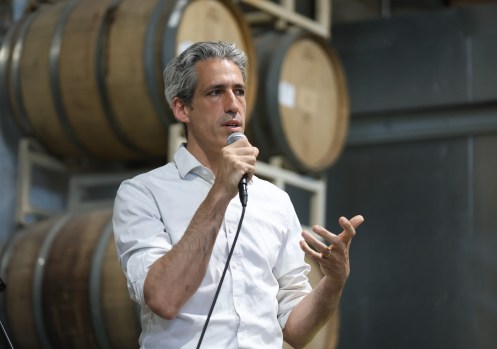

On the eve of one of the most closely watched primary election races in the country, Evanston Mayor Daniel Biss’ congressional bid took an unanticipated turn.
Biss, who ran against 14 other candidates vying for the Democratic nomination in Illinois 9th Congressional District, found himself at the center of a development playing out across social media less than 24 hours before voters were set to head to the polls — though it turned out two-thirds of them had already voted.
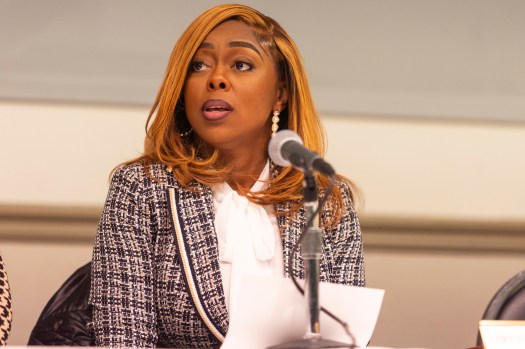
Megan Wachspress, a Stanford Law School lecturer and former undergraduate topology student of Biss’ at the University of Chicago, took to Bluesky and later Substack to publicly detail a relationship she had in 2004 with the congressional frontrunner which she described as “inappropriate.”
“To want someone who wants to learn from you is to want someone for their powerlessness,” Wachspress wrote on Substack. “And so, much later than I should, I realized this was my last chance, and I said something.”
Wachspress was an undergraduate student at University of Chicago from 2002 to 2006, majoring in mathematics and political science, according to UChicago alumni office records. Biss started as an instructor in 2002 and taught as an assistant professor in the mathematics department from 2005 to 2008, according to the university’s public affairs department.
In a personal statement published on her Substack account, Wachspress detailed the short-lived relationship, which she said developed while being one of the few female math majors in a male-dominated department.
“Rather than direct my enthusiasm for math to the subject, my topology professor (Daniel Biss) directed it at himself,” Wachspress said. “Flattered and insecure, I convinced myself it didn’t mean anything – I was a student, after all! – until the quarter ended, and he emailed to ask if I wanted to meet up, socially.”
Wachspress said after a couple of “intense evenings,” Biss had “second thoughts” and ended the relationship. According to her statement, they continued to spend time together “in what to any external observer would look like dates,” until that ended too.
“It took becoming a professor myself to realize the implications – what it means to be attracted to someone who categorically has less power than you,” Wachspress wrote on Bluesky. “I don’t know if it’s disqualifying, but there are too many women not getting a platform as a result of behavior like this for me not to say something.”
Biss’ campaign did not respond to a request for comment on the relationship, but referred to a previous statement they sent to the Daily Northwestern on March 17.
“In 2004, when Daniel was 26 and before he met his wife, Dr. Wachspress was a 20-year-old student in a course Daniel taught during his time as a postdoctoral instructor at the University of Chicago,” the statement clarified.
“After the course ended, Daniel and Dr. Wachspress went on a handful of dates over the course of a few weeks. Daniel realized then, as he does now, that it was ill-advised, and he ended it.”
Wachspress did not respond to a Pioneer Press request for comment.
Wachspress said their paths crossed years later on a Zoom call relating to her work, and he reached out following the meeting with a “cryptic email” asking her to call him. A few days later, he offered “an apology, of sorts,” she said.
“When the IL-09 primary campaign became unavoidable for those of us who follow left politics…I was miserable,” Wachspress wrote on Substack.
“I know it’s going to get ugly,” she said, referencing the potential impact of her decision to speak publicly, “but if there is one woman in a mathematics (or physics, or economics, or chemistry, or computer science) department out there who feels a little bit more empowered to recognize grooming for what it is, to insist on boundaries… well, it will have been worth it.”
But even with an eleventh-hour revelation, Biss secured a Democratic victory in the 9th district congressional race, receiving 34.22% of the vote with 100% of precincts reporting, according to unofficial Cook County election results.
Cook County statistics show that a majority of the votes in the race were cast prior to Election Day.
According to Cook County Clerk’s Office records, 62.6% of ballots cast in the 9th district race were cast either in early voting or through mail-in ballots.
Early voting accounted for 37.5% of the 65,351 total ballots cast, or 24,533 total votes, and mail-in ballots returned as of March 24, accounted for 25.0%, or 16,363 votes out of the total turnout.
The numbers underscore a central question: how much can a crunch time revelation actually work in shaping a race or election outcome when most voters have already made up their minds and cast a ballot?
Not much, according to Eric Hansen, an associate professor and graduate program director for political science at Loyola University Chicago.
“Apart from the fact that many ballots will have already been cast, my guess is that many voters will not see the news even if they haven’t voted yet,” Hansen said. “Most voters aren’t constantly checking social media for the latest updates on politics. That’s especially true for congressional primaries, which usually suffer from low voter engagement and garner much less traditional media coverage than, say, a presidential election or even a Senate or governor’s race.”
While Hansen said scandals can have some potential to sway voters, “especially in primaries where it’s harder for voters to distinguish between candidates than in general election contests,” the scandals would have to be well-known enough for them to affect the overall outcome.
Political analysts say most of the evidence suggests that voters care much more about policy and substance than they do about the personal behavior of politicians.
“How else could we explain the success of Bill Clinton, Donald Trump, and countless other successful politicians with many personal shortcomings?” asked Anthony Fowler, a professor in the Harris School of Public Policy at the University of Chicago.
Fowler said it’s impossible to know for sure whether and to what extent the revelation affected Biss’ total vote share, but expects the overall effect was “very small.”
“I’m sure there is a range of opinions regarding the appropriateness and morality of a young professor dating an adult whom he previously taught, but I doubt that there is a large share of voters for whom this revelation would change their voting decision,” Fowler said in an email to the Pioneer Press.
Some systematic research on the topic does suggest that personal relationship revelations do, on average, have an effect on voter behavior, but only slightly.
One study Fowler pointed to found that romantic scandals decreased the total vote share of incumbents who ran for reelection in Congress by approximately 5 percentage points.
“That’s not nothing, and it could be pivotal in a close race, but it’s smaller than the effect of corruption scandals,” Fowler said.
While it’s “conceivable that a major sex scandal could have a bigger impact in a primary election where the policy positions of the candidates are more similar,” he added, Fowler said he wouldn’t classify these allegations as comparable to that.
Even if revelations of this nature did have an impact on voter preferences, a high percentage of early ballots cast could work to compress the window for late-breaking developments to concurrently shift outcomes, if at all.
Biss is expected to face John Elleson, an Arlington Heights pastor who declared victory as the Republican nominee in the 9th District congressional race, in the general election this November.
When asked for comment on Wachspress’ allegations, Elleson responded, “Did he agree to some kind of policy and did he break it? I don’t know.” With Biss put into a position of authority, it would come down to the “school’s policy,” Elleson added.
Until at least the general election, Biss will continue to serve as the Mayor of Evanston.