








In 1998, when Illinois’ 9th Congressional District last held an open-seat primary after nearly a half-century of representation by Sidney Yates, it was a three-way Democratic fight. Jan Schakowsky prevailed, and the guy who came in last was a young heir to a hotel fortune named JB Pritzker.
Nearly 30 years later, the contrast is stark. With Schakowsky retiring, 15 Democrats are vying for the nomination, a crowded race that is among the most closely watched House primaries in the country. It’s a contest that encapsulates how much the Democratic Party has transformed in the Trump era, the growing influence of outside money in safe-blue districts and the generational shift in a seat long anchored by Chicago’s liberal Jewish political tradition.

What might once have been a largely local affair has become a fight about the political party’s direction as much as constituent issues in the district that represents parts of Chicago’s North Side as well as many north and northwest suburbs.
The March 17 primary is all but certain to determine the district’s next member of Congress. The question for voters is not whether to send a Democrat to Washington, D.C., but what kind.
Schakowsky, a stalwart progressive, became a national voice on abortion rights, consumer protection and opposition to the Iraq War. The slate to replace her is diverse, reflecting the broader region, as both longtime politicians and a handful of outsiders have proven competitive.
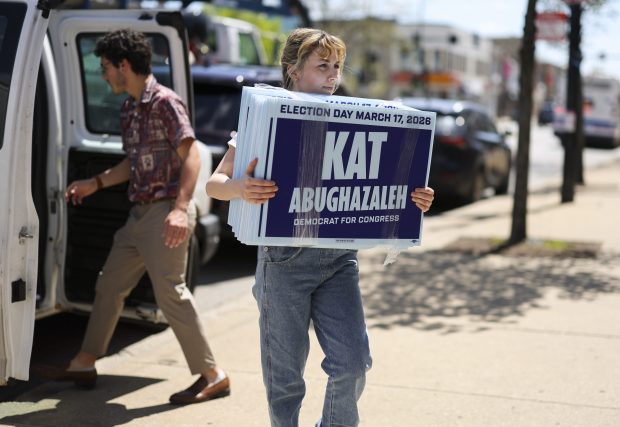
Evanston Mayor Daniel Biss, state Sen. Laura Fine of Glenview and political commentator Kat Abughazaleh led fundraising at the latest reporting deadline last month. Narrowly, the race between the three of them is a fight over who has the most solid grounding among two established local officials in core suburban parts of the district and a young, newly established Chicagoan looking to push the conversation to the left.


But the rest of the field — including former FBI agent and shooting survivor Phil Andrew, Gen Z Skokie school board member Bushra Amiwala, state Sen. Mike Simmons of Chicago and state Rep. Hoan Huynh of Chicago — is knocking doors and chatting in donor living rooms from Uptown to Wilmette and Crystal Lake, searching for a path toward an upset.
If there is a single through line, it is the nationalization of what was once more local business.
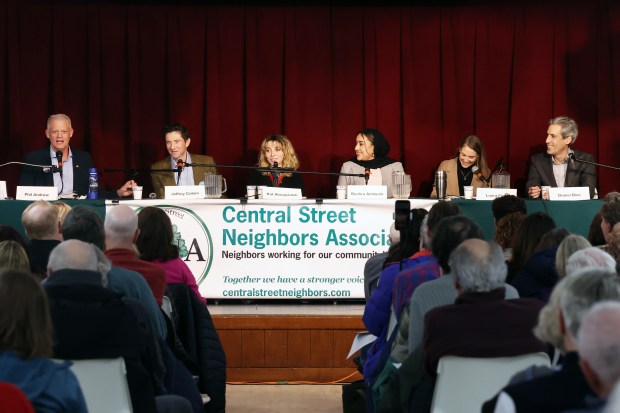
President Donald Trump’s aggressive immigration enforcement in the Chicago region looms over candidate forums. While their visions for how to best resist ICE differ, the leading candidates have said the agency can’t continue in its current form. And in a lightning round of questions at a recent forum in Evanston, all six participating candidates, those listed above except Huynh, shared other points of consensus, backing a transition to universal health care and opposing federal legislation to ban gender-affirming care for children.
For the past several weeks, though, the most heated exchanges have centered not on policy differences but on money — most prominently, the role of donors aligned with the pro-Israel lobbying group American Israel Public Affairs Committee, who have benefited Fine’s campaign.
Moving forward, that debate could extend to the U.S. and Israel’s attacks on Iran this past weekend and the ensuing spiral of war in the Middle East.
Biss, Fine and Abughazaleh each released statements on the strikes: Abughazaleh referred to an earlier statement that she wouldn’t support a vote to attack Iran and believed it was just part Trump’s efforts to assert power; Fine said Trump needed to be reined in and impeached; and Biss criticized both Trump and Israeli Prime Minister Benjamin Netanyahu for pushing “another reckless and illegal regime change war.”
The Evanston panel discussion hosted last month by a group called Pink Poster Club quickly turned into a debate about the outside groups that have now dumped more than $5.1 million into the race, mostly to support or oppose Biss or Fine and six figures to oppose Abughazaleh, according to filings from the Federal Election Commission.
And there are other signs of influence. An analysis of contribution records shows a substantial share of Fine’s most recent fundraising — close to $1 million last quarter out of $1.3 million raised — came from contributors who matched the names and zip codes of those who previously gave to AIPAC or an affiliated super PAC, United Democracy Project. And of the $5.1 million in independent expenditures for the entire race as of Monday, a newly formed super PAC, Elect Chicago Women, accounted for all but about $1 million — funding television ads, mailers and phone outreach either supporting Fine or opposing Biss.
Fine has said she did not solicit AIPAC’s endorsement and that donors backed her because of her legislative record. As a supporter of Israel and a Jewish woman, she said she’s not surprised to have the support of those who also contribute to AIPAC.
The clash mirrors a broader fight within the Democratic Party, as progressive candidates push for a more confrontational stance toward Israel’s government and more moderate lawmakers warn against alienating pro-Israel voters and donors.
“It’s okay to just admit that AIPAC is supporting you because they agree with your position on military aid to Israel, but own that,” Biss said to Fine on the Evanston forum stage. “Nobody who says they’re tough enough to go to Washington and fight against Donald Trump and the authoritarian nightmare should be too scared to tell their own constituents about who’s donating and why.”
In addition to the AIPAC issue, Biss and Fine have each tried a guilt-by-Republican-donation tactic, pointing to the other accepting money from people who have in the past contributed to GOP candidates and committees — Biss homing in on donors to Fine who previously supported Trump and Fine accusing Biss of not telling voters about Republicans on his own donor rolls.
Pressed about outside spending, Fine has called for overturning the Supreme Court’s Citizens United decision and on the debate stage described herself as a “punching bag” for rivals unable to assail her legislative work.
Fine’s husband, Michael, lost an arm after a car crash in 2010, setting off her years-long work on health care legislation. Recently, she introduced state legislation that would ban people hired as ICE agents during the Trump administration from later becoming law enforcement officers.
“There are many candidates out there that are attacking me, but they can’t attack my record,” she said in an interview.
Biss’ outside support is primarily split between the Congressional Progressive Caucus and 314 Action, a fundraising committee.
Abughazaleh, who is Palestinian on her father’s side and whose massive online audience came from her work criticizing the far right, also has a “red box”-style page on her website outlining talking points, suggesting she’s seeking outside funding, though FEC reports don’t reflect any spending in support of her as of this week. Among her most recent endorsers is a new group called PAL PAC, which says it supports candidates who oppose human rights abuses by Israel against Palestinians.
Electing her would represent not only a progressive vote in Congress but an insurgency in the district.
Shortly after moving to Chicago from out of state, Abughazaleh initially launched her campaign as a primary challenge to Schakowsky, only for the congresswoman to announce her retirement weeks later.
Having never held public office, she has embraced an unconventional political approach, combining dropping f-bombs and fundraising on live streams with hosting mutual aid events as she has sought to channel the energy of younger voters impatient with incrementalism.
Abughazaleh is also dealing with a different kind of political challenge: she and five others have been indicted by the Trump administration, accused of conspiring to impede immigration agents during protest activity at the federal immigration processing center in west suburban Broadview. A jury trial in the case is scheduled to start in late May, several weeks after the primary.
Abughazaleh has cast the charges as political retaliation and an attack on free speech by the Trump administration and said voters have shown they want a new generation of leadership over “a quote-unquote ‘more moderate’ candidate.”
“For me, ‘the center’ is, everyone has equal rights. For me and pretty much every American, it’s that you and your loved ones can live a safe, happy life without begging for scraps or being exploited by billionaires. And so, these ideas that have been touted as moderation instead have been hurting us,” she said.
Biss, another Broadview protester who was not indicted, has made the case in interviews and across the campaign trail that he’s a progressive who can work both inside and outside government. He’s a former assistant math professor at the University of Chicago and previously ran unsuccessfully for governor in 2018 against Pritzker.
“The basic attitude we oughta have, when the level of emergency is what it is, is any tool that we can find, we use, and that’s the approach that I’ve taken as mayor of Evanston,” Biss said, asked about how he would work in Congress at a debate last week televised on Fox 32.
Fault lines have also developed over the national Democrats’ current leadership. During a yes-no round of questions at the Evanston forum, Fine and Simmons indicated support for current House Democratic leader Hakeem Jeffries to become House speaker, though Simmons’ campaign later said he’d wait to hear from contenders to make a final decision. Amiwala and Abughazaleh held up “NO” paddles, and Andrew and Biss didn’t appear to answer.
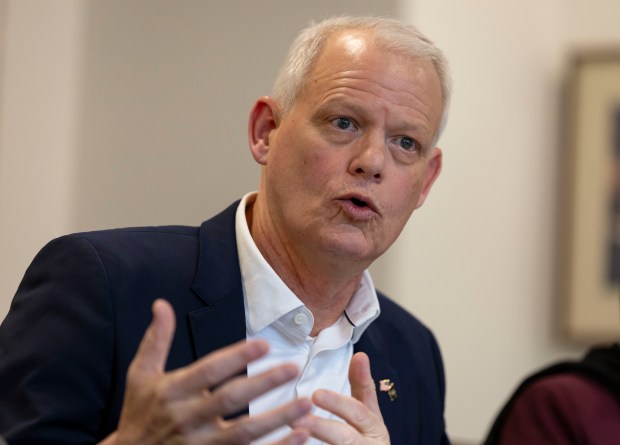
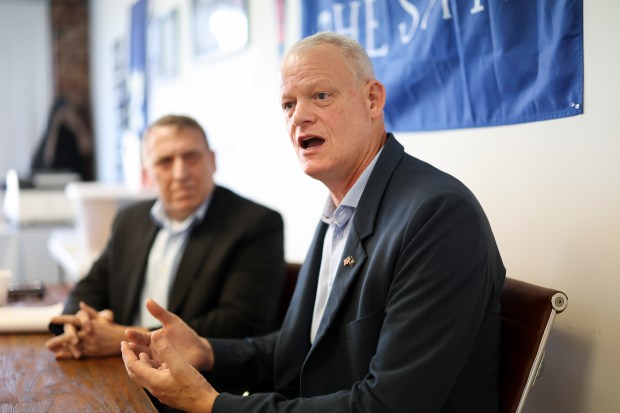
Andrew, who survived a 1988 school shooting and later built a career in crisis negotiation at the FBI, has campaigned against what he calls “petty corruption” in Illinois politics and pledged to serve no more than 10 years. He recently received endorsements from Steve Kerr, the former Chicago Bulls guard and Golden State Warriors coach whose father was assassinated in 1984, and from former Evanston Mayor Steve Hagerty.
And Andrew has repeatedly attacked both Fine and Biss for exploiting a loophole that allows them to spend state campaign cash on ads and mailers that effectively benefit their federal races by running for both Congress and for Democratic Party state central committee posts.
“Will we continue with the broken politics of the past and do something bold and courageous and really lead in a moment of crisis? Or will the sort of inertia of political machinery win?” Andrew said.
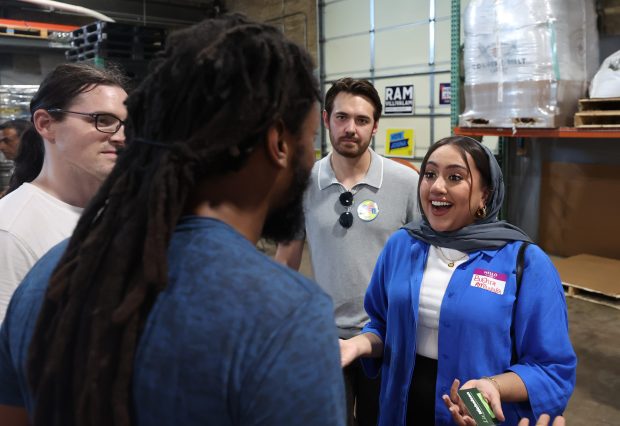
Amiwala, first elected to the Skokie school board at 21, has also fought her way to the top of the crowded field, despite not following the traditional path in Illinois politics. Focused on boosting turnout in Skokie, Lincolnwood, parts of Evanston and other parts of the congressional district where she has built a base, she has argued that the district can send a signal about the party’s direction.
Given Illinois’ relatively early primary, Amiwala said, the “type of Democrat we elect in this district will send the message and signal of, good is not good enough, right? We deserve elected officials, candidates and representatives who understand the communities they’re seeking to represent, who are not scared to take bold ideas and stances.”
Simmons, the first Black person to represent his district and the state Senate’s only openly LGBTQ member, has often said that he doesn’t look like a typical member of Congress — and last last month, according to a video and news release from his campaign, a woman called the police on him while he sought to talk to constituents in an apartment building, an incident he called “canvassing while Black.”
“I would expect more from my neighbors. But you take care,” Simmons says in the video.
Simmons, who grew up in Lincoln Square, has emphasized his roots throughout the campaign and his efforts to push colleagues to take difficult votes, including in support of transgender residents.
He said he thinks people are looking for “new blood, a new generation of people with real roots here, as I have, and people who have shown they can get this work done.”

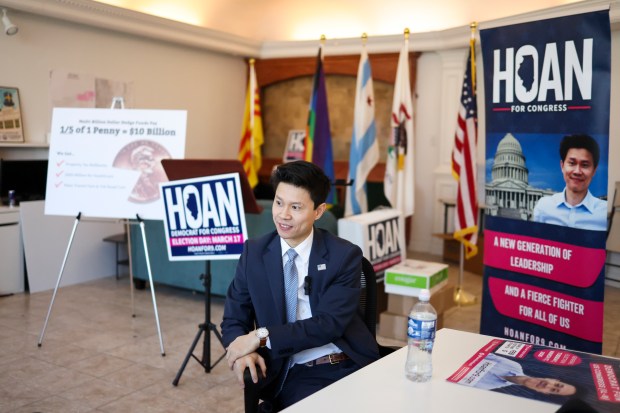
Huynh has noticeably stayed out of some of the intraparty skirmishes and tried to campaign primarily on the tax-the-rich-type economic plan he’s introduced in Springfield. It would charge one-fifth-of-a-cent on investment transactions at multibillion-dollar hedge funds, which Huynh argues could pay for property tax rollbacks, transit and schools.
The plan appears on Huynh’s website more prominently than any other information about his candidacy or his life background as a refugee from Vietnam.
“We’ve been very laser-focused,” Huynh said. “That’s how we’re going to win this race, is providing a very clear solution to addressing affordability.”
Early voting began last month.
“It’s a quarter-century opportunity,” Simmons said — important “not just because of how long it’s been since we had an open primary, but also because of what’s going on in our country, and the fascism that Donald Trump has unleashed.”