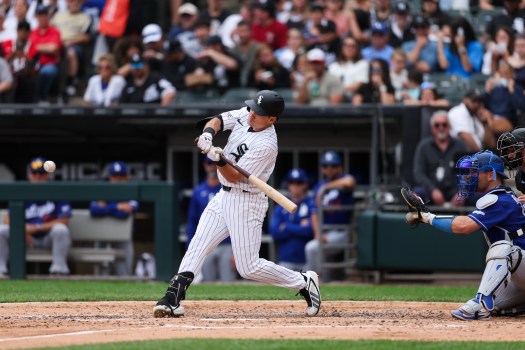
The Chicago White Sox made a habit of hyping the major-league debuts of many prospects in recent years, from Yoán Moncada to Michael Kopech to Noah Schultz.
When you’re still in a rebuilding phase, promoting the future is usually preferable to talking about the present.
So the low-key call-up of Rikuu Nishida by the Sox before Monday’s 3-1 win over the Minnesota Twins was a refreshing change of pace.
Only diehard Sox fans were probably even aware of the 5-foot-6, 150-pound utilityman, a rare Japanese-born player drafted out of an American college instead of being signed out of Japan. According to the Japanese media, he’s still relatively unknown in his own country, where fans obsessively follow the careers of Japanese players in the major leagues.
But the Sox brought the 25-year-old Nishida up with no fanfare and immediately inserted him in right field while assigning him No. 51 — the same number as Ichiro Suzuki, the first Japanese player inducted into the Baseball Hall of Fame.
Nishida went 1-4 in his debut with a fourth-inning single, threw a runner out at the plate, lost his shoe, made seven putouts in right, hugged third base coach Justin Jirschele and received multiple standing ovations from the sun-kissed Memorial Day crowd of 30,114.
It was a Rikuu-cool afternoon.

After the game, he stood with the ball in an enclosed case and a “First Game” certificate from the Sox, like the one they hand out to kids.
Someone told him it was made for young Sox fans. “What?” he said, laughing out loud.
The Sox became only the third major-league team in history to start two Japanese position players — Munetaka Murakami and Nishida — and the “Mune and Rikuu Show” could be a summertime hit for a Sox team that’s starting to make believers on the South Side.
Murakami, whom Nishida said was “like a dad” despite their one-year age difference, kick-started the Sox offense with a solo home run in the first, his 18th of the season. Drew Romo added a go-ahead two-run shot in the second, and Anthony Kay allowed one run over six innings, improving to 4-1.
Nishida spent his pregame time buzzing between the clubhouse, batting cage and field like a caffeinated bee, smiling and laughing and telling himself this was actually real.
“I just feel like I just woke up,” Nishida said through an interpreter. “Maybe it’s still early in the morning, but I still can’t believe it’s true right now. It’s a lot of butterflies inside of me. I’m trying to feel it right now as much as possible.”
He received some pregame advice from Ozzie Guillen, who told him to have fun and be himself, two qualities Guillen has a bit of expertise in. Reporter Bruce Levine asked Nishida to hit a home run for him in his debut, but Nishida replied that he only had two in his minor-league career, so no promises were forthcoming.
Photos: Chicago White Sox 3, Minnesota Twins 1 on Memorial Day
When the Sox players were ready to go out onto the field, Nishida was the only one to leave the dugout. He said Chase Meidroth told him “go” and he didn’t notice he was the only one.
“That’s a bad teammate right there, Chase,” he said in English, laughing.
Nishida spent two years at a junior college and one year at Oregon before being selected in the 11th round of the 2023 draft. Primarily a second baseman, he hit .347 in 33 games at Triple-A Charlotte after an early-season promotion from Double-A Birmingham, where he spent the previous two seasons.
He’s a speedster with a high contact rate and little-to-no power, which obviously makes Sox fans think of Nick Madrigal, another diminutive player who was the fourth pick of the 2018 draft out of Oregon State. Madrigal had an injury-plagued career with the Sox and Cubs and is currently at Triple-A Salt Lake City, a Los Angeles Angels affiliate.
“Definitely a resemblance in terms of the contact and the approach aspect, the ability to defend,” said Sox scout Josh Krstulovich, who recommended Nishida out of Oregon. “A little more versatility with Rikuu going to the outfield.”
Giving the kid Ichiro’s No. 51 was a huge compliment, but a daunting task as well. Nishida called it a “very heavy number … that speaks a lot” to every Japanese player.
“It’s a really big number for me to be honest,” he said. “I’m still a bit unsure about if I can wear it or not. I’m speechless.”
Afterward, he jokingly said he wanted a new number after someone compared him to Suzuki.

Krstulovich said a player of Nishida’s size needs to “play with your hair on fire, and you need to affect the game with speed and defense, and he does that tenfold.”
Nishida checked those boxes, and Krstulovich said that as pitching gets better and better with harder throwers, “those guys (with high contact rates) will have the best ability to hit.”
Questions about his arm strength in right field were answered in the second inning when he gunned down Orlando Arcia trying to score from second base on an Alex Jackson single. His left shoe fell off after the throw.
“You didn’t see it?” he asked.
Uh, no.
“First time,” he said. “Bad preparation. Tight shoes.”
Welcome to the South Side, Shoeless Rikuu.
Nishida not only ran down every fly, but nearly made a diving catch to rob Jackson of a hit in the seventh, earning another big ovation. He said it was his first time in a big stadium, so it was hard to see. But his seven putouts were the most by a Sox player in his debut since at least 1974.
“He does the little things so well — the approach to the ball, the routes he takes, the transfers are so clean — that those things can make up for a lack of arm strength,” Krstulovich said.
Krstulovich said the Sox player development staff raved about Nishida’s personality, adding, “I don’t think we’ve seen a player that’s as universally loved.”
How will the left-handed-hitting Nishida be used?
“He’ll play a lot,” manager Will Venable said. “He’s going to be out there against righties. We’ll take it day by day to see what the matchups look like and our best group is for that day. But he’ll certainly be in the mix.”
Nishida understands he’s here to get on base and provide some energy, much like Sam Antonacci, even as he doesn’t see himself as the Energizer Bunny.
“I can’t really see myself from a third-person aspect,” he said. “I don’t feel like I’m the most energetic guy on the team or such. But, like I said earlier, I love playing baseball and I think that kind of really shows who I am as a person. That’s why I think everybody sees me as an energetic person. See me out in the field and how I bring the energy to this team here. I can also be kind of quiet, too. If you want me to.”
That won’t be necessary, the entire Sox media corps said in unison.
No one can say exactly what Nishida will bring to the White Sox. No one can say exactly how good this team will be come September.
But it’s going to be fun finding out.