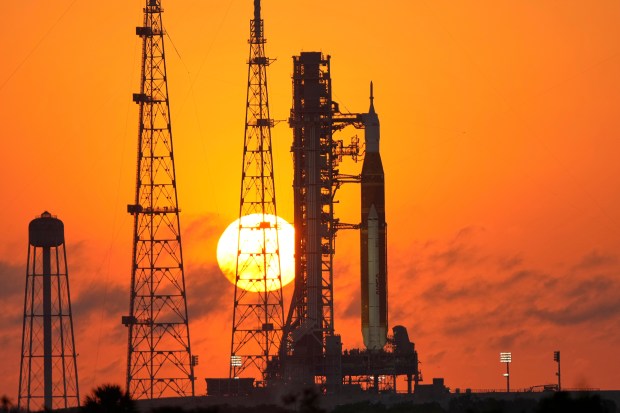


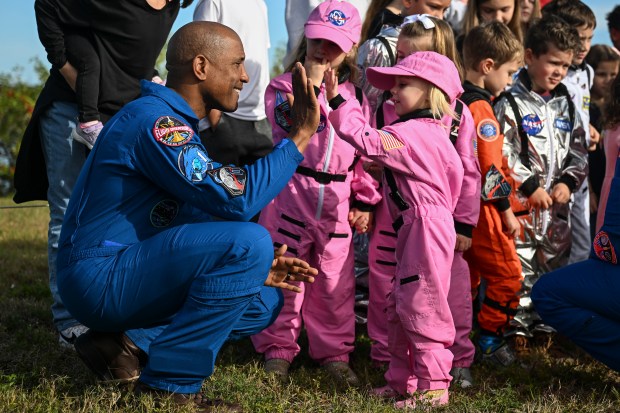


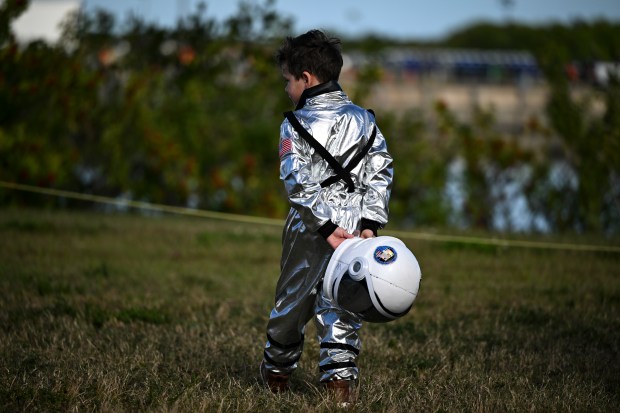


After weeks of delays, four astronauts are preparing to launch Wednesday evening on a trip around the moon, the first such spaceflight to be undertaken in more than 50 years.
“It’s really just a historic mission for the future Artemis missions, but also to prepare us for the human journey to Mars and further space exploration,” said Voula Saridakis, National Aeronautics and Space Administration Solar System ambassador. “So it has this wider purpose, if you will.”
As head curator of the Griffin Museum of Science and Industry, Saridakis is also preparing to bring the celebration of this historic space launch to Chicago — offering residents and visitors an opportunity to experience history firsthand.
The Henry Crown Space Center houses the original Apollo 8 control module, the spacecraft that made history more than 50 years ago.
Three Americans and one Canadian will embark on a 10-day journey to orbit the moon aboard the Orion spacecraft as part of the Artemis II mission, the first to be crewed beyond low Earth orbit since the Apollo era.
It will also make history as the first time a Canadian, a person of color and a woman will travel that far in space.

“Each one of the four of us, we carry a whole lifetime of experiences,” said Artemis II Cmdr. Reid Wiseman during a Sunday news conference. “Honestly, for me, it’s just an honor to get to watch the way everyone brings their unique perspectives.”
The astronauts entered quarantine last week at Kennedy Space Center and reflected on representing NASA’s diverse crew.
“If we’re not going for all, by all, we aren’t truly answering all of humanity’s call to explore,” said Mission Spc. Christina Koch. “That, to me, is what’s worth celebrating.”
The mission is designed as a critical step ahead of NASA’s next objective: to return humans to the moon for the first time since 1972.
Artemis II was originally scheduled to launch in February, but technical issues with the rocket launcher, including a liquid hydrogen leak, were discovered during testing, according to NASA administrator Jared Isaacman.
NASA has begun its countdown for the moon rocket launch, which could be as early as 5:24 p.m. Wednesday.
Earlier this month, NASA announced an accelerated launch plan, moving up the timeline of the Artemis III mission to 2027 and positioning Artemis IV for lunar landing in 2028. By the time Artemis V launches, the space agency aims to have routine moon landings at least every six months.
“There’s always been a lot riding on this (Artemis II) mission,” said Lori Glaze, acting associate administrator of NASA exploration systems during Sunday’s news conference.
“How can we work to achieve this amazing launch cadence that allows us to keep our learnings and turn them around quickly and build muscle memory,” she added. “From what I see, it’s more of an energizer than anything.”
This push comes as President Donald Trump issued an executive order in December urging NASA to put Americans on the moon by 2028.
Koch emphasized the importance of maintaining global leadership in space exploration.
“The question is not should we go, but should we lead or should we follow?” Koch said. “Many countries have recognized the value there is in exploring further into the solar system, to the moon and onto Mars.”
“Humanity’s call is to go explore, to do those things and then to share them with the world,” added Wiseman.
But first, a successful Artemis II mission is necessary before astronauts can return to the lunar surface — and eventually set their sights on Mars.
Artemis II mirrors the role of Apollo 8 in 1968, which sent astronauts around the moon for the first time and paved the way for the first moon landing the following year.


The Artemis program is named after Apollo’s twin sister in Greek mythology, Saridakis explained, a nod to NASA’s long-standing goal of sending the first woman to the moon.
The Orion spacecraft’s trajectory will carry the crew roughly 6,000 miles beyond the far side of the moon, Saridakis said.
“They’re actually traveling even farther than any astronaut has traveled before,” she said.
Chicago’s space center also houses the SpaceX Dragon cargo spacecraft, which will be honored during the Artemis II mission. Astronauts will bring a flag flown during the first space shuttle mission, the last mission and the first cargo mission, Dragon SpaceX, on the Orion spacecraft to celebrate these milestones in space aviation history.
“That’s another interesting thing and connection to what we have back here at Henry Crown Space Center,” Saridakis said.
She credits the rise of private space companies like SpaceX, whose founder and CEO is Elon Musk, for helping reenergize NASA’s exploration efforts after decades without crewed lunar missions. For Artemis III, SpaceX is building the lunar lander that will transport astronauts from their spacecraft down to the moon’s surface.
“(SpaceX) has really, really made a difference in terms of not just moon exploration but just space exploration and reinvigorating the whole space program,” Saridakis said.
Looking ahead, Artemis III will focus on the moon’s south pole, where scientists have discovered ice water, said Saridakis — a key resource for future space exploration. She anticipates Artemis II astronauts will photograph this region during their orbit around the moon, helping prepare for the lunar landing mission.
Despite the previous delays for Artemis II, enthusiasm remains high.
Saridakis hopes Chicagoans will take this opportunity to visit the Griffin Museum of Science and Industry and celebrate this milestone in space exploration.
“Anybody could look up at the stars and wonder what’s out there,” Saridakis said. “That’s really what makes us human. It’s innate for us as humans to want to explore and discover, and that’s what space exploration is all about.”
The Griffin Museum of Science and Industry plans to commemorate the Artemis II launch this week. Additional watch event details will be posted on the museum’s website.