
Construction of the Marquette Greenway is in the home stretch, with about two-thirds completed.
“We’re putting 10 miles on the ground this year, new trail,” said Mitch Barloga, active transportation planning manager with the Northwestern Indiana Regional Planning Commission. “That’s two-thirds of the trail done, and most of that will be in the national park and the city of Gary.”
When completed, the trail will stretch from Chicago’s Calumet Park to downtown New Buffalo, although there’s talk of extending the trail north from New Buffalo to South Haven, he said.
Barloga and Rafi Wilkinson, outdoor recreation planner at Indiana Dunes National Park, offered an update on the 60-mile trail Thursday as part of the Green Drinks monthly online gathering of environmentalists.
The first National Park Service management plan for the national park, produced in 1980, already saw the need for an east-west trail stretching from Mount Baldy in Michigan City to Gary’s Union Station. “Some 45 years later, it’s finally coming to fruition,” Wilkinson said.
“There is so much infrastructure we have to go through,” Wilkinson said, which drives up the cost. The trail’s 45 segments will cost a total of about $120 million when it’s completed.
“You’re not going to fund 60 miles all in one shot; you’ve got to do it piece by piece,” Barloga said.

“We start technically at 100th Street in Calumet Park,” Barloga said, where the trail is an improved sidewalk and appropriate signage.
“We were hoping for a side path, but the city of Chicago is a bear to work with,” Barloga said.
Barloga just might have shamed Chicago officials into action. He shared a photo at the site of the former State Line Generating Station in Hammond, where a nice new trail was built right up to the state line on the Indiana side.
On the other side, where Chicago had broken pavement, Barloga put up a “Welcome to Chicago” sign. “They weren’t exactly pleased with it.”
The trail’s beauty is evident at Whiting Lakefront Park, where the Northwest Indiana Regional Development Authority put up $25 million into refurbishing the park, “and part of that was kicking off the Marquette Greenway,” Barloga said. To commemorate the occasion, a bronze medallion was installed. “If you bronze anything, it’s a permanent thing.”
The Marquette Greenway is part of former U.S. Rep. Pete Visclosky’s decades-old Marquette Plan to gain public access to Lake Michigan.
“When Congressman Visclosky was first pursuing a trail, he wanted it right on the lake, and bless his heart, we kind of can’t do that,” Barloga said. “We get as close as we can to the lake. We have steel mills, we have private property, we have the national park.”

In Hammond, a bridge at Wolf Lake lets bike riders and pedestrians safely cross the roadway. “It crosses over to where the Bears are going to play … OK, it crosses over to the pavilion,” Barloga said.
A 3.5-mile stretch between Indianapolis Boulevard and the NIPSCO property across from the South Shore Line’s East Chicago station, then underneath the Indiana Toll Road and east to a bridge at Kennedy Avenue. INDOT is putting a separated bike path on a new bridge there.
The new stretch continues past Seidner Dune and Swale to an old South Shore Line bridge at Cline Avenue.
Seidner Dune and Swale, controlled by both the Nature Conservancy and Shirley Heinz Land Trust, is a natural area few might see without the trail. “People are not aware of so many great parcels outside the national park,” Barloga said.
The old railroad bridge is “still there because you ain’t moving it anywhere,” Barloga said. It’s all steel and concrete. “This is right smack next to the Cline Avenue Bridge, the old South Shore bridge before it was rerouted.
“For reasons known only to God, Save the Dunes owns this bridge, and they would like to get rid of it, and we’re happy to take it from them,” he said.
Another 3.7-mile route, in Gary’s western side, stays south of the South Shore Line tracks, connecting neighborhoods in Gary to the Gary Green Link Project.
“This is right now under engineering review. We received some money for this from the federal government, but not nearly enough. In fact, we don’t have enough to complete the engineering,” Barloga said. It’s a pricey stretch of trail, at about $17 million. “That’s a pretty big chunk, and that’s of course providing a very critical connection,” he said. “Getting it done, we’re still looking for that funding.”
Barloga noted how quickly Indiana came up with money to fund a potential Chicago Bears stadium in Hammond. “I’m sitting here saying, I’ve got a trail, and it’s a lot cheaper and it’s going to be enjoyed by a lot more people.”
In Gary, the trail connects to the Gary Metro Station, which serves both South Shore Line trains and Gary Public Transportation Corp. buses. Bikes can be rented there as well.
The station is set to be replaced with a new station. Planning has begun for that effort.
The trail moves on to Union Station in downtown Gary, for which the president of Decay Devils has large dreams, Wilkinson said. “Hopefully, someday this will become a fantastic amenity for the trail.”
Between there and the national park’s Douglas Environmental Center in Gary’s Miller neighborhood will be another costly section, with some bridge replacements in store.
Design and compliance work is funded, but not construction, Wilkinson said. “We estimate that this will be a $6 million to $7 million project,” including two new bridges.
Design work is being done this year, compliance work next year and hopefully construction in 2028.
That unbuilt section offers a bird’s-eye view into the U.S. Steel complex plus a beautiful, rare black oak savannah along an old railroad bed, Wilkinson said.
The National Park Service replaced “truly a bridge to nowhere that had sat over Grand Boulevard,” Wilkinson said. The old bridge was built in 1999, but it was too low for truck traffic to go underneath.
Between the Douglas Center and County Line Road, a new segment of the trail is now completed, with a ribbon-cutting expected later this spring, Wilkinson said.
Park at either the Douglas Center or West Beach to walk or ride that segment. “It’s really spectacular,” Wilkinson said.
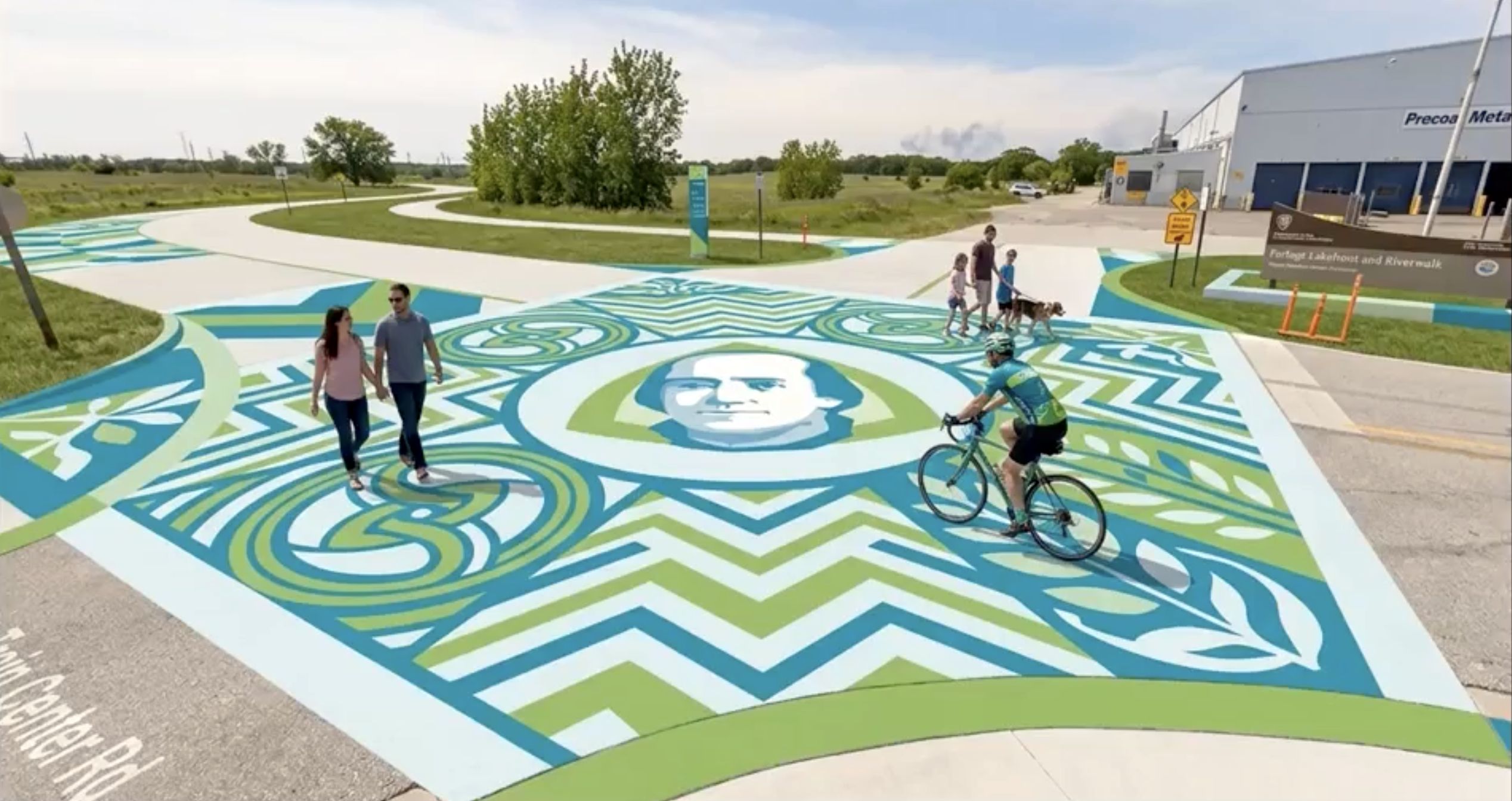
The stretch from County Line Road, at West Beach, to Burns Waterway, is planned. It will connect with the South Shore Line’s Portage/Ogden Dunes Station and skirt the southern edge of Ogden Dunes to connect with Portage Lakefront Park and Riverwalk, a popular unit of the national park.

“This is the location of a new museum, the Sand and Steel Museum,” planned at the site of the Portage Park Department’s open-air pavilion, Wilkinson said.
From there, a section of the trail will cross Burns Waterway and go to the NIRPC office in the Ameriplex development. “It is completely outside the national park, but thankfully, Mayor (Austin) Bonta and the city of Portage have taken up the charge to get this section complete,” Wilkinson said.
An old railroad bridge at Crisman Road, parallel to Ind. 249, will be reused or replaced. “That would be a fantastic reuse of a historic structure,” he said.
“Look at how amazing it would be to be able to ride that and have that be the major entrance into the Portage Lakefront part of the national park,” Wilkinson said.
From Ameriplex to beyond Burns Harbor’s municipal complex has already been completed. A bit past Ind. 149 is “one of the key blocks this trail has had for decades,” Wilkinson said.
Construction has finally started for the trail to go under the Norfolk Southern main line.
Porter has started its construction along Beam Street along the southern edge of Minoke Prairie.
The Porter Brickyard Trail will connect the Marquette Greenway to the Prairie Duneland Trail, which becomes Oak Savannah Trail in Hobart and continues into Griffith.
“This is really an important junction where the Marquette Greenway will hook into a broader trail system,” Wilkinson said.
The Porter section has over 1,000 feet of boardwalk, hopefully completed by next spring. “It’ll be a dramatic piece of riding when it’s done,” he said.
“I always think that Burns Harbor and Porter are the little towns that could and do. They have very small populations but they have figured out ways to build a lot of this trail, which is very expensive,” Wilkinson said.
Porter Brickyard Trail goes into a nice overpass over U.S. 12 at Mineral Springs Road.
The Marquette Green incorporates “maybe the region’s oldest regional trail, the Calumet Trail,” a little over 9 miles long, Wilkinson. The Calumet Trail was originally built through NIPSCO’s power line corridor. “It really was kind of dangerous to ride,” becoming a lake at times, Wilkinson said. “I personally have seen small fish on this trail before it was fixed.”
Now the trail is being raised with trench drains to keep it above the wetland Mother Nature decided it should become. It’s paved, too, an important feature of the Marquette Greenway. To meet Americans with Disabilities Act standards, grades are less than 5%, as well as being paved.
A stretch of the trail from Ind. 49 to Broadway in Beverly Shores is expected to be completed this year. An adjacent segment is fully funded and needs to be built.
A $4 million federal grant for a segment from Beverly Shores eastward was awarded Thursday. “It’s so new I don’t have any timelines on it,” Wilkinson said.
In Michigan City, the trail doesn’t follow a straight line. Former city Planning Director Craig Phillips convinced Barloga to use an isolated trail that takes the Marquette Green into neighborhoods and commercial areas, into some areas “that people never knew were there, some isolated remnants.”
Surprises like shipping containers found in an old landfill the trail crosses led to “quite a bit of overrun for the construction,” Barloga said. Michigan City’s remaining unbuilt portion of the trail is funded, to be built within the next two to three years.
In New Buffalo, the trail goes past dispensaries – “so have fun while you’re in New Buffalo,” Barloga quipped – before it ends downtown.
“At that point, there’s a whole ‘nother effort to get it to go north to South Haven,” he said.
Doug Ross is a freelance reporter for the Post-Tribune.