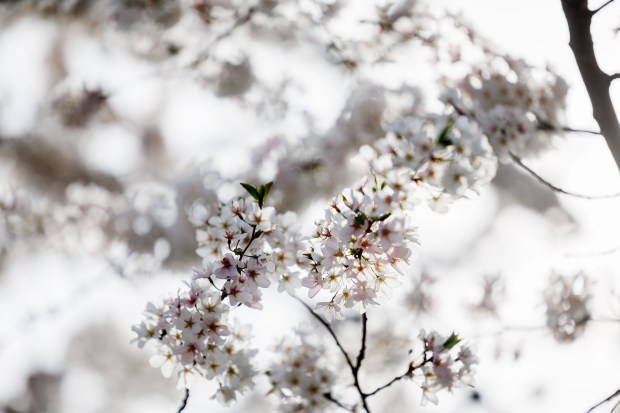


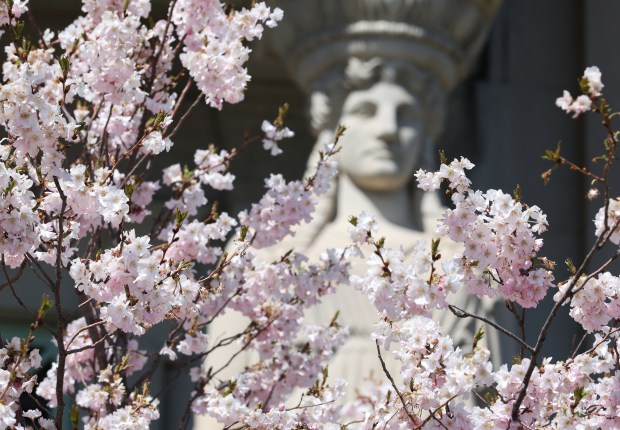
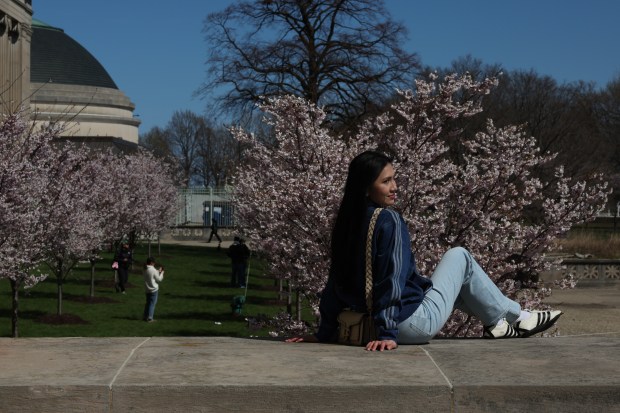
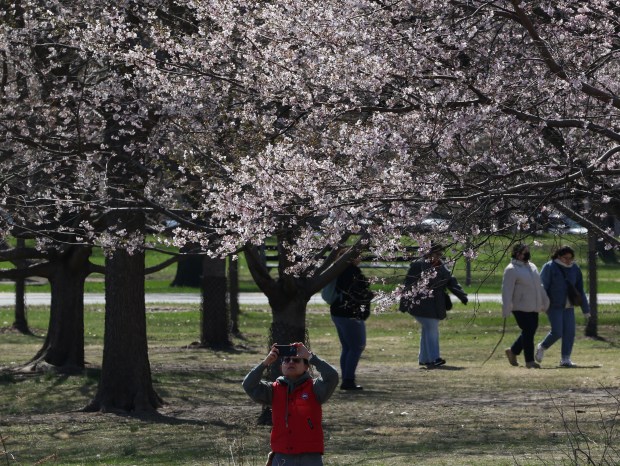
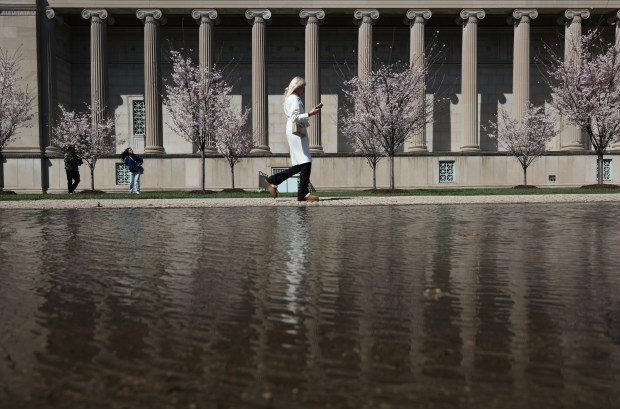

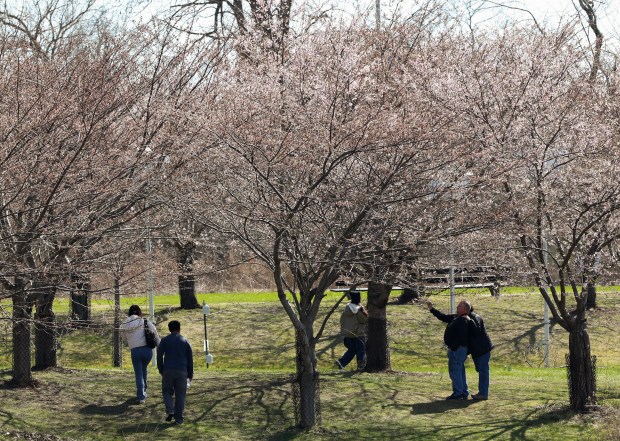


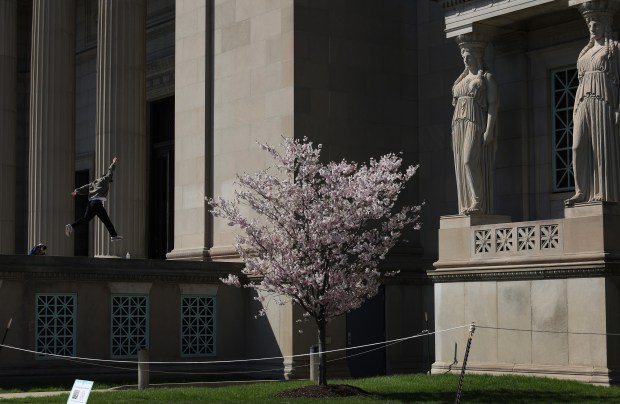

Pink and white cherry blossoms dot the thin, long branches of the trees in Jackson Park on Chicago’s South Side. The trees will reach full bloom in the next few days, and Chicago Park District staff say viewers will have to act quickly to catch them.
Many blossoms are already open, revealing clusters of five petals with a heart-shaped notch on each one. The trees bloom in stages, where stage six is full bloom. According to a Monday press release from the Park District, the pink blossoms are approaching stage five, and many of the white blossoms are in stages three and four, meaning blooms will be slightly staggered.
Once nearly all the blossoms fully open in stage six, they’ll stay like that for the next three to eight days, depending on the weather, according to the Park District. Wednesday winds may cause some blossoms to fall off the trees, but Park District staff are optimistic most will hold on and remain through the relatively warm but rainy weather expected the rest of the week.
Staff members say viewers should start coming to the park now to experience the bloom.
Karen Szyjka has worked with the Park District for over 20 years. She and her colleague Michael Dimitroff take care of the cherry trees — which don’t actually grow cherries — just south of the Griffin Museum of Science and Industry. Dimitroff said the trees only bloom once a year, and it captivates people across the city each time.
“It’s just a beautiful, colorful tone in the landscape that you’re not used to seeing,” Dimitroff said. “And that magnitude — it’s stunning. You’re just drawn to it.”
According to the Park District, 120 cherry trees were first planted in 2013 to commemorate the 120th anniversary of the 1893 World’s Columbian Exposition. Since then, the Park District and the Japanese Chamber of Commerce and Industry of Chicago have planted over 100 more, and others will soon follow.
Szyjka and Dimitroff said the cherry trees are pretty self-sufficient. They need to be watered as needed after they are planted, and caretakers need to remove dead and diseased branches. Otherwise, the trees grow freely.
Dimitroff added that there are checks, like on the soil contents, to make sure the trees have a fit environment for their growth. Last year, a gardener from Japan who consults on the thousands of famous Washington, D.C., cherry trees came to assess Chicago’s and found the trees to be in good shape and cared for appropriately, Dimitroff said.
Szyjka, a seasoned cherry tree caretaker, had fun facts to share about the trees: The blossoms smell like almonds and are edible.
She added that she appreciates the bloom especially after harsh winters and hopes others do as well.
“We really need to have something that brings in spring and gives people hope and represents life,” Szyjka said about the trees.
Brian Nelson, a 34-year-old living in Oak Park, went to photograph the cherry blossoms Tuesday afternoon over his lunch break. He said he lived in Washington for a few years and recalled the cherry blossom festivities there.
“It’s nice to be able to come here and get a mini version of that,” Nelson said.
Mary Sue Marzullo came to visit the cherry blossoms from her home in Evanston. A photographer, she said she appreciates the beauty of the blossoms, and the scenery behind the Museum of Science and Industry keeps her coming back.
“I love the juxtaposition of the flowers against the building, and then the lagoon in front of it,” Marzullo said. “It’s just a really, really beautiful sight.”