Here’s a look back at what happened in the Chicago area on April 15, according to the Tribune’s archives.
Is an important event missing from this date? Email us.
Sports page flashback: April 16, 2003

2003: Four fans ran onto the field at The Cell (now Rate Field) during a game between the Chicago White Sox and Kansas City Royals.
“A night that should have been notable for Billy Koch’s second late-inning meltdown in two weeks and Frank Thomas’ clutch eighth-inning homer was marred when a few people in the U.S. Cellular Field crowd of 20,591 would not stay in their seats,” the Tribune’s Teddy Greenstein wrote.
First-base umpire Laz Diaz was attacked by 24-year-old Eric Dybas of Bolingbrook, who pleaded guilty and was sentenced to six months in jail and 30 months’ probation.
Weather records (from the National Weather Service, Chicago)
- High temperature: 88 degrees (2002)
- Low temperature: 25 degrees (1943)
- Precipitation: 1.74 inches (1884)
- Snowfall: 1.7 inches (2020)

1912: Who was on board and who survived? That’s what was being asked — for days — after the White Star Line’s famous steamship Titanic hit an iceberg and sank in the North Atlantic Ocean. News of the ocean liner’s peril was carved into a late, extra edition of the Tribune on April 15, 1912, and much of the account was devoted to the prominent people aboard.
They included Charles M. Hays, president of the Grand Trunk Railway and a Rock Island, Illinois, native; Francis Millet, an artist who was the decorations director for the World’s Columbian Exposition in Chicago in 1893; and William T. Stead, the English journalist and reformer who wrote “If Christ Came to Chicago.”
The Tribune reported several passengers as Chicagoans: Ida Hippach and her daughter, Jean; and Ervin Lewy, a jeweler. The Hippaches survived; Lewy did not. (Fate at other times was unkind to the Hippaches. In 1903, two young sons, Robert and Archie, died in the horrific Iroquois Theater fire. Two years after the Titanic disaster, the third son died in an automobile accident. And in 1915, Jean was the passenger in a car crash that killed an 8-year-old boy.)
The agony of not knowing was heartbreakingly illustrated by the plight of Oscar Johnson, of St. Charles. A brief on Page 2 of April 17’s newspaper reported how his wife, two children and his two sisters were not among those saved. But the following day, under the headline, “Merchant faints from joy,” the Tribune reported that the 32-year-old businessman “fell over in a dead faint which lasted half an hour” when he received word that all five were rescued.

1921: Daylight saving time once saved the life of a Chicago gangster sentenced to die by hanging — for an extra hour, anyway.
The Chicago City Council passed a daylight saving ordinance in June 1920. That fall, after the city’s clocks had been turned back to Central Standard Time, poolroom proprietor and gang leader Salvatore “Sam” Cardinella was convicted of murdering saloonkeeper Andrew Bowman.
Cardinella, who went by the nickname Il Diavolo (The Devil), was not at the scene of Bowman’s slaying but was convicted of murder under a state law that found the instigator of the crime equally guilty as the killer. His gang reportedly was involved in at least 20 murders, 100 holdups and 150 burglaries.
Daylight saving time: Why it began, where it exists and how it saved one Chicago man’s life
Il Diavolo was scheduled to die by hanging on April 15, 1921. After several unsuccessful ploys by his henchmen to save his life — including one that would be attempted post-hanging — Cardinella was down to one last try.
The New York Times reported that Cardinella convinced jail officials to spare his life for one additional hour because of daylight saving time.
The jailers complied, and Cardinella’s execution was bumped back to 10 a.m. Reportedly unable to stand at the gallows, he was hanged while seated in a chair at 10:26 a.m. on April 15.

1955: A hamburger joint named McDonald’s opened in northwest suburban Des Plaines. No one except for its Oak Park-raised owner Ray Kroc may have believed the tiny to-go place that offered hamburgers for 15 cents ($1.80 in today’s dollars), fries for 10 cents ($1.20) and milkshakes for 20 cents ($2.40) would one day become the second-largest fast-food chain in number of stores in the world. (McDonald’s was overtaken by a Chinese bubble tea and ice cream brand in March 2025, according to Newsweek.)
Vintage Chicago Tribune: As McDonald’s turns 70, a look back at its suburban origins
Certainly the Tribune didn’t. The paper didn’t write about the operation until 1962. By then, McDonald’s had 341 restaurants in 40 states and had served its 700 millionth burger. Today there are 36,000 restaurants in more than 100 countries.

1977: A highly anticipated exhibit of items from King Tutankhamun’s tomb opened at the Field Museum. Unlike his possessions, King Tut didn’t make the trip to Chicago — his mummy remained in the Valley of the Kings outside Luxor, Egypt. A discotheque employee and his sister were first in line at 5 a.m.
For the next four months, visitors waited outside in the rain, heat and wind to enter the museum. Only a power outage on the Fourth of July kept visitors away. More than 1.3 million people — at a rate of more than 1,000 per hour — viewed the exhibit.
Vintage Chicago Tribune: Sue the T. rex’s journey to the Field Museum
1998: The dinosaur previously known as Sue formally became known as Sue. The news came as a disappointment to the thousands of kids who entered a contest to give the dinosaur a new name after legal disputes over licensing of the name Sue erupted. But museum officials conceded that lawyers advised that the contest-winning name — “Dakota” — had the potential to cause legal problems as well, given that it was already used for several products.

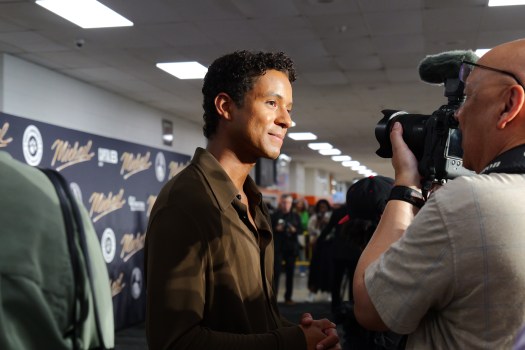
2004: In the finale to the first edition of the NBC reality show “The Apprentice,” Donald Trump “hired” Chicago businessman and Loyola University graduate Bill Rancic over Kwame Jackson during a segment that was telecast live.
As part of his prize, Rancic received a $250,000 salary and a job running one part of Trump’s corporation. Trump offered him the chance to stay in Chicago and oversee the building of the new Trump International Hotel and Tower and Rancic took it.
“It’s a coincidence that Bill comes from Chicago, and I have a big project going there,” Trump said. “It just worked out. He’s going to be outstanding.”
As for Rancic’s choice of the Chicago building project over a job in California, he told the Tribune: “Chicago is where I’m from, and to me it’s the best city in the world.” Rancic stopped working for the future president before Trump Tower was completed in 2009.
Want more vintage Chicago?
Subscribe to the free Vintage Chicago Tribune newsletter, join our Chicagoland history Facebook group, stay current with Today in Chicago History and follow us on Instagram for more from Chicago’s past.
Have an idea for Vintage Chicago Tribune? Share it with Kori Rumore and Marianne Mather at krumore@chicagotribune.com and mmather@chicagotribune.com