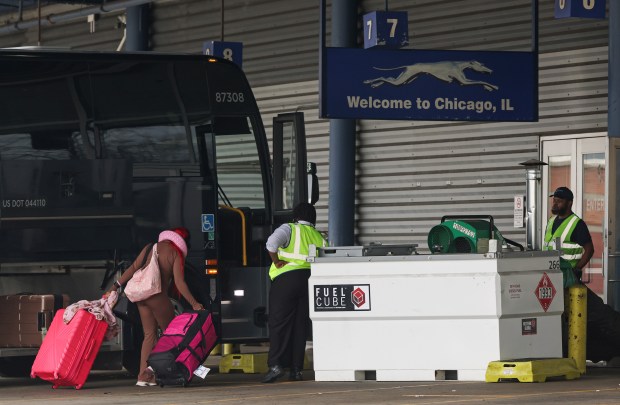


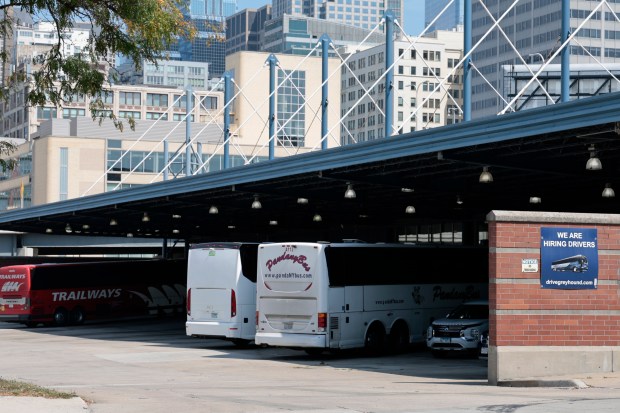

Mayor Brandon Johnson’s administration took a major step Tuesday toward buying the downtown Chicago Greyhound station in a bid to maintain a building for intercity bus riders to embark and disembark.
The Community Development Commission approved two plans aimed at facilitating the takeover, one to expand a downtown tax increment financing district so that it includes the station, and the other to acquire the station.
But moves still require City Council approval, a necessity that suddenly appeared to be a potential roadblock when Ald. Bill Conway, whose ward includes the downtown station, left the commission’s meeting unimpressed by the Johnson administration’s pitch.
“That hearing really illustrated the ‘first we get the money’ mentality of this administration,” Conway said as he walked out. “It’s hard to describe that hearing as anything short of a total train wreck.”
The downtown alderman had officially shared a “letter of no objection” to the expansion of the tax increment financing district ahead of the hearing. As he spoke to commissioners before they voted unanimously to approve the two proposals, he said he was not against buying the station, but had “significant concerns.”
He argued the city needs to share clearer plans describing how it will ensure public safety, manage traffic, facilitate the financial transaction and run the station.
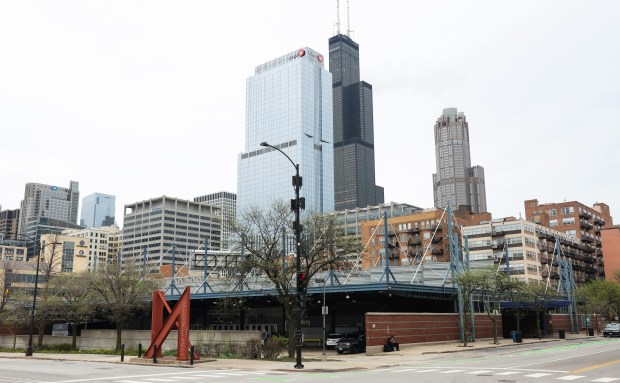
The future of the station at 630 W. Harrison St. — and the future of intercity buses in Chicago — have hung in limbo since August 2024, when the long-term lease for Flix, the company that owns Greyhound, ended. The company has been on a month-to-month lease since.
The facility is currently owned by Twenty Lake Holdings, the real estate division of private equity firm Alden Global Capital. Alden also owns the Chicago Tribune through its Media News Group subsidiary.
Johnson’s administration plans to use $35 million next year and another $15 million in 2027 to purchase and rehabilitate the building.
Former Johnson spokesperson Cassio Mendoza said in November the city expected to spend just north of $19 million to purchase the property, with the rest of the funds expected to go to refurbishment. The city will assess whether the site has structural problems or only needs cosmetic work done, he said.
Twenty Lake plans to sell the deteriorating property and discontinue all bus operations, Emily Kish, a financial planning analyst for the city’s Department of Planning and Development, told commissioners during the Tuesday hearing.
The plan won support during the meeting from activists and experts who testified the terminal’s location near Union Station creates a critical opportunity for travel, especially for low-income passengers.
Privately run bus stations have been bought by cities across the country amid economic pressures, said transportation expert Joseph Schwieterman of DePaul University’s Chaddick Institute for Metropolitan Development.
“The opportunity cost of not taking action, we’re likely to see the station further deteriorate, we could see buses move to curbside locations around the city, which you saw in Philadelphia and Portland created a lot of street chaos we want to avoid,” he said.
The Chicago station plays an “irreplaceable role” as an international bus-transit hub, said Kyle Lucas, executive director of the pedestrian advocacy group Better Streets Chicago.
“This body has not only a responsibility to the citizens of Chicago to ensure that Chicagoans have world-class access to intercity bus travel, but you have a duty to the American people to ensure that our national bus network doesn’t collapse,” Lucas said.
Kish said the city’s Department of Fleet and Facility Management will own the station and share operations with the Department of Transportation. The site would also get a higher level of security, and more passengers and operators would be expected, she said.
“An asset management plan will be developed, but it is not yet in place, as it will be informed by the redevelopment and operations plans for the site, which are actively being discussed,” she said.
Representatives from several city departments said the city would utilize third-party management contracts to operate the facility and similarly contract out security services.
Planning and Development Commissioner Ciere Boatright said leaders across the city are having weekly calls to pin down security, infrastructure and management plans.
“I want to be abundantly clear that these conversations around safety and security are by no means an afterthought,” she said. “There is heavy coordination, and we understand clearly, both from the aldermen but also to city concerns around safety, that this has to be top of mind.”
Conway said after the meeting that he expects a final council vote on the purchase in June.
Many aldermen are likely to look to Conway as they decide how to vote, though others could view the station as a critical asset for all Chicago neighborhoods that only makes sense downtown.
Conway said he would “do everything” to ensure plans on public safety, construction and operations are in place before any vote.
“The executive branch of government has not done the proper planning to spend $50 million of taxpayer money,” he said. “But it was disappointing and disheartening to see that very little work has been done on those aspects up to this point.”