
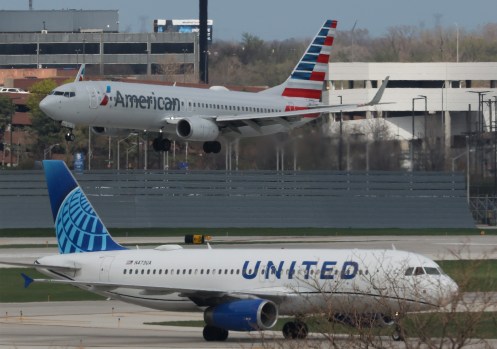

American Airlines was marking its centennial on Wednesday with celebrations at Chicago’s O’Hare International Airport and the giant carrier’s other hubs. We would imagine Scott Kirby’s 100th birthday invitation got lost in the mail.
That’s because the famously competitive Kirby spoiled American’s birthday party by casually suggesting that, hey, wouldn’t it be great if Chicago-based United Airlines, where he is the CEO and president, were able to take over American, forming the mother of all global carriers, far and away the largest airline on the planet?
The whole thing was shady indeed, with reports in Bloomberg and elsewhere saying the idea had been pitched “to senior government officials” and that all of this was according to “people familiar with the conversations,” with United not even commenting on the remarks by its own outspoken CEO, as deft a media manipulator as exists in the airline sector.
Among the many obsessive bloggers and observers who cover the industry, the idea was mostly treated as so improbable, even delusional, as to be not even worth taking seriously. But, well, when a CEO pitches things to “senior government officials,” the story gets picked up in media outlets and the market pays attention, in the short term at least.
American Airlines’ stock was up more than 8% on Tuesday.
We think that gain came because the market knows who the president of the United States is and surmises that Donald Trump, famous lover of really big deals, might just be dumb enough to approve this one, if only for presidential bragging rights for having created some great U.S.-flagged colossus of the skies that could dominate all those European and Asian minnows.
According to Bloomberg, Kirby floated the idea right in Trump’s ear during a Feb. 25 meeting on a different topic: a discussion of the revamping of the aging Washington Dulles International Airport. God help us.
Never mind the impact on those of us who pay actual airfares and would prefer there to be choice and competition on the routes we fly regularly. Some cynics, including us, are of the opinion that Kirby was, in fact, playing to an easily manipulated audience of one with his “pitch,” taking the position that even audacious asks can sometimes pay off, when timed right and placed in the right ears.
American, we suspect, read about this less-than-appealing prospect at the same time as everyone else. As far we know, not a single conversation has taken place between executives of the two carriers.
We further suspect that some of the experienced hands at American, where Kirby used to be president and no doubt would love to return in running both airlines, saw this as a way to deflect attention away from its rival, especially at O’Hare, where United and American have dual hubs. Instead of a good-news story about a 100-year-old iconic company, American executives suddenly found themselves having to defend its very existence as an airline. You have to admire Kirby’s chutzpah; we know of no CEO more adept at manipulating the perception of his competition and seeding the idea that it is weak or, to use a Kirby term, “cooked.”
This would, of course, be a completely terrible idea for reasons so obvious we hardly need to state them. There are only four major carriers in the U.S. — American, United, Delta and Southwest — and American and United together control more than a third of the market for air travel. Most industry observers think that prior mergers, such as Delta being allowed to swallow Northwest in 2008 and United eating Continental in 2010, resulted in higher airfares. If this super-merger were to take place, Chicago would lose its dual hub, and you can be sure airfares would soar. We can’t even imagine how much divestment of gates or routes would have to take place for this to pass muster with antitrust regulators — or, more importantly, even remotely benefit customers.
All industries are subject to consolidation, of course. And when it comes to the second-tier carriers such as Alaska, Allegiant, JetBlue, Breeze, Spirit and Frontier, some of which are struggling, we (unlike some judges in the past) see no problem in their combining. Indeed, an Allegiant-Frontier combo, to cite one example, would surely be good for consumers because it would give the combined leisure-oriented carrier more power to compete with the big guys. Kirby has long been seen as lusting after JetBlue, which would get United back into New York’s John F. Kennedy Airport in a big way. Anyone who cares about competition would not love that tie-up either, but it surely would not be as terrible for the consumer as a UA-AA combo. And not as terrible for Chicago, where JetBlue is not a significant player.
As we have written before, the O’Hare dual hub is crucial for our city’s economic well-being. The same is true in Los Angeles, among other airports where one airline does not rule the roost entirely.
All of this is perfectly obvious, but the salient question here is, how obvious is this to Trump?
We suspect that Kirby, who really should act more responsibly for his industry and for its customers, has an inkling that it may not be obvious at all.
So, we’ll repeat: A merger between United and American Airlines must never be allowed to happen.
Submit a letter, of no more than 400 words, to the editor here or email letters@chicagotribune.com.


