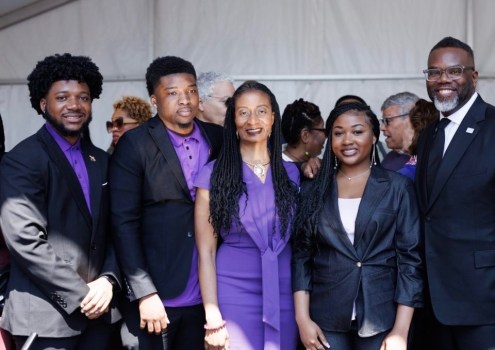
Elected officials and community leaders joined a noted University of Chicago paleontologist on Tuesday to unveil plans for Scitopia Chicago, a science center dedicated to teen education and public exhibits planned for Washington Park.
Paul Sereno, a UChicago professor and founder of the upcoming Scitopia Chicago, detailed his plans for the sprawling new center from his Washington Park lab, the Fossil Lab, 5437 S. Wabash Ave. Scitopia Chicago will include library resources, gathering spaces, a museum and teen maker labs for hands-on learning, Sereno said.
Serano, a longtime scholar who has been called the “Indiana Jones of paleontology” for his discoveries of new dinosaur species, explained that the goal of the center is to invite teens from across the city inside to learn, create and connect with peers.
“To me, a neighborhood doesn’t have a plan for the future if (it doesn’t) have something for the teens,” Sereno told the Tribune.
The more than 45,000-square-foot center will be free for teens across the state to visit, Sereno said. He added that around $50 million will be needed for construction — which will hopefully be completed in 2029 — and the project’s team will pursue both public and private funding sources.
The facility will be located near East Garfield Boulevard and South Prairie Avenue in what’s now a vacant lot, steps away from the Garfield CTA Green Line stop. Sereno said City Colleges of Chicago plans to build new healthcare program facilities in the area, furthering Scitopia Chicago’s mission of education.
Ald. Pat Dowell, 3rd, said she anticipates Scitopia Chicago will bring people from outside Washington Park to spend their money in the neighborhood while educating Chicago’s next generation.
“I’m someone that likes cutting-edge projects that spur people to think about their lives and how to self-actualize, and that’s what you’re all about,” Dowell said of Scitopia Chicago.
Cecilia Butler, the president of Washington Park Residents’ Advocacy Council, echoed Dowell, saying she expects the increased tourism to turn vacant lots into thriving local businesses and affordable housing.
Butler described the project as a “ray of sunshine.”
“As far as Washington Park itself compared to other surrounding communities, we need more help and as much help as we can get, and Scitopia opens the door,” she said.
Scitopia will also include a museum called Lost World that features dinosaurs, live plants and animals. The building will be the first zero-energy, carbon-neutral public science destination in the world, Sereno said.
Sereno said he’s led youth outreach and education efforts across Chicago since he came to the university nearly 40 years ago. Scitopia Chicago will provide a larger reach in teen education.
“This is going to be what I’ve always dreamed of,” Sereno said.
In his current Fossil Lab, Sereno invites teens to join him in the space decorated with fossils and dinosaur replicas. He teaches students during his after-school and summer programs about the discoveries lining his lab and encourages them to lead their own projects.
Marcus Trotter, a 13-year-old student at Beasley Academic Center, who has participated in the Fossil Lab’s programming since the summer, said that in addition to learning about the fossils, he teaches others about them at monthly open house events.
Trotter said the program has helped him become more confident in public speaking, adding that he’s anxiously awaiting Scitopia Chicago.
“I’m excited to see what it brings for everybody else,” Trotter said.