
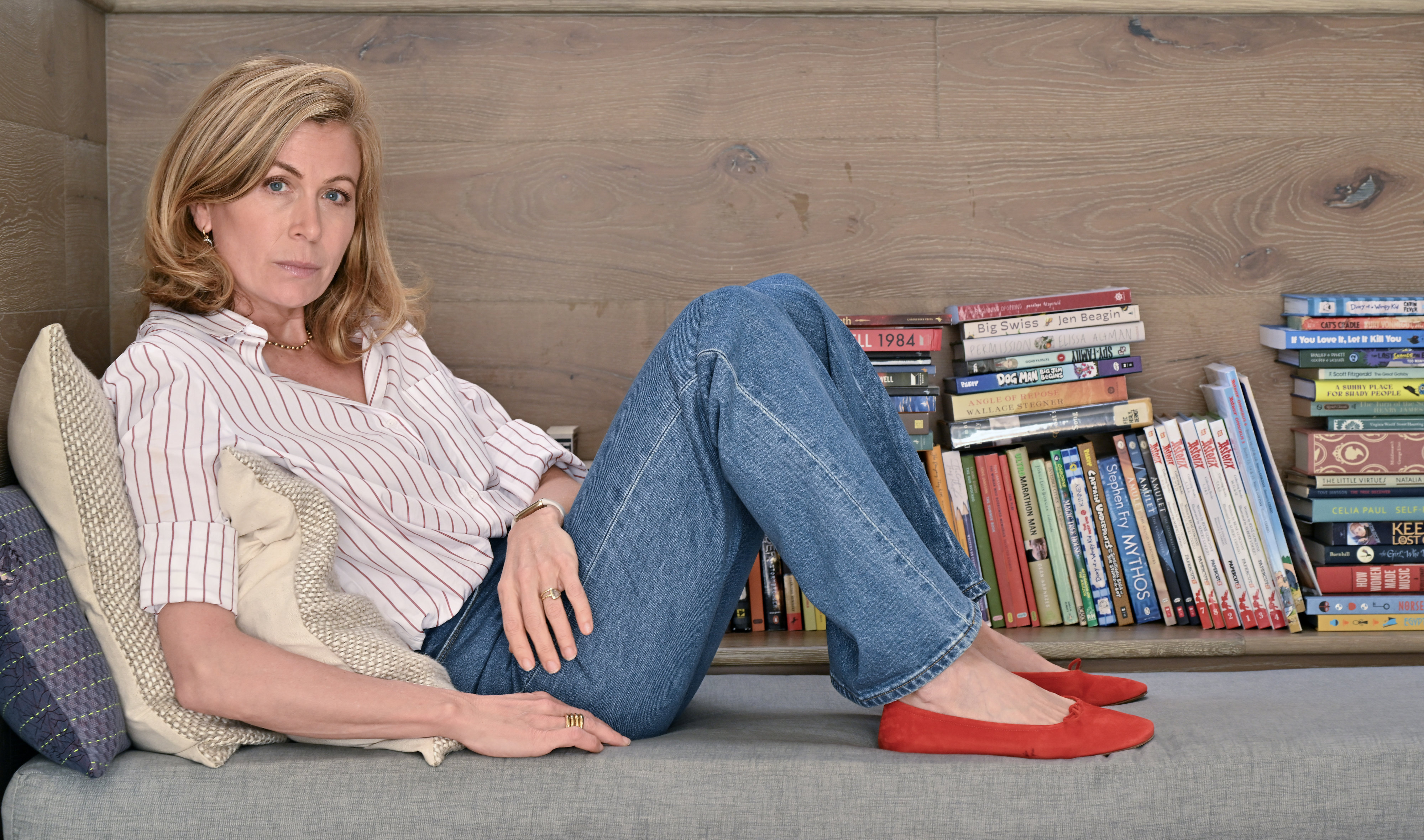

Sonya Walger’s semi-autobiographical novel, “Lion,” was one of my favorite books of 2025, a kind of sustained fever dream of memory and feeling rooted in Walger’s relationship with her charismatic, mercurial rogue of a father.
I did not anticipate that the same author would somehow also produce what is destined to be one of my favorite books of 2026. But Walger’s “Wifehouse” is just as potent a reading experience as “Lion,” perhaps even more so in its ambition to map the experiences of a multitude of characters, rather than focusing on a single perspective. Walger is most known as an actress in “Lost” and “For All Mankind,” but to me, she is primarily a powerhouse novelist.
At the center of “Wifehouse” is Annie, mother of newly teenaged Vita and younger son Jackson, married to Hector, a working actor who lacks whatever special quality leads to stardom, but who has achieved enough success to move the brood from Hollywood to semi-rural Connecticut and a large, semi-crumbling house in an attempt at a midlife family reboot.
Annie receives French lessons as a gift from her oldest friend Candace for putting her family up in their guest house as Candace’s home is being renovated. Thierry, who has been tutoring Remy, Candace’s son, is now in Annie’s kitchen, not making fun of her terrible French.
Annie does not want French lessons. She is, truthfully, not sure what she wants. She is a painter who does not paint and instead uses her eye for aesthetics to stage houses for a realtor friend. She is fiercely attached to her children, but also prone to storms of anger, and resentment at Hector for his sometimes-extended work-related absences has been simmering for years.
Enter Thierry, handsome, cool in demeanor, an aspiring writer who pays the bills through tutoring and bartending, biding his time until he feels his work is of the quality he aspires for. Annie is attracted to Thierry’s ease with himself, but it is a series of gestures he makes from a distance after a sudden upset in Annie’s life that has her increasingly drawn to him.
Readers of Miranda July’s “All Fours” or Dana Spiotta’s “Wayward” (two books I recommend) will find echoes of a story about a suburban mom in sudden emotional extremis acting rashly, but the pleasure is always in the specifics, and the specific pleasures offered by “Wifehouse” are considerable.
Walger’s prose is lyrical and evocative, an accrual of fine-grained observations that bring life to the page. No moment is a throwaway, and I found myself underlining many passages in admiration, like this description of a character, Candace’s mother-in-law, who appears only briefly, but is still indelibly drawn, “Leonore, Ed’s other, a macaron of a woman, delicate, exquisite, pastel, glazed with Catholicism.”
The scope is also larger than “Lion,” with the novel spending significant time with Hector, Thierry, and even Vita and Jackson. Annie is the catalyst that stirs their lives, but each character gets sufficient attention to bring them alive in their own right. An extended chapter of Hector on a shoot in Argentina could stand by itself as a wonderful short story about male ego, vanity, desire and loyalty.
As we move forward toward the inflection point in the present narrative, we’re also made privy to Annie’s childhood in Australia with an abusive father, and her courtship with Hector. We also gain insights into Thierry’s childhood, his dreams of becoming a writer and his genuine connection to Annie.
Some will be tempted to judge Annie, perhaps harshly, but that judgment is bound up in a whole host of cultural expectations that “Wifehouse” challenges to dramatic effect.
Book recommendations from the Biblioracle
John Warner tells you what to read based on the last five books you’ve read.
1. “The Machine: A Hot Team, a Legendary Season and a Heart-Stopping World Series: The Story of the 1975 Cincinnati Reds” by Joe Posnanski
2. “This Other Eden” by Paul Harding
3. “Mightier Than the Sword” by David S. Reynolds
4. “El Paso: Five Families and One Hundred Years of Blood, Migration, Race and Memory” by Jazmine Ulloa
5. “The Jackal’s Mistress” by Chris Bohjalian
— Bill B., Des Plaines
For Bill, a book of braided stories that knocked me out when I read it, so I immediately read it a second time: “The History of Sound” by Ben Shattuck.
1. “Strangers” by Belle Burden
2. “Intermezzo” by Sally Rooney
3. “Heart the Lover” by Lily King
4. “Buckeye” by Patrick Ryan
5. “The Correspondent” by Virginia Evans
— Betty M., Glenview
I need something with a strong emotional pull, rooted in relationships: “Morningside Heights” by Joshua Henkin.
1. “Player Piano” by Kurt Vonnegut Jr.
2. “A Sport and a Pastime” by James Salter
3. “Flesh” by David Szalay
4. “Train Dreams” by Denis Johnson
5. “Catch-22” by Joseph Heller
— David N., Chicago
David tells me that three of these are re-reads, so I want to try to give him something he hasn’t read that has the stuff to hang with these favorites, “The End of Vandalism” by Tom Drury.
Get a reading from the Biblioracle
Send a list of the last five books you’ve read and your hometown to biblioracle@gmail.com.
John Warner is the author of books including “More Than Words: How to Think About Writing in the Age of AI.” You can find him at biblioracle.com.


