
When William Hewes was born in 1761, the United States of America did not exist. When he died in 1855, it was clear the issue of slavery might tear the country apart.
But between those 94 years, Hewes put on a uniform, fought the British, helped establish a new country and then headed west with his family, finally stopping in Crete, where 29 of his descendants now live. He’s been dead now longer than he lived several times over, but his memory lives on in Will County.

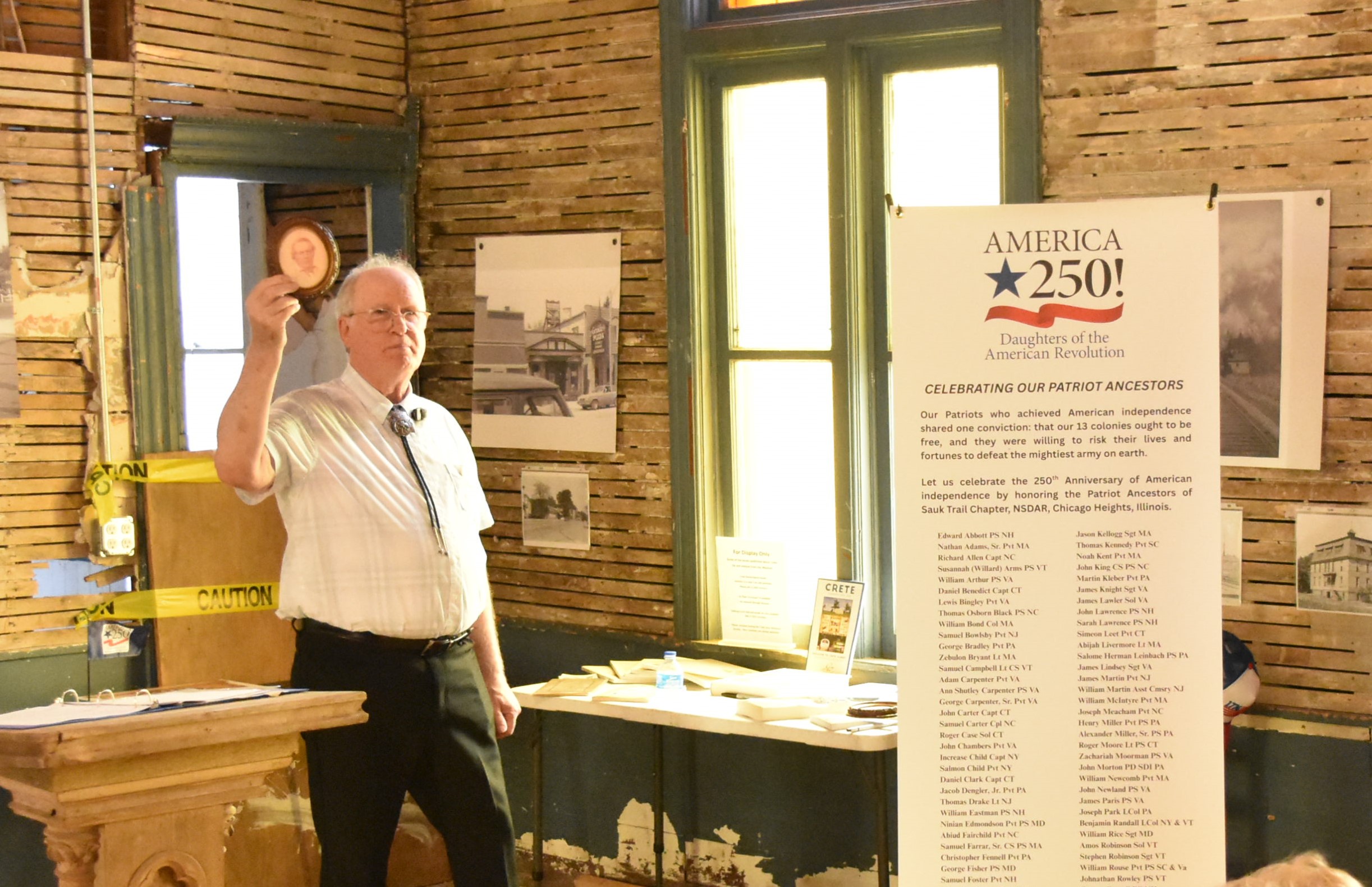
About three dozen people — a handful of descendants, local historians and members of the National Society Daughters of the American Revolution — gathered Saturday to rededicate Hewes’ plaque at his grave.
This isn’t the first plaque. The first was dedicated in 1959. DAR regent Melody Paris-Rush said the 250th birthday of the nation plus the fact the original plaque was showing its age were both good reasons to hold another ceremony.
“Over time, and because it’s out in the elements, and the cemetery has mowers and maintenance crews, that particular marker discolored and lost a few of the letters that were attached,” Paris-Rush said. “So for the 250th anniversary of the country, the chapter decided to replace that marker to honor his service.”
The marker is metal and it doesn’t say much about him. It notes he fought in the Revolutionary War, his birthday, his birthplace (Massachusetts) and his death date and place.
But his legacy is bigger. Tim DeMuth, a Hewes descendent, spoke at the ceremony at the First Congregational Church, which sits next to Hewes’ grave. DeMuth said Hewes was only a private in the biggest war of his life.
He turned 18 and enlisted for six months, but in those months, he was present at the hanging of John Andre, the man who convinced Benedict Arnold to betray the Continental Army and served at West Point, one of the most strategic forts controlled by Washington and key to keeping the colonies bound together.
He wasn’t the sort of soldier who made the history books, but, DeMuth said, it took every soldier to win the war.
“They all made it possible to enjoy the blessings of liberty as we celebrate our 250th anniversary as a nation,” he said.
After that, DeMuth said his ancestor rode the Erie Canal into the Great Lakes and down to Detroit where he started walking west until he hit Crete.


“Just imagine coming from Detroit on dirt trails,” DeMuth said.
By then, of course, Hewes was old, and traveled with a son. Five of his 12 kids would move to Illinois and would make their homes in the Crete area, some becoming politicians, one a minister, others farmers and others shopkeepers.
And for the most part, the family stayed put. The put down roots and those roots kept growing. DeMuth said some of his family still live in a house in Crete they’ve lived in for five generations.
“It’s just part of our soul, the land,” DeMuth said.
Jesse Wright is a freelance reporter for the Daily Southtown.