

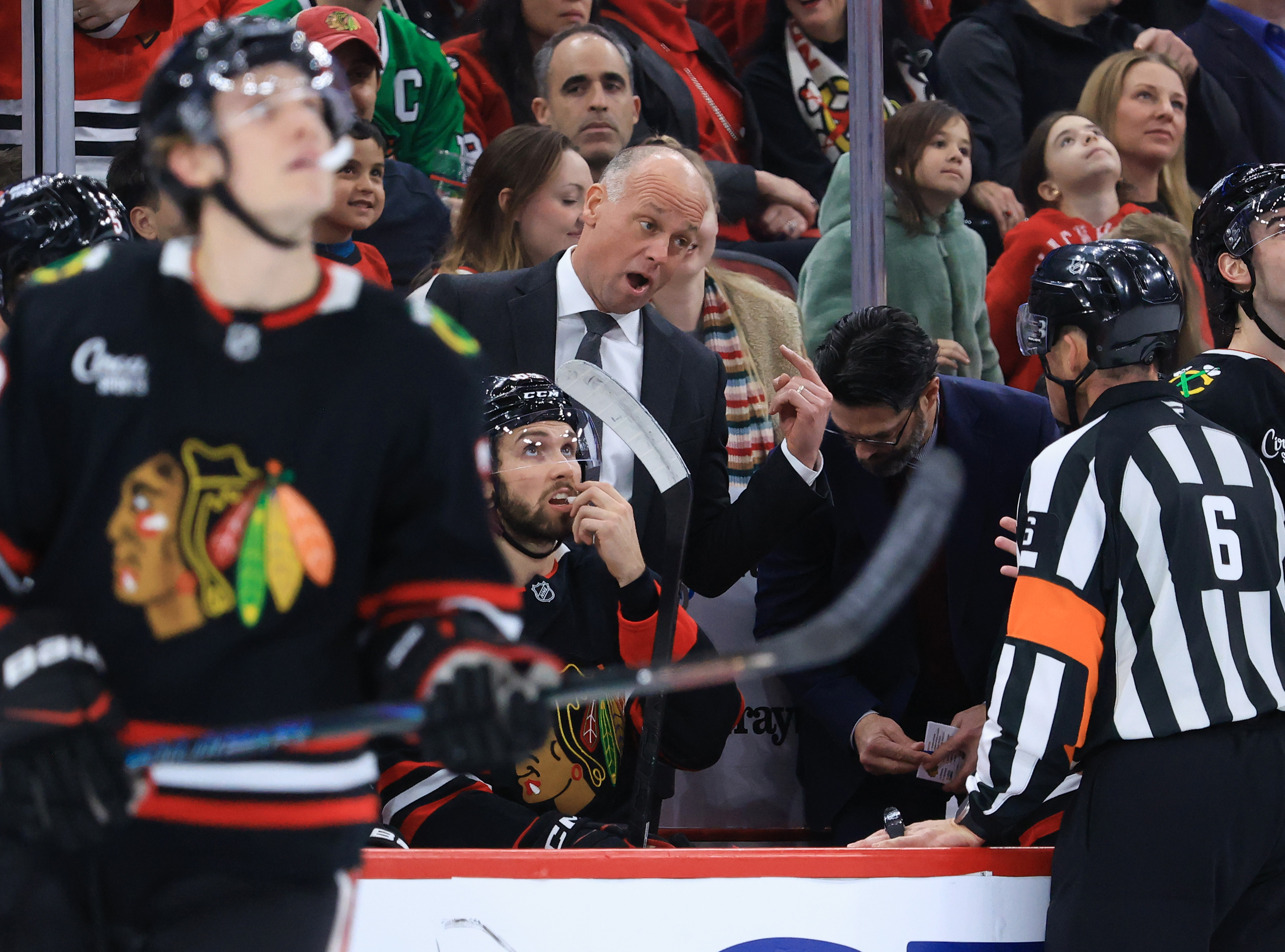
The Chicago Blackhawks needed plenty after a discouraging 2024-25 season. Included on that lengthy to-do list was a patient coach who could form art from the scraps within the United Center locker room.
Insert Jeff Blashill.
The 52-year-old had been in a similar situation in his previous head coaching stint with the Detroit Red Wings. He succeeded Mike Babcock, whose contract had expired after a second straight first-round playoff exit, and while Blashill’s first team went 41-30-11 in 2015-16 before another first-round ouster, the rebuilding Red Wings were bound for a step backward.
The first-time NHL head coach was learning along with his team, and things got ugly as predicted with six straight sub-.500 seasons and no more playoff appearances. The front office’s tolerance finally ran out, and Blashill was fired in 2022.
From Bedard to Burakovsky: How the Chicago Blackhawks players graded in 2025-26
After three seasons assisting coach Jon Cooper with the Tampa Bay Lightning, Blashill received a second chance from Hawks general manager Kyle Davidson. He wasn’t expected to lead the Hawks to euphoria in his first season but rather mesh with the young team as it grows into professionalism — although the Hawks would welcome that process moving a little faster than it did in Detroit.
So how did Blashill do in his first season? Here’s a look at some pros and cons.
Pro: Patience

The average age of the Hawks roster after the trade deadline was 26.14 — the youngest in the NHL. That preceded the arrivals of Anton Frondell, 19, and Sacha Boisvert, 20, and next season’s roster is likely to include Roman Kantserov, 21, and whoever the Hawks draft with the No. 4 pick.
Most of the Hawks — even star center Connor Bedard, 20 — are going through their trials and errors of learning the NHL. They aren’t expected to get it right away, so it helps that Blashill is there to ease the youngsters into the league.
He consistently praised the team’s effort throughout the season in both good wins and bad losses. He did it once more before the season-ending 5-2 victory over the San Jose Sharks.
“Our guys care,” Blashill said. “I’ll give you an example — yesterday’s practice. It’s the last practice of the year, our guys went out and were invested in getting better.
“That to me speaks volumes about the level of care and engagement our guys have. You could say to me, ‘Well, they should.’ You’re right, but that’s not how it always goes at this time of year.”
That effort isn’t easy to come by, especially after blowout losses or nail-biting heartbreaks. Keeping games close is something the 2024-25 Hawks had difficulty doing.
It’s a work in progress, one that could stretch beyond the 2026-27 season. That’s why Blashill used his news conferences to credit his players for learning the fundamentals instead of bashing what they weren’t accomplishing.
Eventually the learning curve must sharpen. But Davidson knew building this roster through the draft would take some time, so an equally accommodating coach is a perfect fit for his vision.
Con: Self-proclaimed stubbornness
The Hawks were 25-30-11 and coming off a lackluster effort in a 4-0 loss to the Vegas Golden Knights when Boisvert signed his three-year, entry-level contract on March 16. The next day, Blashill was asked about what he saw in some of the incoming prospects.
“I’ve watched a good amount of Frondell, Kantserov (and Boisvert); those would probably be the three I’ve watched the most,” he said. “When you come to play, I’m a stubborn person — you’ll have a clean slate in terms of your game, then I’ll watch and see.”
It’s understandable to want players that fight to earn their opportunity. But that stubbornness showed its face this past season.
Take André Burakovsky’s time as Bedard’s right wing, for instance. The veteran started well enough, but his struggles in the second half of the season should’ve signaled a need for change to help not only Bedard, but also the rest of the team.
Instead, Blashill kept Burakovsky among the top six forwards until Frondell’s arrival in late March. The reasons differed each time the taboo topic came up.

“If he wasn’t working as hard as he’s worked, if he wasn’t caring as much as he’s cared, maybe we don’t keep him up there,” Blashill said March 9. “But I just felt like he was working so hard, he was competing hard, he cares a ton and eventually it felt like it was going to happen for him.
Two weeks later, an annoyed Blashill said: “Listen, we need production out of him — we all get that, he gets that. I would say historically, if he keeps getting those chances, it’ll happen for him because he’s a better point producer than what he’s been in the last stretch.”
Blashill also made Nick Lardis’ call-up an interesting one. The rookie was consistently on the fourth line until late in the season, despite putting up 117 points in 65 games with the OHL’s Brantford Bulldogs in 2024-25.
The NHL is a different animal, of course, but Blashill needs to be forgiving when experimenting with his lineup.
Pro: A team player
It’s no secret the Hawks had their share of brutal performances this past season despite their improvements from 2024-25. Entering the final homestand, Blashill said he wanted to show the United Center fans “how good this team can be,” and the Hawks proceeded to be outscored 17-6 in the next three games.
Blashill kept his composure through such stretches. Some stern, honest feedback as the players grow will be essential, but for now he’s a heartening voice the young players need as they ease into the NHL.
“Going into the year, we wanted to set a standard (and) we wanted to begin the process of setting a culture — I know we’ve done those two things for sure,” Blashill said April 16. “When you’re struggling, it feels like those steps backward have wiped out all the steps forward, but that’s not the case.
“Let’s say you took 100 steps forward and 20 steps backward. Even though those 20 feel bad, it doesn’t wipe out the other 80.”
The players likewise expressed their support for Blashill throughout the season. That mutual praise and respect was a big reason Hawks ownership gave the thumbs up on his hiring.
“From the very beginning, we knew (Blashill) was a teacher and was going to approach teaching those winning habits,” CEO and Chairman Danny Wirtz said. “He had his work cut out for him with the amount of young players, but I think he’s done a really good job.
“The players have bought into him as a coach, his system and that culture in the locker room — he’s very much a big part of that, getting these players to work together and make the most out of each other.”
Blashill isn’t easy on the players by any means — he scratched Matt Grzelcyk a day after highlighting his consistency — but he understands the position he’s in. If the Hawks do take the leap into playoff contention next season, credit Blashill for seeing the signs from the start.
Con: The youth excuse

With that everlasting support comes the need for honesty. Among the Hawks’ 53 losses were games in which Blashill’s players didn’t play up to their talent.
What that talent level ultimately will be remains in question, but the ceiling is higher than a 29-39-14 record. When Blashill was asked what went wrong in a blowout loss, his response was usually along the lines of what he said about a March 20 home loss to the Colorado Avalanche.
“We didn’t have it tonight and they did,” he said after the 4-1 defeat. “We just didn’t have our skating legs (and) it’s just another learning process of how to grind through that. That’s just part of the league — we have to continue to grow in those areas.”
Learning is the name of the Hawks’ game — it’s why Davidson hired Blashill in the first place. Sometimes, though, it’s better to tell it how it is.
As the team gets older and gains experience, the immaturity label won’t be a valid excuse. What’s the explanation if an older wing has a scoring drought like Frank Nazar did in the winter? What if Artyom Levshunov doesn’t improve in the next few seasons?
These are all worst-case scenarios, but it is something to consider. We saw the Hawks get bad luck in the draft lottery, and the same could happen with some of their recent high draft picks. How will Blashill respond if that is the case?
Pro: Appreciation for the little things
Several Hawks had trouble putting the puck into the net in 2025-26. Top-six forwards Ryan Greene and Nazar combined for 27 goals, a low mark considering their placement in the lineup and 247 shots on goal between them. Improving their finishing ability is a necessity if the Hawks want to bolster their 5-on-5 offense.
But both players also did a lot right — habits that should be replicated in 2026-27. Their confidence never lapsed as they made plays that don’t appear on the stat sheets. The scoring will come if they continue to create elsewhere.
That was a big part of Blashill’s preaching.
“I can’t sit here and say that stuff doesn’t wear — they’re humans,” Blashill said Dec. 13 about Nazar’s goal drought. “But to be honest, my conversations with Frank are all process-driven. If he (keeps playing well), he’ll get the rewards he wants.”

Blashill added about Greene on Jan. 15: “He’s had steps in the right direction, steps in the wrong direction — it’s just that incremental improvement that we’re looking for out of every player. We’re going to make lots of mistakes, (but it’s) about growing and learning from those situations and (Greene has) had a good attitude about that, just like the rest of our group has, young and old.”
Blashill emphasizes each process — no matter how small or large — that goes into victories. Goaltender Spencer Knight echoed Blashill’s view during his exit interview.
“You can have that mindset (of) winning needs to happen next year, but it’s more or less like … let’s take steps,” Knight said. “Let’s try to collectively buy into what it takes to win, not necessarily just focus on the outcome.”
The Hawks will have few veterans next season, so it will be up to Blashill to continue to work beyond the scoresheet as he develops his players.
Con: Too many experiments

Bedard’s line didn’t see many trials in 2025-26. It was Greene on the left and Burakovsky on the right for a large chunk of the season.
The other lines were convoluted.
Ryan Donato shifted among the bottom six. He finished with 30 points (15 goals, 15 assists) — a steep regression from his 62-point campaign in 2024-25.
Tyler Bertuzzi — who did score a career-high 32 goals — shuffled all over the place. He aided his linemates but wasn’t able to build full chemistry with anyone.
Centers such as Greene and Oliver Moore were shifted from their natural position to wings. The players had no complaints, but some lineup consistency needs to be on the Hawks’ to-do list.
“I feel comfortable at both (center and wing), I’ve kind of bounced back and forth,” Greene said. “Wherever the coach wants to play me, I need to prepare and get myself ready to do the best I can at that position.”
Said Moore: “At center I was a little more comfortable with it being my natural position. (But) one of my strengths is going to be my versatility going forward. There are going to be nights where you have to play with more responsibility, and sometimes there may be nights I’ll have to fill in for a different role.
“I’m willing to do anything. The big thing I want to do is just continue to try to be a winning hockey player, use my compete and do the things I know are going to help the team win every night.”
Lineup stability is likelier now that Blashill has a good idea of what he’s working with heading into Year 2.
Overall grade: C+
Blashill was handed the keys to a Hawks team that didn’t have much direction, identity or confidence to perform. He began steering them down the right path, but there’s plenty of work left to do.
He believes this team can put it all together and eventually compete for the Stanley Cup. How long until it gets there is unknown, but Blashill appears willing to wait for his players to blossom.
Questions remain as his Hawks tenure continues — the biggest being how he might handle an improved roster that is playoff-ready. There’s also a chance we get to see his coaching method with a big trade acquisition, if the Hawks go that route this summer.
All in all, there was more good than bad in Blashill’s first year. But the Hawks need to make more steps forward in 2026-27 to avoid another lost season.


