
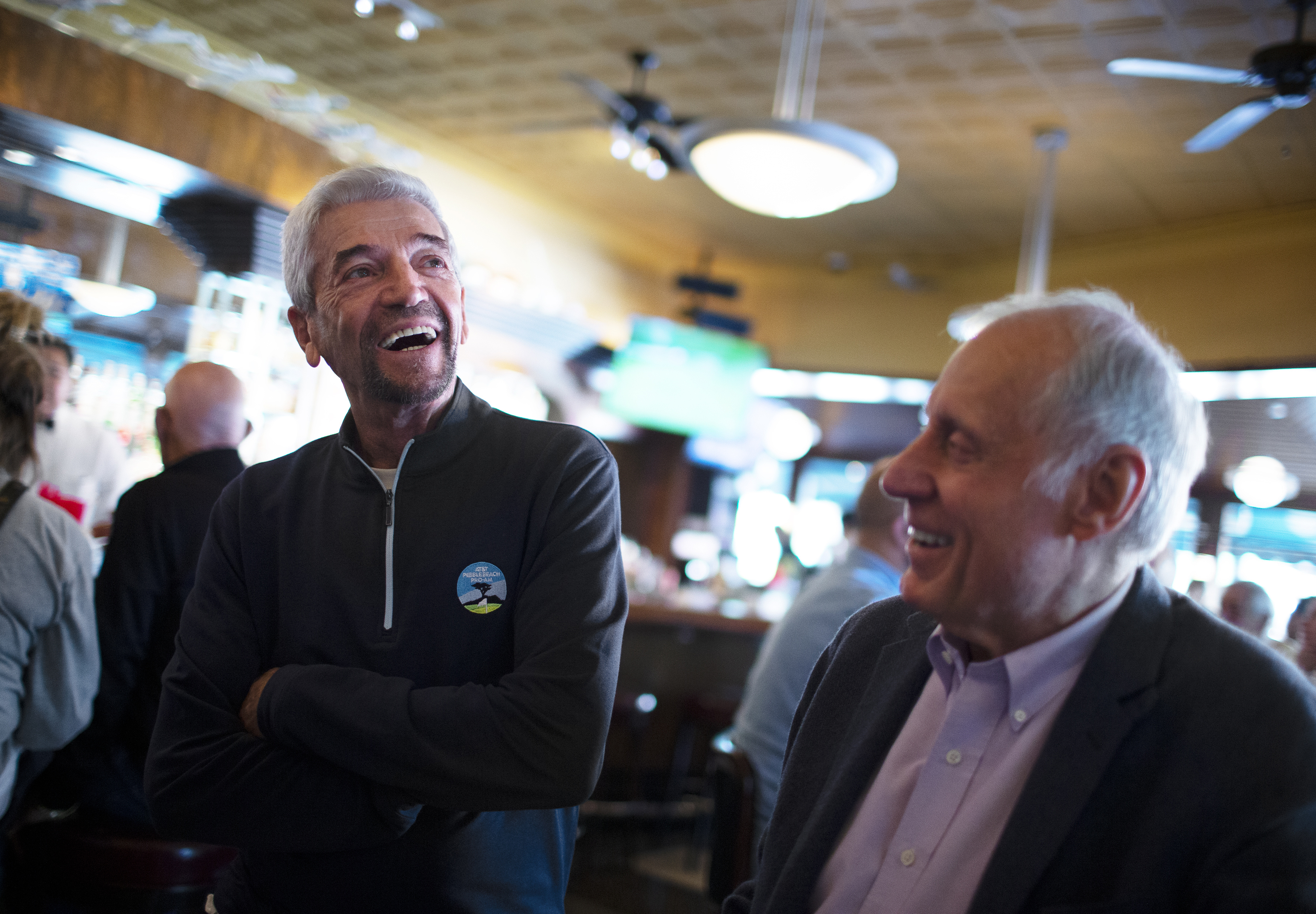

In the 60-some years since he left his hometown of south suburban Harvey, comedian Tom Dreesen had, among many things, made more than 500 TV appearances, including 61 on “The Tonight Show,” and was an opening act for Smokey Robinson, Tony Orlando, Gladys Knight, Liza Minnelli, Sammy Davis Jr. and Frank Sinatra. In fact, he was Sinatra’s opening act for 13 years, the master of ceremonies at the singer’s 1998 wake and one of the pallbearers at his funeral.
“I cannot say enough good things about the guy and his comedy,” late-night host David Letterman said years ago. “He is one of my oldest friends and a born storyteller. And he’s got such a good heart.”
That heart stopped beating in the early morning hours on Wednesday when Dreesen died in a California hospital after fighting cancer. He was 86 years old.
His was an amazing life.
Dreesen was born on Sept. 11, 1939, the third of eight children of Glenore, a waitress, and Walter Dreesen, who worked for Acme Steel and played trumpet in a band. Soon enough, the baby was living in a “home” that was a shack in the shape of a railroad car behind a Harvey factory. Both parents struggled with alcoholism. His mother would eventually stop drinking. His father would not.
“We were raggedy-ass poor,” Dreesen told the Tribune in 2006. “There was no shower, no tub, no hot water. And sometimes there were five of us kids sleeping in one bed. There were rats burrowing into the house, broken windows plugged with rags. If the kids had holes in their shoes, we put cardboard in them.”
He caddied at golf courses, shined shoes, attended but never graduated from Thornton Township High School, and eventually escaped his Dickensian childhood by enlisting in the Navy. For four years, he traveled the world.
While on leave, he met Maryellen Subock, a girl from Harvey. They married in 1958. Daughter Amy arrived. He got out of the Navy, and there were two more kids, Tom and Jennifer.
He often worked 14 hours a day pouring concrete, coming home and falling asleep at the dinner table. But he also went out, he told the Tribune, “trying to capture the childhood I’d missed. I’d go out with the guys and hang out or, you know, whatever the street guys do, play basketball, 16-inch softball.”
He joined the Jaycees and created a drug-education program for schools, speaking in front of classes. He was soon joined in these “shows” by another Jaycees member, Tim Reid, who had recently moved to the Chicago area from North Carolina and was working as a marketing manager.
The pair used humor to get through to the kids and eventually became funny enough that students and teachers started telling them, “You guys should have a comedy act.” And so, in 1969 was born Tim & Tom, credited as being the first interracial comedy duo.
They started getting booked — this is before there were comedy clubs — at such Chicago nightclubs as Mister Kelly’s, the Blue Max and the Playboy Clubs. Their biggest paycheck, though, was $750, split two ways. The act broke up in 1974 when Reid moved to Los Angeles (later starring as Venus Flytrap on “WKRP in Cincinnati”).
Dreesen soon followed, but for the first few months in Los Angeles his “home” was an abandoned car. He washed at the gas station bathroom and lived on $1 a day.
Every day, he hitchhiked to the Comedy Store, one of the first comedy clubs, and begged to get on stage. He became part of a gang of talented, struggling young comics. For a time at a club called Showbiz, he said, “the bill every night was me, David Letterman, Jay Leno, Robin Williams, Gallagher and Michael Keaton. The girl waiting tables was Debra Winger. And there was a bonding experience. We would sometimes have to pool our money to get us all a cup of coffee.”
“Tom was older than the rest of us, had more experience,” Letterman told the Tribune. “When I showed up in L.A., I didn’t know a thing. Tom taught me, taught a lot of us, what to worry about, what to care about. He helped find work for all of us, stuff like warming up the crowds for TV game shows.”
Eventually, Dreesen got a manager and his family moved out to California, and he “started getting a job here and there, drawing unemployment and hoping to get a shot on ‘The Tonight Show.'”
When that chance came, Dreesen recalled, “I blew the roof off. Incredible applause. Two bows. The high sign from Johnny Carson.”
In short order, there was a $10,000 check from CBS to hold him to a development deal. And then a new home in Sherman Oaks, California, jobs as an opening act on the road, $8,000 a week in Las Vegas.

One night in Lake Tahoe, after finishing his show with Smokey Robinson, he went next door to see Sinatra. Standing backstage, he was introduced to Sinatra’s lawyer, Mickey Rudin, who had been hearing good things about Dreesen. He signed on as Sinatra’s opening act.
And so began years studded with stars and adventures, such as the night Sinatra and Gene Kelly got into a heated argument about whether Dreesen was Irish or Italian. Dreesen was a frequent guest at Sinatra’s estate in Palm Springs, where he hung out with Dean Martin, Sammy Davis Jr. and … well, everybody.
Sinatra liked to stay up all night, and Dreesen was usually the last one keeping him company. “We would have long talks about life and family. We shared a lot of feelings,” he told the Tribune.
Dreesen performed steadily after Sinatra died, devoting much of his talent to “Shoeshines to Sinatra,” a lively autobiographical show that he performed nationally.
He performed in clubs and was also one of Hollywood’s most accomplished golfers. And also, not surprisingly, was among the softest of soft touches in show business. As the late Los Angeles Times columnist Jim Murray once wrote: “If you count the benefits he has performed without a fee, he has contributed more to charity than the Rockefellers.”
Long divorced, he lived on — believe it or not — Benefit Street in Sherman Oaks.
His health in recent years was beset by various ailments, but he was always buoyant and optimistic. He got hit hard by COVID in 2020. Still, he visited Chicago often and was scheduled to sing at Wrigley Field later this summer.
“No matter where life took him, Tom never forgot where he came from,” Cubs chairman Tom Ricketts said in part in a statement on Wednesday. “He proudly carried his South Side roots with him and drew inspiration from his family, his hometown and the experiences that made him one of Chicago’s great storytellers. It couldn’t have been easy to be a Cubs fan growing up in the south suburbs, but Tom knew what he loved, and he loved his family, his fans and his Chicago Cubs. … On behalf of our family, our condolences to his family and to his many friends.”
Steppenwolf ensemble member Gary Sinise posted in part on social media that, “This morning America lost one of our great comedians and patriots, and I lost a dear friend. Tom Dreesen died at 86 years old. He was a special person, a U.S. Navy veteran with a tremendously charitable heart.”
Dreesen had served as an ambassador of the actor’s charitable Gary Sinise Foundation for 14 years.
“Tommy was just so much fun,” said his friend of four decades, restaurateur Steve Lombardo, who owns what was Dreesen’s local hangout, Gibsons. “He is the last guy from his generation of performers and such a nice guy, friendly with and kind to everybody. I loved the guy.”
So did former TV and radio executive Larry Wert, who said, “Tom was beloved as an entertainer in Hollywood, rubbing elbows with mega-stars for six decades, but he always remained tried and true to his family, friends, and his roots. He loved being home and visiting with friends and fans. And nobody told a better story.”
There was one story that Dreesen told later in life. It was about how he learned at 12 that his real father was not the man he thought, but rather Frank Polizzi, who was married to his mother’s sister and owned the Cedar Lodge tavern. He kept this a secret for more than half a century, eventually telling the Tribune about visiting the old man in the hospital.
“Tommy, I’m on my last legs, and you know it. I don’t have long. I’m dying,” Polizzi said. “You gotta tell me, do you have any anger or rage?”
“No,” said Dreesen. “First of all, everything that I have, everything that I am, everything I’m about is because of you. I have no regrets whatsoever. But what about you? What do you regret?”
The tough old man sat up in bed, tears in his eyes. He said, “The only regret that I have … the only regret that I have … It’s that every time I was in the bar and you’d come on TV … Tommy, I could never say, I could never say to anybody, ‘Hey, that’s my kid up there. Look at him. He’s a star. Hey everybody, put down those drinks and take a look. That’s my son.'”
A memorial service is being planned.
rkogan@chicagotribune.com


