
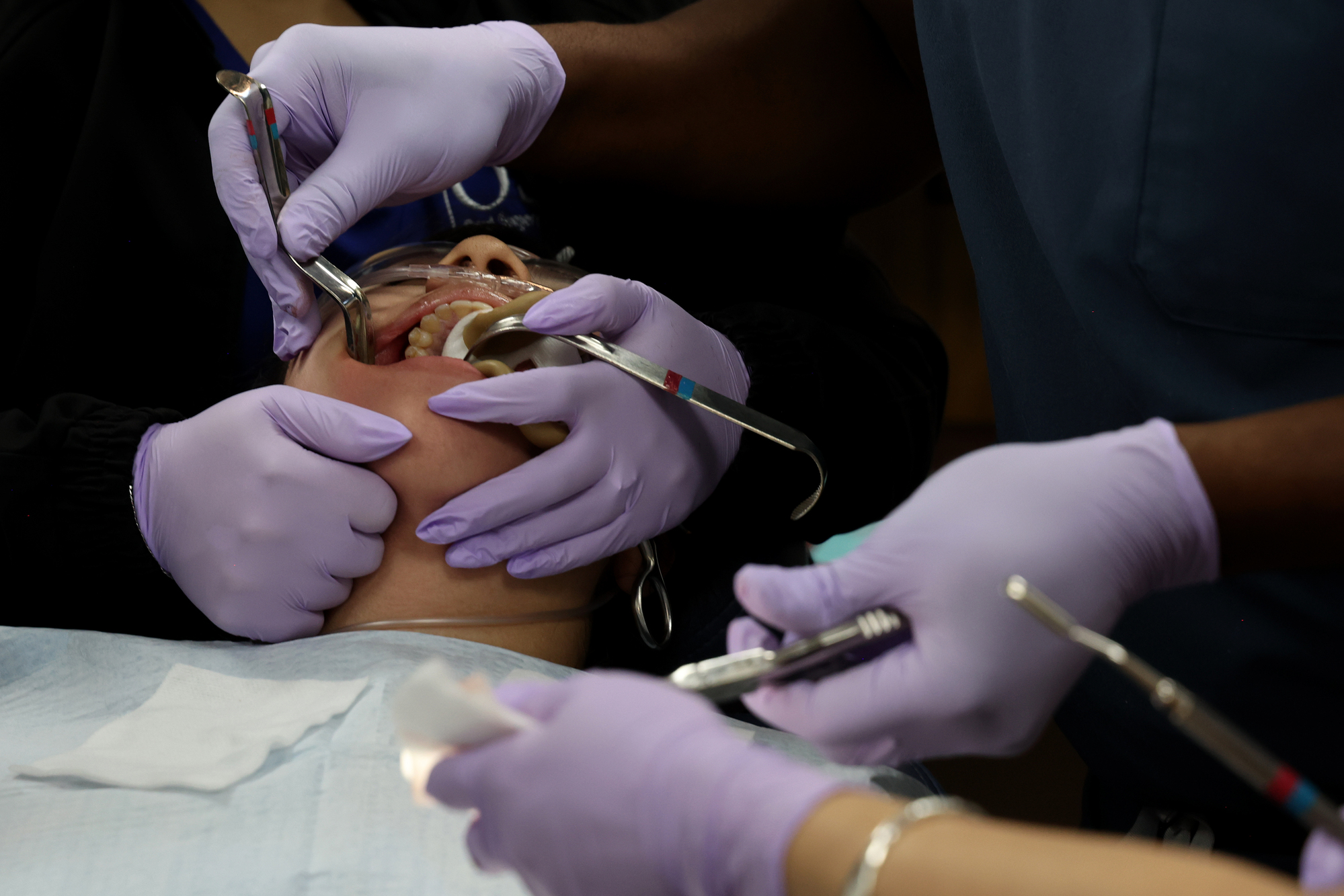

Erica Champ has a serious toothache. One tooth has erupted through her gum. Another throbs below the surface. Sometimes she suffers severe pain and facial swelling. She has to rinse her mouth frequently with mouthwash or peroxide to keep the gums from getting infected.
Normally, the teeth would be removed immediately. But Champ lost her job in February of last year and had to go on Medicaid federal health insurance. She has been suffering from the condition the entire time. The oral surgeons she contacted had monthslong waits for an appointment.
She’s finally scheduled to get her teeth pulled Thursday.
“The wait times are atrocious,” she said. “As someone who paid my taxes into this system, I don’t feel it’s fair for me or anyone with public assistance to have to suffer. It’s like punishment for being poor or losing your job.”
Champ, who’s from south suburban Matteson, is one of more than 3 million people in Illinois — that’s almost 1 of 4 residents — on Medicaid. She is typical of patients who have to wait long times for specialized dental care, primarily due to low pay for oral surgeons who perform such procedures.
While the problem has plagued Medicaid patients for years, dental care advocates say it could be addressed if the managed care organizations, or MCOs, that administer the plan would negotiate higher payments.
“There’s a huge need,” dentist Michael Wilson said. “People are struggling to find care when they need it.”
Wilson, of Oral Surgery Solutions in Chicago and Westmont, said some patients have to wait more than a year to get an appointment with a specialist. Medicaid pays far less than the work costs, he said, resulting in a shortage of oral surgeons willing to do the work. While the normal cash fee for removing a fully impacted wisdom tooth at his practice is $780, Illinois Medicaid’s standard fee is only $117, state records show.


Under the Medicaid system, Illinois pays the MCOs a fixed amount per patient, and sets minimum fees per service that the insurers must pay to doctors and dentists. But the MCOs have the flexibility to pay caregivers more to meet patient-quality standards to provide timely access to care. They also have motivation to pay more to offer a better network of providers than their competitors, and to ensure basic, preventive care to avoid paying more for more extensive procedures later.
But that system has flaws, advocates say.
When Wilson complained to the managed care organizations, some did negotiate higher payments for specialty care. Others ignored the problem, he said.
One MCO gave Wilson a list of hundreds of oral surgeons for his patients to choose from, but when patients contacted the providers, most said they didn’t take Medicaid. One agreed to do the work but was located in Moline, a two-and-a-half hour drive from Chicago.
Wilson contacted DentaQuest, which oversees the Medicaid dental program for Illinois. They helped get some MCOs —Blue Cross/Blue Shield, Molina Healthcare and Humana — to negotiate better rates with his office. Other MCOs, including Aetna, Meridian Health and CountyCare, declined to do so, Wilson said.
More broadly, a study by the Illinois Answers Project last year found that MCOs were denying or delaying claims payments regularly, causing some to stop taking Medicaid. The companies made bigger profits, but didn’t meet standards for patient care.
Oral health can have much broader consequences than mouth pain. Some dental conditions, such as a tooth infection, must be taken care of before other procedures, such as heart or cancer surgery, for fear of spreading the infection. Some patients are forced to pay cash to get quick treatment, though few can afford it.
This is a long-standing and not isolated problem for an expensive program. Even though the federal government pays about half the cost, Medicaid makes up one of the largest chunks of state spending — more than $41 billion in the current fiscal year.
But Medicaid coverage is vital to people with low income who don’t have health insurance through their employers. Research shows Medicaid improves access to healthcare and improves outcomes, particularly in rural areas.
U.S. Sen. Dick Durbin has long pushed for improvements to Medicaid for dental care, saying that delays in reimbursement, rejections of legitimate claims, and time-consuming paperwork also deter providers from taking Medicaid patients.
In response to the Tribune’s questions about the program, the Illinois Department of Healthcare and Family Services wrote in an email that it works with managed care organizations to bolster provider networks and ensure all customers have access to care.
The MCOs are permitted to pay rates above the standard Medicaid reimbursement to support access when provider availability is limited, including for orthodontist care, HFS spokeswoman Melissa Kula wrote.
There are about 85 oral surgeons enrolled in Medicaid statewide, with most of those in the Chicago area, out of about 270 providers overall. HFS officials said they are aware of the need for expanded specialty provider participation in the Medicaid dental program, and have supported multiple rate increases in recent years to bolster provider networks.
Illinois awarded approximately $10 million in COVID-19 grants to more than 75 dentists in 2021, plus $20 million in rate increases between 2022 and 2023. The state also allowed medical anesthesiologists to bill for dental anesthesia care starting in 2024, and raised the reimbursement rate by six times.
Aetna and Meridian did not reply to requests for comment, but CountyCare, Cook County’s program to serve Medicaid patients, replied that it contracts with more than 60 oral surgeons and pays the standard Medicaid rate or more in some cases.
CountyCare audits its oral surgery network to check on wait times and access opportunities, spokeswoman Alexandra Normington told the Tribune.
“CountyCare has expanded covered preventive dental services for enrollees beyond what is required by the State,” she wrote. “CountyCare includes dental exams and cleanings every six months and root canal treatment for all teeth for adults and retreatment of root canals for adults and children in its coverage.”
But recent cuts in federal Medicaid funding have led to reduced enrollment and will limit services statewide, said assistant professor Lindsay Allen, a health economist and policy researcher at Northwestern University’s Feinberg School of Medicine.
She said people will have to “raise a big stink” to further improve access to dental care, where regular checkups can avoid bigger problems down the line.
“Prevention is unbelievably cost-effective,” Allen said. “This is preventive healthcare and medically necessary surgery.”


