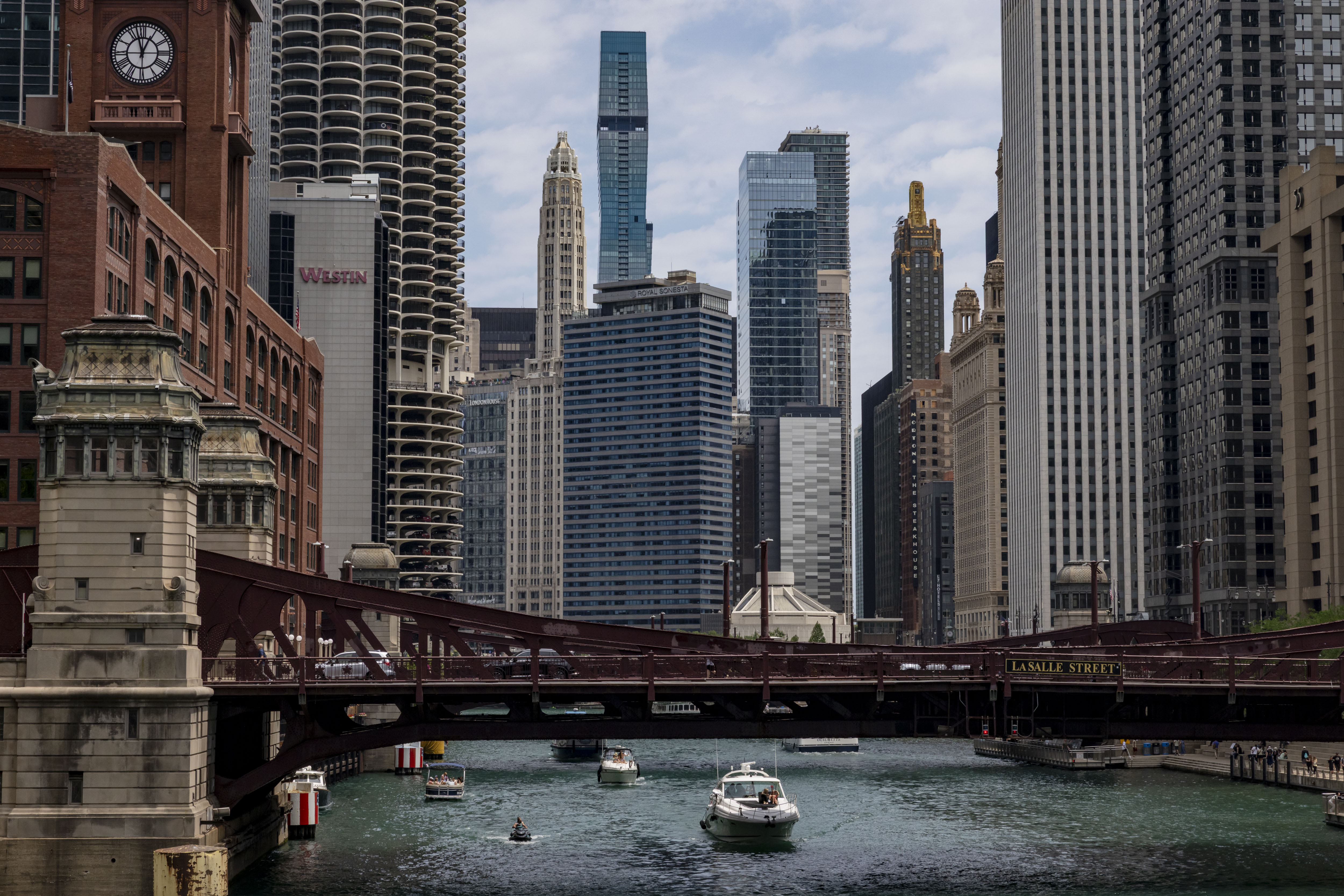

The writer Sarah Vowell was not born in Chicago. She was born a couple of days after Christmas in 1969 in Muskogee, Oklahoma. She is of Swedish, Scottish and Cherokee ancestry and she attended the School of the Art Institute of Chicago, where she earned a master’s degree in art history.
History hangs heavy and entertainingly in her work, in such books as “Assassination Vacation” and “Unfamiliar Fishes,” or her essay collection “The Partly Cloudy Patriot.” It is also the reason to listen to a recent edition of “This American Life,” the hourlong radio program that was born here at WBEZ in 1995. It is hosted by Ira Glass and has won a Pulitzer Prize, Peabody Awards and most other available prizes.
Vowell was an early contributor. Her theory that it was possible to tell the entire history of America by describing what happened on and around one single street corner intrigued Glass. And so she chose the corner of Michigan Avenue and Wacker Drive for the creation of a wonderful radio segment.
Glass, as usual, introduces the show. This one was titled “Four Corners” (which also includes a story from former Chicago writer Achy Obejas), about which he said, “Today on our program … we tell the story of life in America through portraits of life on four different corners in four different states across this great nation.”
This show first aired in 1999 but was rebroadcast last weekend, and it reminded me that history is sometimes right at our feet, that it is colorful and meaningful and that, with the 250th birthday of the U.S. upon us, this radio segment is a good way to be reminded of that.
The Tribune has given you a comprehensive listing of the many fireworks shows taking place in this area, and the news has been and is filled with all sorts of holiday related think pieces, events and other offerings for the 250th, everything from the opening of the Theodore Roosevelt Presidential Library in Medora, North Dakota, to Dairy Queen offering the “Stars & Stripes Misty Slush Float” for $2.50.
Vowell’s words might inspire you. I’ve both listened to the episode and read the transcript and, though in some spots it shows its age, for instance, there is no longer a Burger King near the corner, and the Tribune Tower no longer houses a newspaper. There is also one notable mistake — “The Jungle” was not written by Sinclair Lewis, as she says, but rather Upton Sinclair. But nothing soils the message. It holds up well — mildly opinionated, informative and entertaining.
And so, Vowell observes, “I’m swiveling around, and the view from the bridge is just picture postcard pretty, especially at night when the Wrigley Building is just lit up so soft it glows. Supposedly, the building so delighted Joseph Stalin that he had the University of Moscow designed in its image. And who can blame him?”
She writes, “The American national mythology revolves around the idea that the promise of America is best seen in the West. Home, home, on the range, et cetera. Existentially, that might be true. But economically, the real place to witness the promise of America is the Midwest, where for most of this country’s history, the products of the range were manipulated for fun and profit.
“When the cowboys sang, get along little dogie, they left out the part where the little dogie is railroaded to Chicago to be slaughtered by some underpaid, overworked immigrant en route to its manifest destiny as a New Yorker’s supper.”
Her 20-some minutes on air are peppered with the past in the form of explorers Louis Joliet and Jacques Marquette, Fort Dearborn, Carl Sandburg and Al Capone, Abe Lincoln and Cyrus McCormick, the Civil War and the Sauganash Hotel.
Here she is on Jean Baptiste Point du Sable, “who built a cabin here on the north side of the river in 1779, a century after Joliet paddled by. Du Sable’s mother was an African slave and his father was French. He lived here on what is now the site of a 35 story office tower called the Equitable Building. With his Potawatomi wife, Catherine (now referred to as Kitihawa), Du Sable’s marriage bed was itself a map of America, the mixing of European, African, and Indian blood to make a son and a daughter, true American children with three continents in their dark eyes.”
She adds, “Chicago school teachers like to impress upon their students that Chicago’s first resident, Du Sable, was a Black man. And just think, it only took 204 years for the town to elect its first Black mayor.”
This corner has always been a special place for me and I have written about it often, calling it my favorite spot in my favorite city in the world, the place “where Chicago comes together for me, in a symphony of buildings and water and sky.”
After listening to Vowell, I walked over there earlier in the week. Lots of people, boats in the river, the Chicago Tribune sign affixed to the tower to the north, now filled with condominiums. Just seeing that reminded me of another story, a newspaper story.
So, many decades ago, a reporter was dispatched from the office to report on an event taking place on the South Side. He was to return in a few hours, in time to make a deadline so his story could be printed in the next edition. But he had stopped in and spent time in a cozy tavern.
When he got back to the office, an angry editor shouted, “Where the hell have you been? You were supposed to file by noon. It’s already past six. Why weren’t you here? Where were you?”
The reporter didn’t have to think long.
“The bridge was up,” he said.
rkogan@chicagotribune.com