

Opponents of the Grayslake T5 data center are focusing on almost 16 acres of wetlands on the site that developers have applied to fill in, seeing it as a potential stopping point for a project that has sparked increasing resistance.
Earlier this year, the developers of T5 @ Chicago IV applied to fill in 15.75 acres of wetlands with the U.S. Army Corps of Engineers. In April, the USACE told T5 that it would issue a 30-day public notice describing the project as happening “in the near future.”
After that period, the letter said a determination would be made whether to issue or deny a permit, noting “delays may result if significant issues need to be resolved.” That notice has not yet been issued.
Barrington-area resident Michael Smith is a co-founder of the Lake County Data Center Opposition Coalition, which is planning to file a lawsuit against the development.
He criticized Grayslake, which has advocated for the development publicly, for allegedly flipping on its “historical position” on wetlands and allowing the destruction of “an important waterway and watershed.”
“You can read it on their website when they talk about their village plans for the future,” Smith said. “This goes totally against what they have traditionally stood for and espoused.”
Based on T5’s application, if its preferred plan were to go through, the wetlands — at least some of which feed into Mill Creek and then the DesPlaines River Watershed — would be permanently filled in. T5 would be required to provide wetland mitigation.
If fully built out, the Grayslake data center could be one of the largest single developments in Lake County’s history, with up to 10 million square feet of data center space potentially planned.
Brian Frank, chief engineer at the Lake County Stormwater Management Commission, said he has not yet been contacted by the USACE regarding the start of the required 30-day public notice. He didn’t have an exact timeline for when that notice period could start, although he knew the applicant’s consultant had requested several months ago that it start as soon as possible.
According to a September 2025 letter from the SMC sharing its findings with T5, at least some of the wetlands on site likely fall under USACE jurisdiction, since they feed into the Des Plaines River. Other portions are “isolated waters of Lake County,” the letter said, meaning they are subject to wetland regulation by the SMC.
However, Frank said earlier this year that jurisdiction was still being determined by the USACE. If the Army Corps determines some or all of the impacted wetlands fall under the county’s jurisdiction, that’s when SMC would step in.
Since a 2023 U.S. Supreme Court decision in Sackett v. EPA, federal protections from the Clean Water Act regarding isolated wetlands have been dropped — although Jennifer Walling, executive director of the Illinois Environmental Council, said Lake County has a fairly robust program for mitigation.
Walling warned that filling in nearly 16 acres of wetland would have significant impacts on drainage and flood control. Wetlands also filter water and provide habitat for wildlife, she said.
“Wetlands are incredibly important, so I am definitely very concerned about the development,” Walling said.
Community controversy
After Avon Township passed a resolution voicing its opposition to the data center project earlier this year, another municipality could be moving to take a similar step. During last month’s Round Lake Park Village Board meeting, the village attorney was directed to create a resolution regarding data centers.
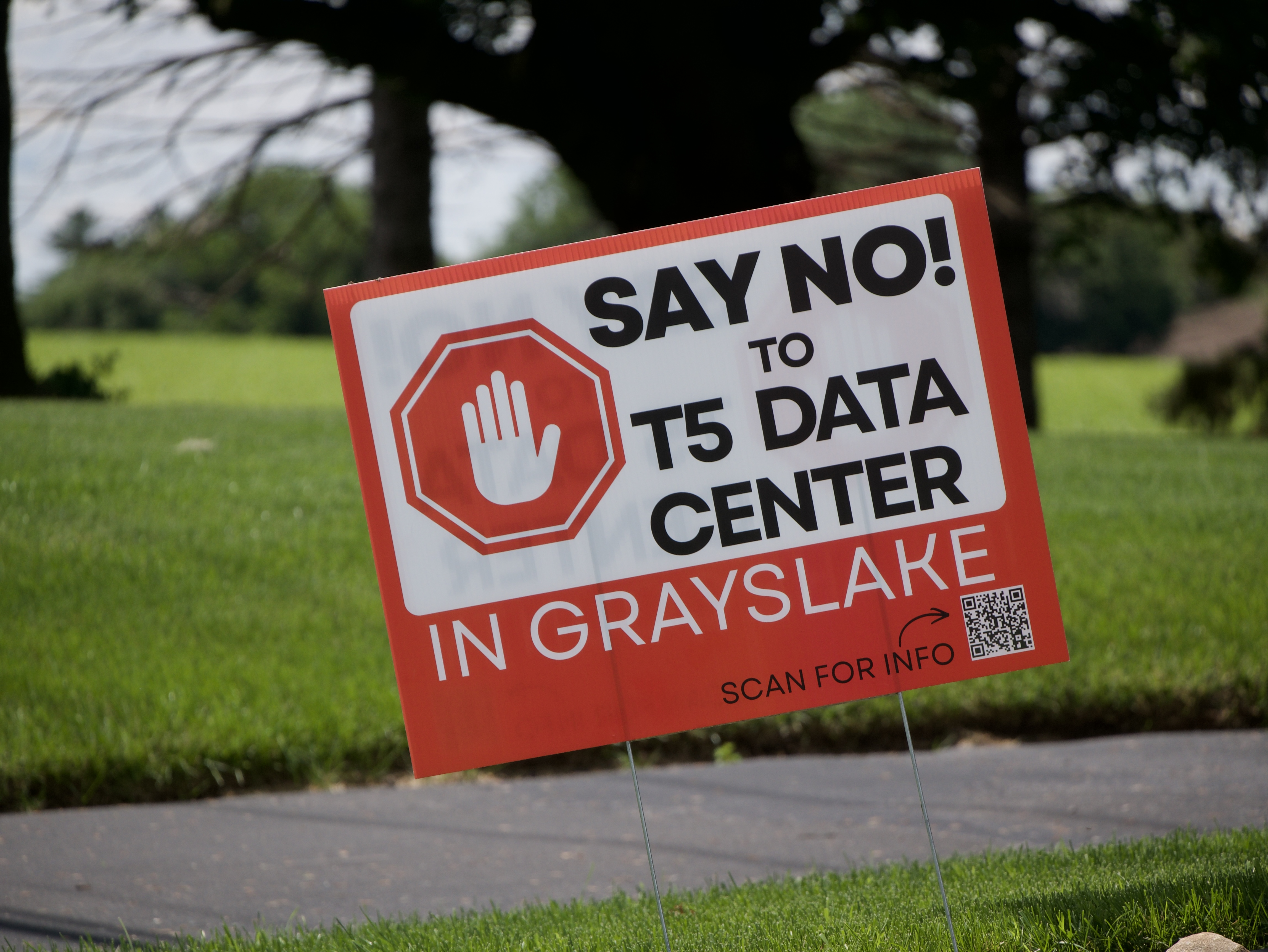
Red signs have begun popping up in yards proclaiming their opposition to the data center, and local government meetings in the area have become filled with residents voicing their anger with the development.
A recent Grayslake Village Board meeting sparked tensions after opponents of the data center felt crowded out by a group of members from the International Union of Operating Engineers Local 150, who gave public comments in favor of the development.
In a statement, a Local 150 representative said the union supports “responsible data center development,” which brings jobs, helps the local economy and expands “critical infrastructure.”
The statement pointed to other Illinois data center projects, like those in DeKalb and Elk Grove, arguing they brought major financial investment, created thousands of construction jobs, and brought in new tax revenue.
If such projects are located elsewhere in the region, Illinois users “still will pay for the electric grid” without the benefits of jobs, tax revenue and local investment, the statement warned.
“We have members who live in Grayslake and Lake County, and they deserve to be heard as residents, taxpayers, workers, and neighbors,” the statement said. “Our members have the right to support projects that create opportunities for skilled local labor, share their insight and address inaccurate claims with facts.”
Grayslake Mayor Elizabeth Davies has previously talked about the benefits the development will bring to the area, including millions of dollars in tax revenue, while having minimal impact on local utilities and services. The property has also been envisioned for such development for many decades, she’s argued.
Smith said he and other area residents were frustrated by the union members “crossing our picket line,” so to speak, arguing that many community members are union supporters. He considered it an attempt to stifle comments against the development during the meeting, which have dominated public comment periods.
Water and electricity
Village and company officials, along with other advocates for the data center, have touted T5’s closed-loop cooling system, which uses drastically less local municipal water than other methods.
Instead of constantly feeding in municipal water to cool the thousands of servers in a data center, the cooling system is filled once with water and coolant and then continuously circulated, T5 CEO Pete Marin said previously.
William Soucie, executive director of the Central Lake County Joint Action Water Agency, said each building will require its own flush and fill. According to a CLCJAWA presentation, a 100-megawatt building would require about 1.6 million gallons of water, with the fill taking place over several days.
Extrapolating those numbers out, the 1.2 GW of capacity being proposed by T5 would require about 19.2 million gallons of water in total. But Soucie did not express concerns about the campus’ water usage, saying the full campus will use less than 50,000 gallons of water per day — a number he said included averaged-out usage from the full build-out, flush and fill, and domestic use.
In comparison, “a fitness center in our service area uses about 25,000 gallons per day,” Soucie said.
But the closed-loop method comes with other concerns, water advocates have warned, requiring higher electricity usage and simply moving water consumption issues to the power plants.
And such a system may still require regular discharges. Answers to questions about how often this may need to occur, where water would be discharged, and what contaminants — if any — it might include remain unknown publicly.
Dave Miller, executive director of the North Shore Water Reclamation District — which handles sanitary sewer for 330,000 customers across the region and whose service area includes the T5 site — said no permits have been issued for the development, and specific information isn’t yet available. It is “still in the back-and-forth stage,” he said.
Miller couldn’t give a timeline for when such permits might be issued, but said the district would have a better idea of the potential impact, if any, from the data center at a later point.
Mary Otto, village planner and development coordinator with Grayslake, said any sewer discharge would be required to comply “with all applicable federal and state regulations, as well as the standards of the North Shore Water Reclamation District.”
Compliance with those requirements would be verified as part of the administrative technical review conducted during the building permit process, she said.