
The Portage Plan Commission voted Monday to create a new technology center zone to restrict where data centers can be located.
It also ensures any future data center is subject to City Council approval.
Currently, data centers could be built anywhere in Portage where warehouses are allowed – in a business park, light manufacturing, heavy manufacturing or, with the approval of the Board of Zoning Appeals, in a marina waterway zone.
The technology center zoning category would also allow other types of technology businesses, Mayor Austin Bonta said.
Any new data center built in the city would have to use a closed-loop system, recirculating water instead of discharging it and drawing more, to cool servers.
Bonta watched what has happened in places like Chesterton, Burns Harbor, Union Township and Valparaiso, where data centers have been proposed. Residents had questions the developers couldn’t answer, such as how tall the buildings would be and other details.
Portage’s proposed ordinance would set a maximum height of 75 feet. In addition, the buildings on the data center campus could not cover more than 70% of the site.
Where a data center borders a residential area, there would have to be a visual barrier, an earthen berm at least eight feet with additional landscaping of at least two more feet in height.
A landscaped buffer zone at least 25 feet wide would include clusters of trees, of which at least 70% must be evergreens. Any deciduous trees would have to be species native to northern Indiana.
A security fence at least eight feet high would have to be installed around the perimeter of the property.
To address concerns frequently brought up in other communities, the noise from any data center would be no more than 65 decibels at the property line, with exceptions for emergencies and when emergency generators are being tested or maintained.
That would be the equivalent of Bonta’s normal voice when not before a microphone, as he was during the Plan Commission meeting, he said.
“I don’t know if the people living next to the data center want to be thought of as having the mayor talk to them all night long,” resident Michael Cooper told the commission.
He offered a litany of complaints about data centers.
To put it in perspective, Hobart’s planned data center campus is 725 acres. In New Carlisle, it’s over 1,200 acres, he said.
“When you’re talking about scale, what we currently have in Portage is very small,” Cooper said.
The one at Ameriplex on the city’s north side is just over 10 acres, Planning and Community Development Director Tom Cherry said.
“I don’t want any more data centers in our region, especially in our community,” Cooper said. He doesn’t want to see Portage extending much further to the south or southeast, toward Wheeler or South Haven, to accommodate data centers.
“I don’t want this to be a blank slate for the AI data centers to walk in and destroy Portage,” he said.
When data center developers have looked at Portage since Bonta took office in 2024, he said, they have made it clear that they want dry, flat land – not in a floodplain – that is near high-tension power lines. They also want the available acreage they need. That pushes them to the south.
Complicating their plans is a pipeline that would have to be dealt with in that area, Bonta added.
Resident Kurt Knutsen said the 500-foot setback to separate data centers from residential areas doesn’t seem enough.
But that’s more than five times the existing setback rules in the city’s zoning ordinances.
“We do not have in our code 500-foot setbacks. We do not have 200-foot setbacks,” Plan Commission attorney Scott McClure said.
He favors the proposed ordinance. “This Plan Commission is very used to having a set of rules. We call it the cookbook,” he explained. The proposed ordinance gives the city a set of tools to use to regulate where data centers can be built and what limits to put on them.
“Now I have some height, some distance on setbacks, and I have some idea on the water system,” he said.
The ordinance also adds definitions that didn’t exist before, calling a data center “a facility primarily designed and used to house computer systems, servers and associated equipment that store, process or transmit digital data, including supporting electrical, mechanical, cooling and backup power infrastructure, but excluding ordinary office uses.”
A hyperscale data center is defined as using more than 50 megawatts of power or with more than 500,000 square feet or more of aggregate floor area across all buildings in the campus.
A hyperscale data center must be part of a planned development – a zoning category customized just for that development – after first being rezoned as a technology center.
That gives the city more bargaining power in setting conditions for the data center and requires City Council approval as well as public hearings, Bonta said.
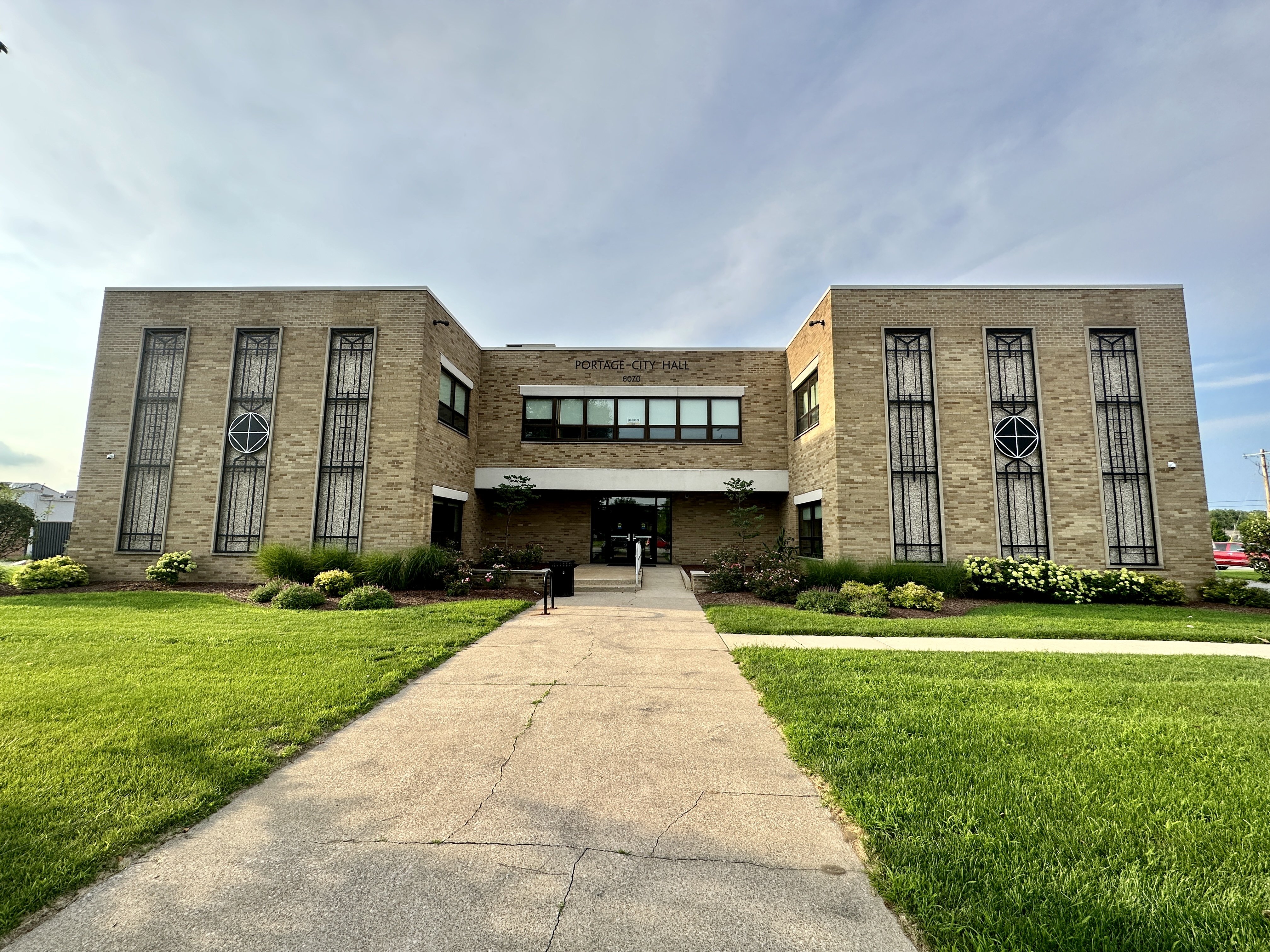
Resident Jessica Szabo went to City Hall to speak at the meeting, but the doors were locked. She knocked to get attention so Cherry could let her in.
“There should be no loopholes. There should be no possibility for it,” she said. “Everything has to be more strict.”
“Please triple-, quadruple-check. You have to protect our children. You have to protect the environment. There’s so many animals being displaced,” Szabo said.
Plan Commission member Bill Moran, an information technology expert, said even as Portage considers the data center zoning proposal, ground was broken in Chicago for a quantum computing campus that could result in a drastic miniaturization and revolution in computing.
Doug Ross is a freelance reporter for the Post-Tribune.