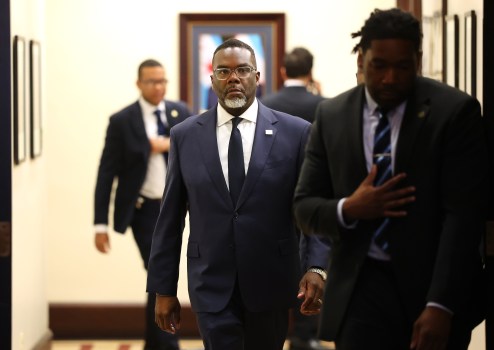
Mayor Brandon Johnson allowed the City Council’s 2026 budget to become law without his signature and he then spent the early months of the year trashing that plan. So it was beyond predictable that this summer we would find ourselves hearing the mayor warn of a shortfall in Chicago’s current budget.
Sure enough, Team Johnson unveiled a midyear update earlier this week and used the opportunity to lambaste the council majority and scare the public into believing the city faces a current-year budget gap of $130 million or thereabouts. Headlines fell in line with the terrible news: “Chicago is $130M short,” “Chicago midyear budget claims $131.7m shortfall.”
But the actual budget document laid out a revenue picture far less frightening.
Revenues through the month of May came in $32 million short of what was budgeted, not $132 million.
Why? Some line items are substantially exceeding expectations even as the administration has failed to execute in a timely way $132 million worth of the measures that the council approved but Johnson opposed, such as selling a portion of the billions in unpaid fines, fees and other debts owed to the city to outside firms for collection. The council figured the city could reap nearly $90 million from such a sale, but so far it hasn’t happened.
Whose fault is that? It depends who you ask.
Johnson blamed the majority of council members who passed the budget over his objections late last year. Leaders of the majority aldermanic bloc that forged the budget and continue to oppose other of Johnson’s initiatives accused the administration of slow-walking the debt sale as well as other more modest of their revenue raisers that he didn’t like.
The mayor consistently has castigated the debt sale proposal as immoral (it’s not) so it’s hardly surprising his administration hasn’t made a high priority of getting it completed despite the substantial dollars attached. That’s the sort of executive resistance or opposition to a separate but co-equal branch to which Johnson and his supporters rightly object when the Trump administration attempts to withhold appropriated funds from jurisdictions the president doesn’t favor, such as Illinois and Chicago.
In either case, the executive branch is tasked with administering and enforcing laws, whether the mayor or president likes them or not. That’s how our governments must function in a democracy. When they don’t, we get the relitigating of past debates and general chaos.
Johnson continued this week to push for his foolish and counterproductive desire to impose a $33-per-month tax on each Chicago job generated by the city’s largest private-sector employers. The head tax was at the heart of the budget battle last year and led to Johnson’s extraordinary decision to allow the budget to become law without his signature.
It is more than clear at this stage that the head tax is anathema to the council majority. Rightly so, since it would send a horrendous signal to the private sector that Chicago is so hostile to business that it would punish employers for putting people to work. Johnson, of course, is free to run for reelection on the issue next year if he chooses to seek another term. But that tax isn’t happening this year. Obviously.
We’ll mention at this point that one of the largest upside surprises so far this year has been the revenue generated by Chicago’s eye-watering tax on cloud computing licenses, the vast bulk of which is paid by the corporations Johnson frequently accuses of having “no skin in the game” in terms of financing city government. The city projected $362 million from that tax as of the end of May; it took in $402 million.
One other interesting factoid that demonstrates how taxes have unanticipated consequences: The budget hiked the checkout bag fee to 15 cents from 10 cents. And more irritated consumers clearly have started bringing their own bags. The city collected just $10.3 million through May, 10% below the projected $11.5 million.
You don’t think businesses would react negatively to a head tax? When a fee or a tax is egregious enough, people and businesses respond.
The midyear budget report should not be occasion for fighting last year’s wars. It should be a clear-eyed status report on the city’s finances — and no more.
And if the mayor is going to warn of deep budget shortfalls that presumably must be filled, he and his team should be providing concrete estimates and calling specifically for action instead of continuing to fight yesterday’s ideological battles. We have no idea based on what was said and presented this week whether such action will be necessary.
But if the hole is deep enough, the mayor shouldn’t waste time. He should be calling in the unions representing city workers and negotiating belt-tightening steps that would mitigate otherwise-necessary position reductions and layoffs. That’s what other mayors do in such circumstances, including recently in liberal cities such as Denver, Los Angeles and San Francisco.
And if this tunnel-vision mayor is unwilling to do that unpleasant work, the council majority must step into the breach as it did with last year’s budget and do what should be the mayor’s job.
Submit a letter, of no more than 400 words, to the editor here or email letters@chicagotribune.com.