
On the heels of the United States’ 250th anniversary, the national tour of Shaina Taub’s Tony Award-winning musical “Suffs” arrives in Chicago with a potent reminder that women have had the right to vote for less than half of the nation’s history — and that fuller enfranchisement for Black women and men came even later. With an inspiring story and a catchy score performed by a superb touring cast, “Suffs” recounts a consequential chapter of the women’s suffrage movement in the decade leading up to the 1920 adoption of the 19th Amendment to the U.S. Constitution.
Taub’s book, music and lyrics largely center on leading activist Alice Paul (played by Maya Keleher on tour) while encompassing a sprawling cast of suffragists from various backgrounds in a movement that often was roiled by ideological and tactical disagreements. This underdog tale — a popular trope in musical theater — offers many moving moments, though several feel cloying. Taub avoids a triumphalist conclusion in her generally optimistic show by acknowledging the work that must continue, generation after generation, in order to bend the arc of the moral universe toward justice. In the final anthem, “Keep Marching,” she leaves us with the exhortation, “Progress is possible, not guaranteed.”
An illuminating education for those who didn’t learn this history in school (which is probably most of the audience), “Suffs” covers key events such as the 1913 Woman Suffrage Procession that Paul organized in Washington, D.C., the day before Woodrow Wilson’s presidential inauguration. Wilson, played by understudy Merrill Peiffer on opening night, recurs as a comedic yet antagonizing force throughout the show, making a years-long series of excuses for not promoting women’s suffrage. The plot continues with the suffragists’ silent picketing outside the White House in 1917, their imprisonment and subsequent hunger strike, and the eventual campaign to ratify the 19th Amendment in the required 36 states after it passed through the U.S. Congress.
The show also addresses the rift between Paul and an older suffragist leader, Carrie Chapman Catt (Marya Grandy), who opens the show with “Let Mother Vote,” a droll number that illustrates her generation’s tactics of “strategic sweetness.” Two Black suffragists, Chicago’s own Ida B. Wells (Danyel Fulton) and Mary Church Terrell (Trisha Jeffrey), anchor a plotline about the racial dynamics within the movement, which often sidelined Black women in favor of appeasing white Southern supporters. There’s also a nod to economic divides in the characters of Ruza Wenclawska (Joyce Meimei Zheng), a Polish union organizer and socialist, and Alva Belmont (Laura Stracko), a Manhattan philanthropist and socialite.
The book certainly covers a lot of ground, and some threads inevitably seem underdeveloped, but the show moves along quite smoothly under Leigh Silverman’s direction. It helps that Taub writes such toe-tapping melodies and entertaining lyrics. In the number “G.A.B.,” Wenclawska initiates a hilarious reclaiming of a sexist expletive along with fellow suffragists Inez Milholland (the riveting Monica Tulia Ramirez), Lucy Burns (Gwynne Wood), Doris Stevens (Livvy Marcus) and Paul. Later, Stevens delivers a comedic duet, “If We Were Married,” in which she schools the president’s well-meaning chief of staff Dudley Malone (Brandi Porter) in the myriad rights denied to married women. Vocally, this all-female cast also shines in more serious numbers that allow their harmonies to soar.
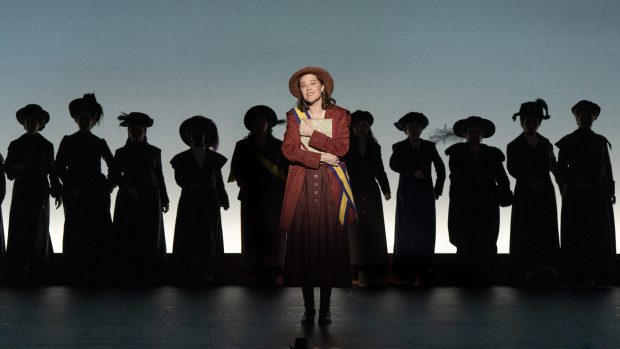
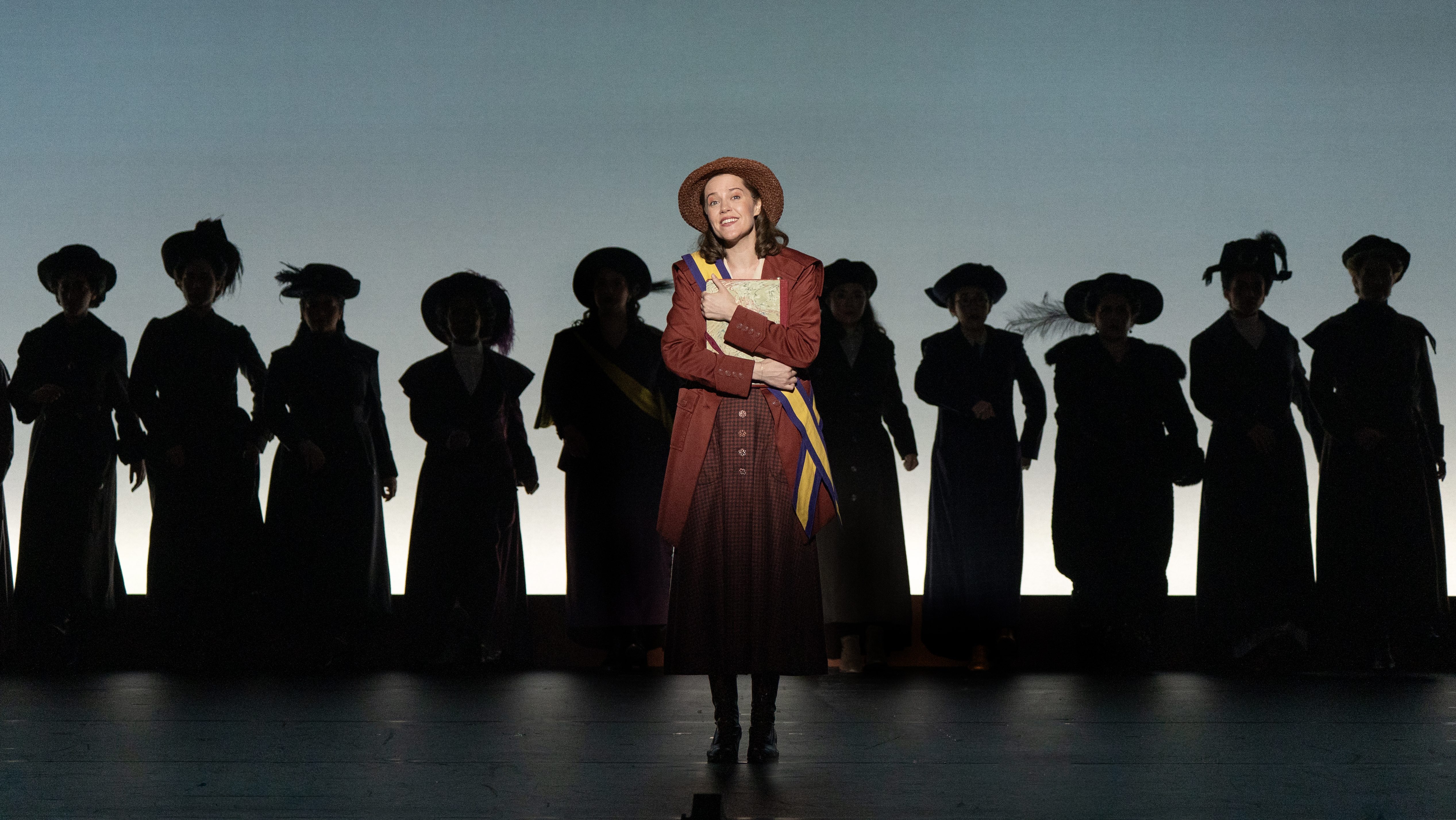
The current tour boasts beautiful design work, based on the original 2024 Broadway production. Christine Peters’ minimalist set, comprising sliding wood panels, allows space for striking silhouettes created by Silverman, choreographer Mayte Natalio and lighting designer Lap Chi Chu. In a scene where the suffragists burn an effigy of President Wilson, Natalio amplifies the turbulent tone with intense movement from the ensemble. Costumes by Paul Tazewell (whose designs for “Hamilton” and the “Wicked” movies are on temporary display at the Griffin Museum of Science and Industry) serve to differentiate and unify the suffragists when they respectively appear in street clothes or in matching white dress suits and striped sashes.


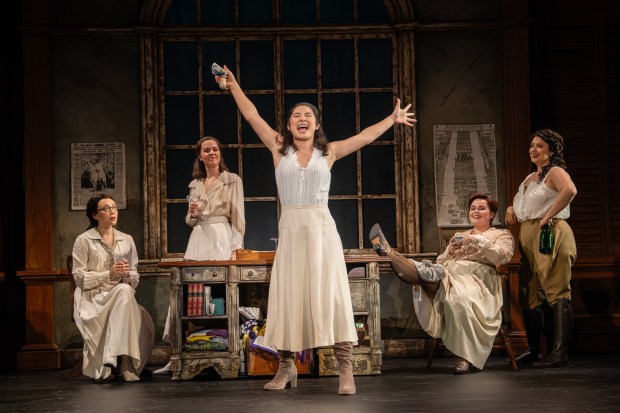

Paradoxically, although “Suffs” brought me to tears several times, I also found myself interrogating those emotions. In the year 2026, does a show like this merely serve as political copium (in the Urban Dictionary sense: a metaphorical opiate inhaled when faced with loss, failure or defeat)? Certainly, its values tend to preach to the liberal choir, but it also offers an important look at a moment in history when a heterogeneous group organized to achieve a seemingly impossible victory. As the show makes clear, the 19th Amendment didn’t solve all of the country’s injustices, but learning how it came to pass can point the way forward for present and future generations.
All philosophizing aside, though, the simple fact is that “Suffs” is particularly powerful to watch as someone whose right to vote was won by these remarkable women.
Emily McClanathan is a freelance critic.
Review: “Suffs” (3.5 stars)
When: Through July 19
Where: CIBC Theatre, 18 W. Monroe St.
Running time: 2 hours, 30 minutes
Tickets: $37-$147 at broadwayinchicago.com