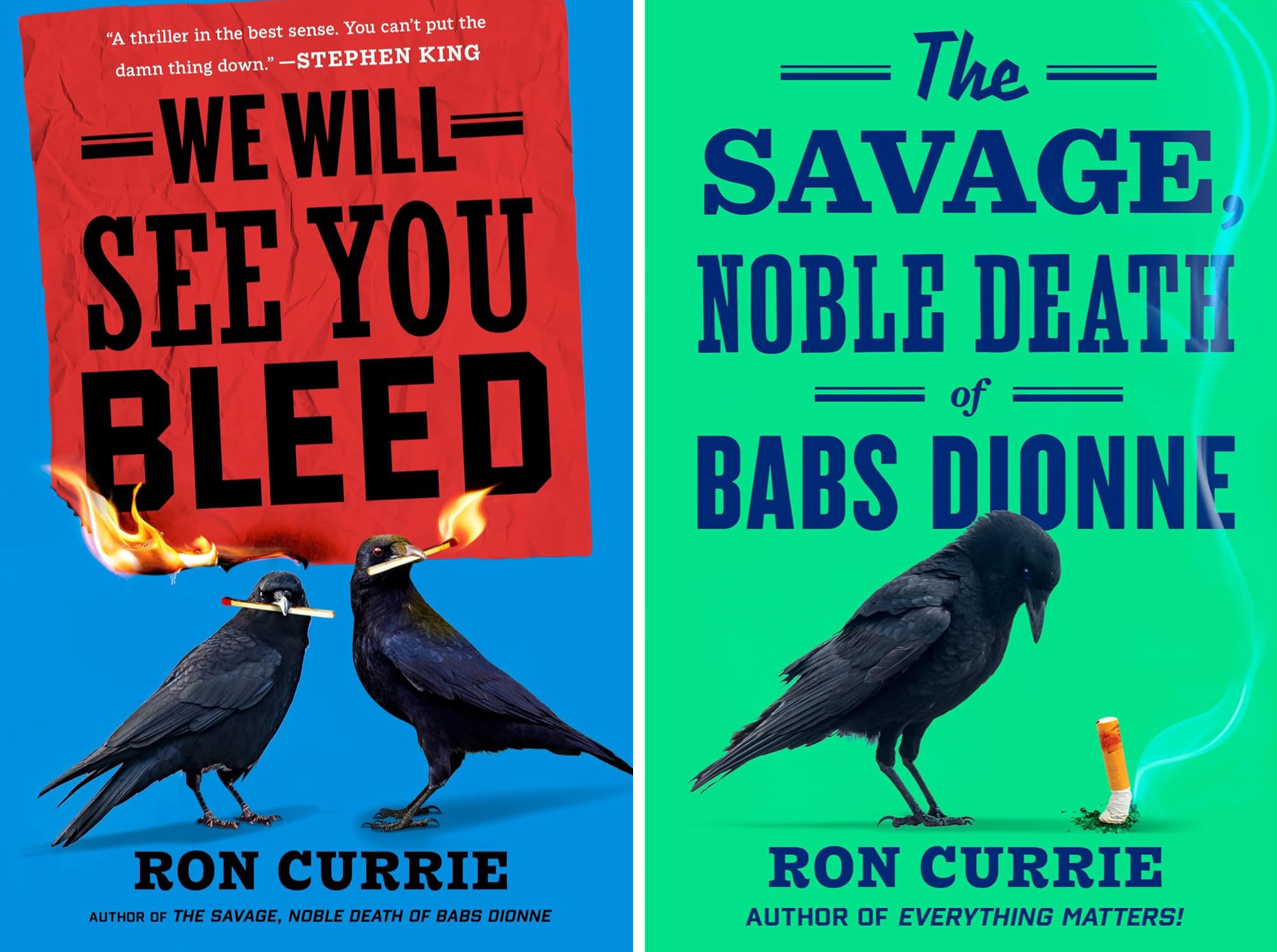

How does one write a sequel to a novel where you not only killed the protagonist in the first book, but declared her death as inevitable in the title itself?
This is the challenge Ron Currie Jr. set himself in deciding to write a follow-up to 2025’s “The Savage, Noble Death of Babs Dionne,” in which Babs Dionne, a crime family matriarch overseeing the “little Canada” francophone community of Waterville, Maine, does indeed die in savage and noble ways.
I was a fan of the novel’s mix of noir, suspense and close character work, but I was uncertain about how Currie could pull off a satisfying story about someone whose origin story, and ultimate fate, has already been told.
In “We Will See You Bleed,” Currie not only pulls off this feat, but he shows that there are perhaps many more stories to be told in the Babs Dionne universe.
He does this by setting the story as a prequel to “Savage, Noble” with Babs not yet a matriarch, but a 29-year-old labor leader for the workers at the paper mill, the centerpiece of the town’s economy. After years of being squeezed by management, the workers have been on strike for many months and people are starting to break. Replacement scab workers have kept the mill operating and it becomes clear that there is no intention to ever return the locals who have worked in the mill for generations back to the line.
Babs has sworn off violence following a killing done in (mostly) self-defense as a teenager, the central origin story of “Savage, Noble.” Babs fears what she is capable of once the governor is off, but the situation becomes so dire that everyone in the town agrees that something must be done, and Babs is the one to lead them.
The plan is to first seize the drug trade from the outsiders who control it as a source of both power and money, and then seize the mill in a way that makes it necessary for the owners to recognize that the alternative — Babs Dionne as your enemy — is unacceptable.
The story unfolds as a kind of thriller/procedural as Babs, and her very capable husband Rheal, unleash violence as a precision instrument of power and persuasion. Rheal brings in the Saucier brothers, childhood friends and compatriots from their time in Vietnam, to do some of the messier tasks, like kidnapping some of the replacement workers and subjecting them to a couple of days of psychological terror before releasing them as an example of what could happen to others.
We also spend time with Clement, the local parish priest who saved the teenage Babs, but finds himself deposed for supporting the strikers, and winds up entangled in the early days of revelations about systemic sexual abuse in the Catholic Church.
There is a thrill to seeing these characters we root for execute their plan to retake what we know belongs to them, but as with the first book, Currie refuses to let his characters off the hook when it comes to the consequences for enacting this violence on others.
Babs fears unleashing herself because she knows that these prices must always be paid, no matter how ruthless one believes themselves to be. Because this is a prequel, we know that big picture, Babs is going to triumph, but Currie puts her and Rheal and the reader through the wringer.
The novel builds momentum like a thriller as we head toward the climax, but in the end, what we’re left with is the sense that these stories are only beginning, and truth be told, you could read these books in any order.
Book recommendations from the Biblioracle
John Warner tells you what to read based on the last five books you’ve read.
1. “Theo of Golden” by Allen Levi
2. “Becoming Madam Secretary” by Stephanie Dray
3. “Water from My Heart” by Charles Martin
4. “My Friends” by Fredrik Backman
5. “A Gentleman in Moscow” by Amor Towles
— Irene S., Wayzata, Minnesota
Meg Wolitzer’s “The Interestings” is a fascinating exploration of a group of friends over time and a good fit for Irene.
1. “Romantic Outlaws: The Extraordinary Lives of Mary Wollstonecraft and Mary Shelley” by Charlotte Gordon
2. “The Limpopo Academy of Private Detection” by Alexander McCall Smith
3. “His Eye is on the Sparrow: An Autobiography” by Ethel Waters
4. “Up from Slavery” by Booker T. Washington
5. “Dracula” by Bram Stoker
— Erica H., Winthrop Harbor
“Washington Black” by Esi Edugyan is the right book for Erica, and hopefully she can find an edition that’s not the dreadful TV show tie-in version.
1. “James” by Percival Everett
2. “The Nightingale” by Kristin Hannah
3. “Whistler” by Ann Patchett
4. “Theo of Golden” by Allen Levi
5. “Remarkably Bright Creatures” by Shelby Van Pelt
— Diane N., Darien
I’m going to reach back to a very early Richard Russo book that I think will be a winner for Diane, “The Risk Pool.”
Get a reading from the Biblioracle
Send a list of the last five books you’ve read and your hometown to biblioracle@gmail.com.
John Warner is the author of books including “More Than Words: How to Think About Writing in the Age of AI.” You can find him at biblioracle.com.