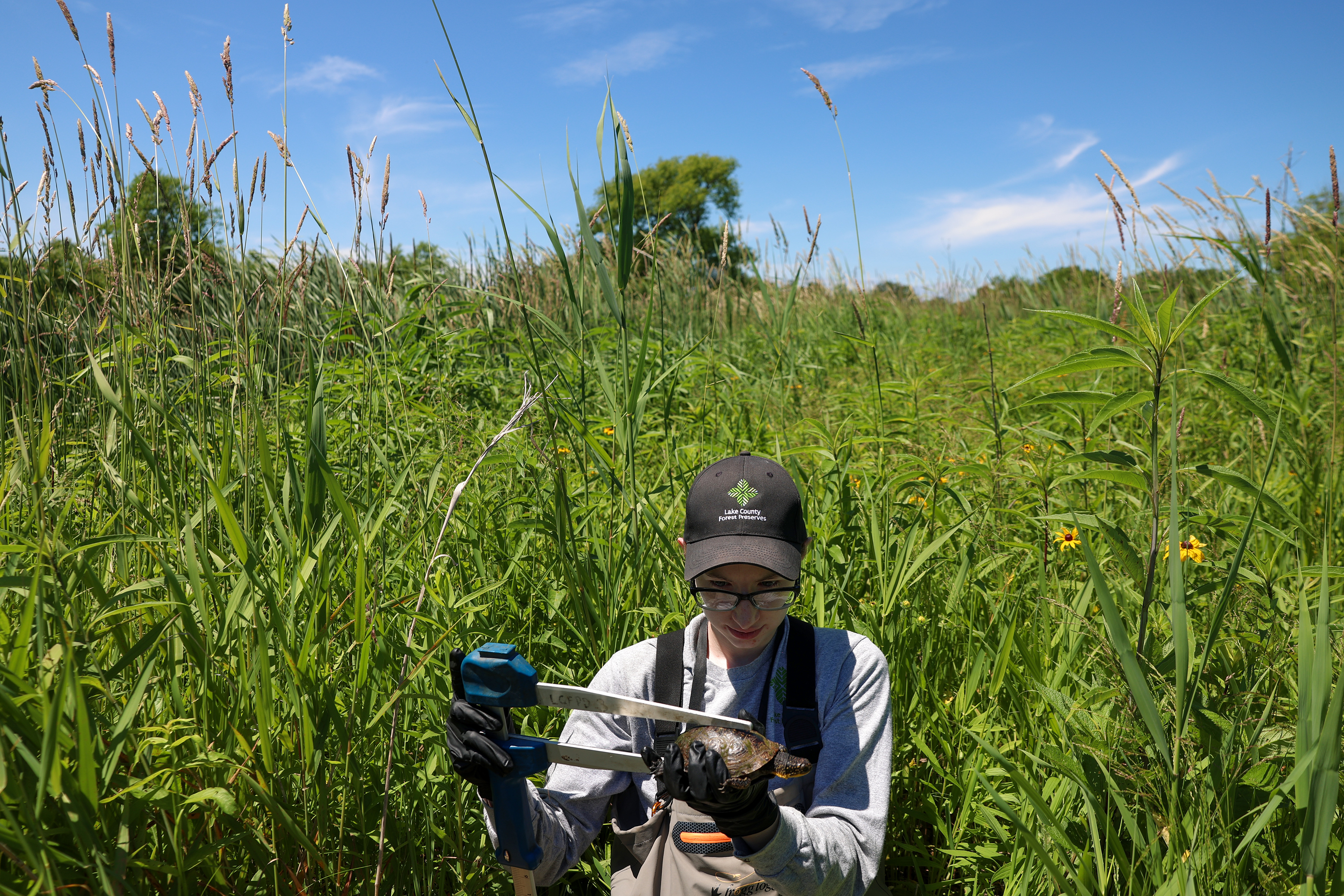
Over the squelching and sloshing of waders and the eggy smell of shallow wetland waters, Matt Allender bent down and caught something in his hand. He raised it triumphantly.
“Found a turtle!”
It’s a snapping one, and it does just that; it snaps at him, unhappy about being grabbed.
It was in 2015 — when all the equipment he had fit in a tackle box and the only help he had was a part-time vet student — that Allender, now the director of conservation biology at Brookfield Zoo, began heading out to Lake County every year to tend to turtles in the wild. They would do some blood work and test for a few diseases.
In the years since, as science has uncovered more threats, viruses and bacteria affecting turtles, these field visits have become longer and more complex.
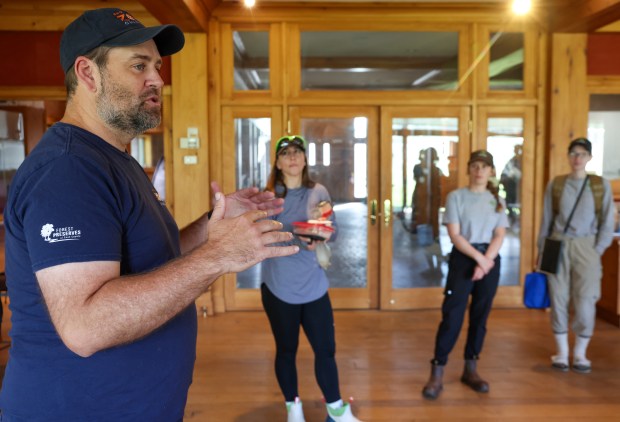
This June, Allender was joined by more than 20 people, mostly veterinarians, in a yearly “Blanding’s Bowl” — a friendly competition that splits scientists from multiple institutions, including the Cook and Lake County forest preserves, into several teams to tend to native species such as the painted turtle, the common snapping turtle and the event namesake, the state-endangered Blanding’s turtle, of which fewer than 500 are left in Illinois.
“So now it’s quite the operation,” Allender said. “We’re doing something special, and people want to be a part of that.”
The groups found a total of 50 different Blanding’s turtles over four days.
“For an endangered turtle, that’s pretty remarkable,” said Gary Glowacki, manager of conservation ecology at the Lake County Forest Preserves District.
The scientists strategically set more than 100 traps across wetland and prairie habitats in the county, and inside placed sardines, cat food or store-bought salmon to lure the turtles. (One biologist believes the tinned fish make the best bait when coated in sriracha.) They then returned to the site every morning for three days to check up on their patients and release them.
And the fanfare was visible among the scientists, some of whom wore turtle earrings and custom-made T-shirts. But the primary focus of the bowl is to offer healthcare to turtles in the wild, Allender said. “We’re their doctors. Nobody else is doing this.”
“The fact that we’re able to, in three and a half days, assess the health of one of the state’s most endangered turtles is pretty amazing,” he said in a follow-up call with the Tribune. “We won’t have a lot of those test results for several months, but the effort in order to get (them) is really unparalleled anywhere else in the country.”
Glowacki said the same.
“There’s not many people that are experts in the health and wellness of wild turtles, and they’re right in our backyard,” he said.
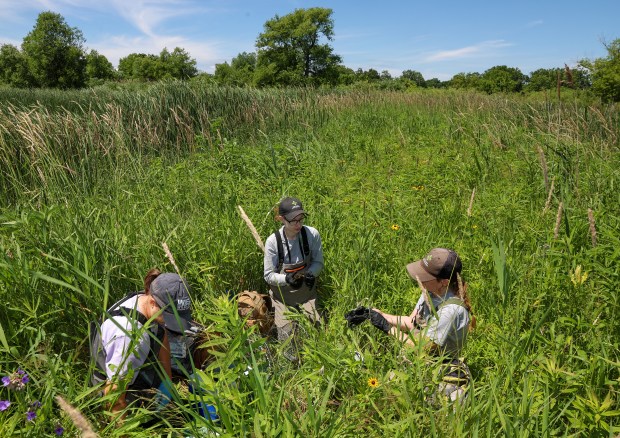
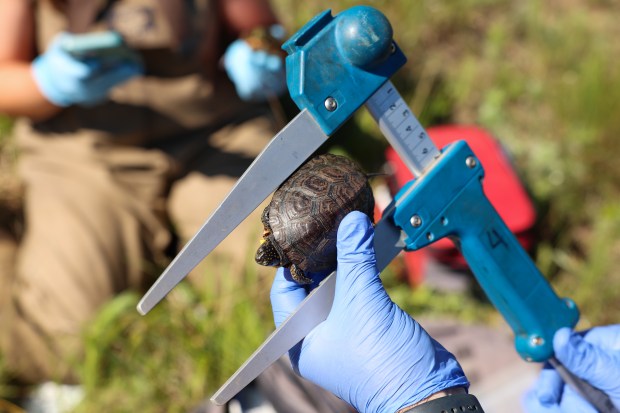
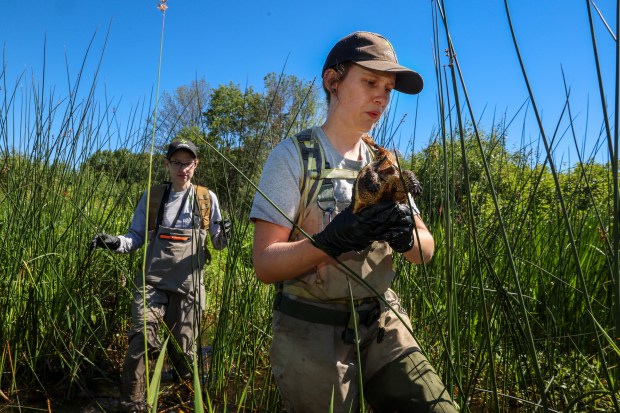
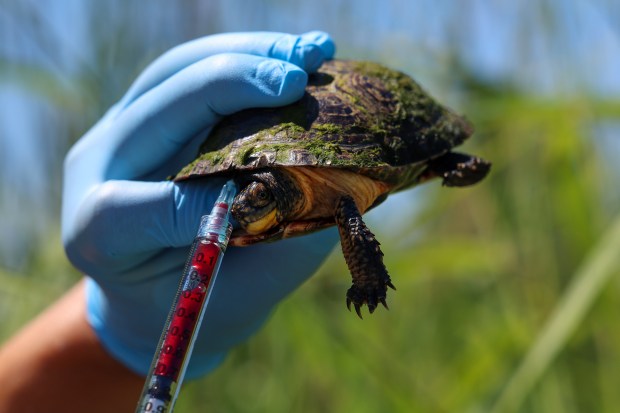
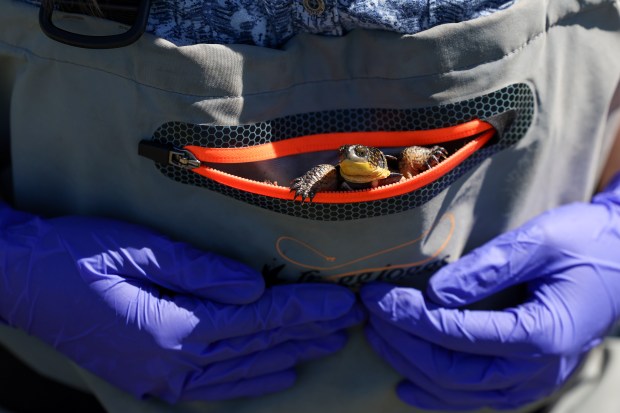
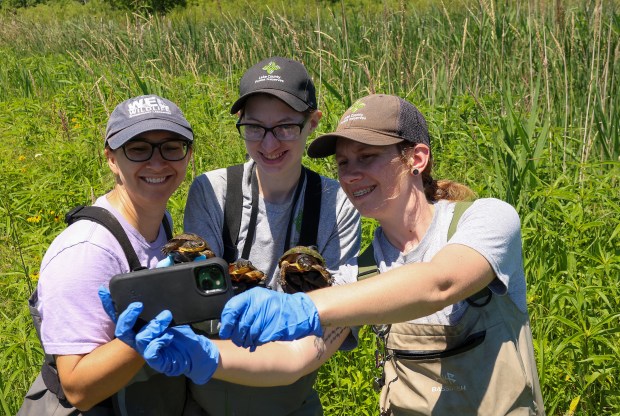
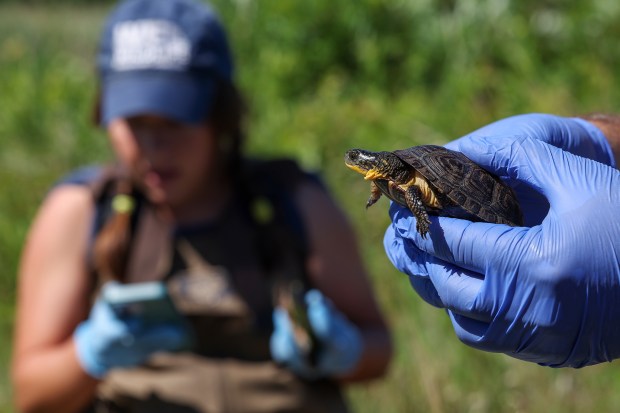
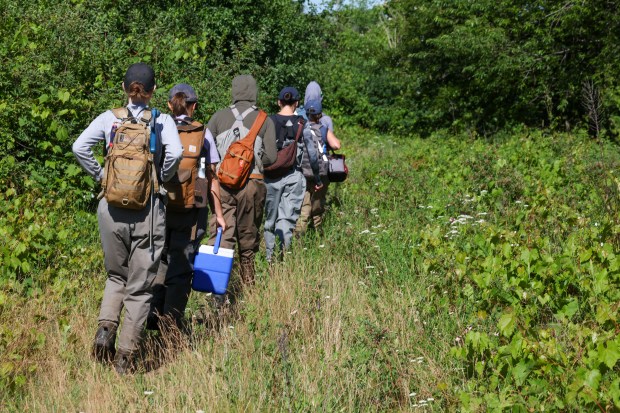
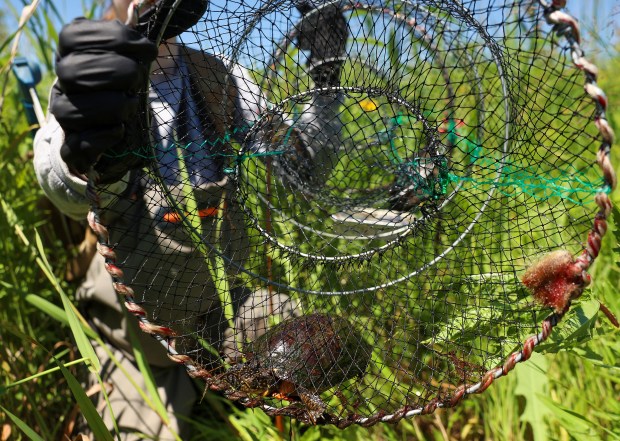
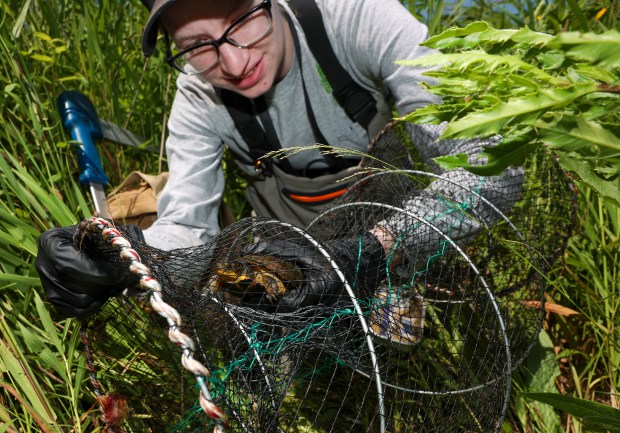
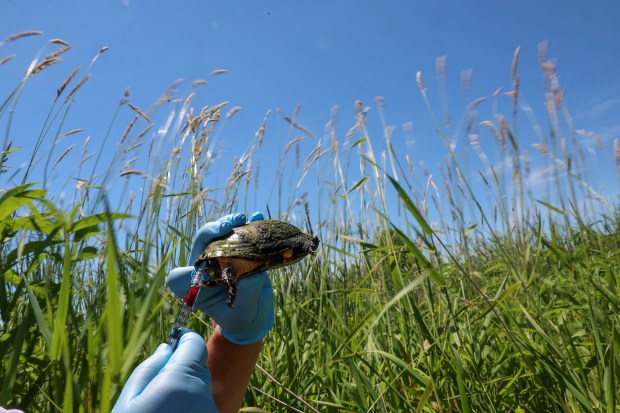
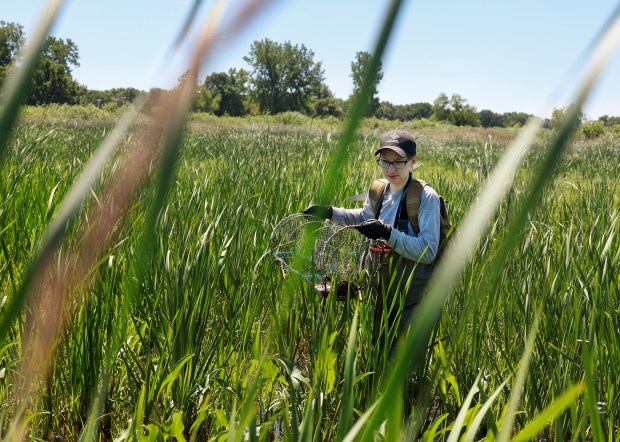
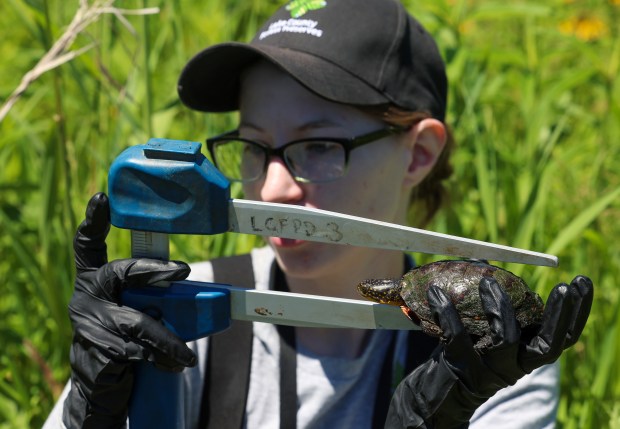
After the scientists found stable footing on a sand pit, a painted turtle and a snapping turtle, recovered from traps, became their first patients of the day. Getting word from a nearby team, they then prepared for the arrival of a Blanding’s turtle — the real star of the week.
Illinois at the forefront of research and treatment for turtles infected with rare fungus
First, the turtle was set on its back to be weighed. At 117 grams, it was lighter than a cup of all-purpose flour. Promptly dubbed Shrek by the scientists who found it, it was then handed off to Allender, who gently poked its beak with a Q-tip to start taking swab samples. The reptile opened up.
“Thank you,” he said. “What a good turtle.”

Eliza Baker, a resident veterinarian at a collaborative wildlife health management program between the University of Illinois, Brookfield Zoo and the Forest Preserves of Cook County, ran Allender through a checklist as he inspected the turtle more closely.
“Mouth?” Baker said.
“Pink and moist,” he replied. No plaques or lesions.
“Nostrils?”
“Symmetrical.” No upper respiratory infection.
Both are signs of a healthy specimen.
A few moments earlier, Baker had tended to the painted turtle, weighing and measuring it, swabbing and drawing blood.
“You can see something was trying to chew on him in the past,” she said. “They’re just such hardy animals. I mean, this is true of all our wildlife, but the things that they are able to live through, you can see the evidence of predation attempts and, like, old injuries.”

She pointed at some dents on his shell and underside, possibly teeth and claw marks from a predator. Regardless, he looked like a “pretty happy, healthy little turtle.”
Lake County, a “crown jewel” for Blanding’s turtles in Illinois, is home to an assurance population, Allender explains — the state’s largest and likeliest to survive over the next 50 to 100 years. And it’s a busy year at the site, with the Super El Niño extending the water’s reach and allowing the different turtle species to spread out.
Turtles are among the most endangered vertebrates on the planet; almost half of all 357 species are considered threatened. Compare that to 11,000 snake and lizard species. “It’s not a very big group,” Allender said.
Other threats to native turtles in Illinois include the loss and fragmentation of habitats like wetlands — of which Illinois has lost as much as 90% to development — as well as changes in habitat hydrology from dams and agricultural tile drainage and poaching for the exotic pet trade.
“That makes these populations, where Blanding’s have persisted, critically important,” Allender said. But it also means concentrations of individuals are vulnerable to localized catastrophic events such as floods, fires, disease and injury.

Glowacki said when he started studying wild Blanding’s turtles more than a decade ago, this population was identified as the “biggest and best” of its kind in Lake County.
Back then, however, the turtles had a 95% chance of becoming extirpated within 50 years. First, there weren’t enough young turtles to replace adults as raccoons preyed on eggs; most nests were being raided within the first 24 hours. And adults were not surviving at a high enough rate.
At the site, Allender pointed out cracked eggshells around shallow holes in the sand. “They’re all over,” he noted.
“About one in 100 to 200 eggs laid will make it to adulthood,” Allender later said. “If a Blanding’s turtle lays 20 eggs in a year, it might take her five years to produce one offspring that would make it to adulthood, to supplant the population.”
And so the Lake County Forest Preserves set out to improve survivorship for both older turtles and their offspring.
“And that’s kind of where (Allender) and his team have really come in,” Glowacki said. “That health component: What can we do to make sure these adults are surviving …? Is it a health issue, or is it simply things like road mortality is too high?”

That population was stabilized and is even on a growth trajectory now, he added.
“Our initial goal was to have a viable, self-sustaining population,” Glowacki said. “So we’ve been able to get to that viable population, but now we want to get to that self-sustaining, where we’re a little bit (more) … hands-off.”
For a while, efforts to head start populations — that is, raising young, vulnerable turtles in captivity and then releasing them into the wild when they’re better suited to survive — in other Lake County sites were paused when Emydomyces testavorans, a rare fungal disease, was discovered in three Blanding’s turtles on private property in the county.
“We’re starting to see the light at the end of the tunnel for Emydomyces, where our treatments are effective,” Glowacki said, setting the county up to resume releasing young turtles next year to continue establishing new, self-sustaining populations.
The success rate of the treatment, developed by the University of Illinois Wildlife Epidemiology Lab and Brookfield Zoo, is between 30% to 40%, Allender said, “which for a fungus in a slow-growing animal … is better than I thought.”
Running into the group of scientists, a Lake County resident enjoying the pleasant, sunny June afternoon asked Allender what would happen after numbers and data from tests are crunched.
“Save turtles. Save the world,” he said.
“That’s a heavy lift,” the man replied.
“No kidding,” Allender chuckled.
The longer answer: “I’m really attached to local wildlife,” he told the Tribune. And, for his children and younger generations, he said, “I want to find a way (the turtles) can live in an urban and suburban environment without the need for constant protection.”
Glowacki highlighted Blanding’s turtles as a unique part of the area’s natural heritage and history.
“I can’t think of another animal that’s more symbolic of the habitat we find in Lake County, the Chicago region, these coastal landscapes and … marsh habitats, prairies and savannas,” he said. “And you quickly learn that, by protecting and conserving Blanding’s turtles, you’re really protecting a whole suite of other species.”