
Here’s a look back at what happened in the Chicago area on July 14, according to the Tribune’s archives.
Is an important event missing from this date? Email us.
Flashback: July 14, 1931

1931: An unnamed man walking in the 1100 block of South Ashland Avenue said he saw an image of a woman holding a baby in her arms projected onto the side of a nearby three-story building. He pointed out the likeness to other people, including a woman who declared, “A miracle has come. It is the Blessed Virgin Mary.”
Five hundred people later gathered on the street, some falling to their knees on the street to pray. Twenty police officers were sent to the scene. A firefighter told a Tribune reporter, “It is a reflection. Where it comes from I don’t know. But it is not for the fire department to tamper with.”
At 11:30 p.m. the next night — with thousands of people watching — the image suddenly disappeared. Police realized lace curtains were to blame for the excitement. When a shade was lowered in a second-story apartment, which just happened to be owned by a member of the Genna crime family, then the projection vanished.
Weather records (from the National Weather Service, Chicago)
- High temperature: 100 degrees (1995)
- Low temperature: 52 degrees (1926)
- Precipitation: 1.75 inches (1913)
- Snowfall: None

1885: Entrepreneur Sarah E. Goode was the first Black woman to receive a U.S. patent in Illinois. Born into slavery in 1850, Goode was freed at the end of the Civil War in 1865 and moved to Chicago.
As the owner of a furniture store, she observed that many residents of the rapidly growing metropolis had a modicum of space in their cramped apartments. Goode designed what she called a folding cabinet bed. When folded, the assembly, which included compartments for stationary and writing paraphernalia, could be used as a writing desk.
Vintage Chicago Tribune: Inventions and innovations by Black Chicagoans
1912: Fourteen people died when a Chicago, Burlington & Quincy Railroad mail train slammed into the rear of a passenger train stopped for a signal in Western Springs. The crash was blamed on a brake operator in the first train who failed to place a warning torpedo (a small explosive) on the tracks behind his train to alert the mail train he knew was following by about nine minutes. The accident was one of several that highlighted the need for railroads to install signals at shorter intervals on high-speed (around 40 mph), heavily traveled mainlines.

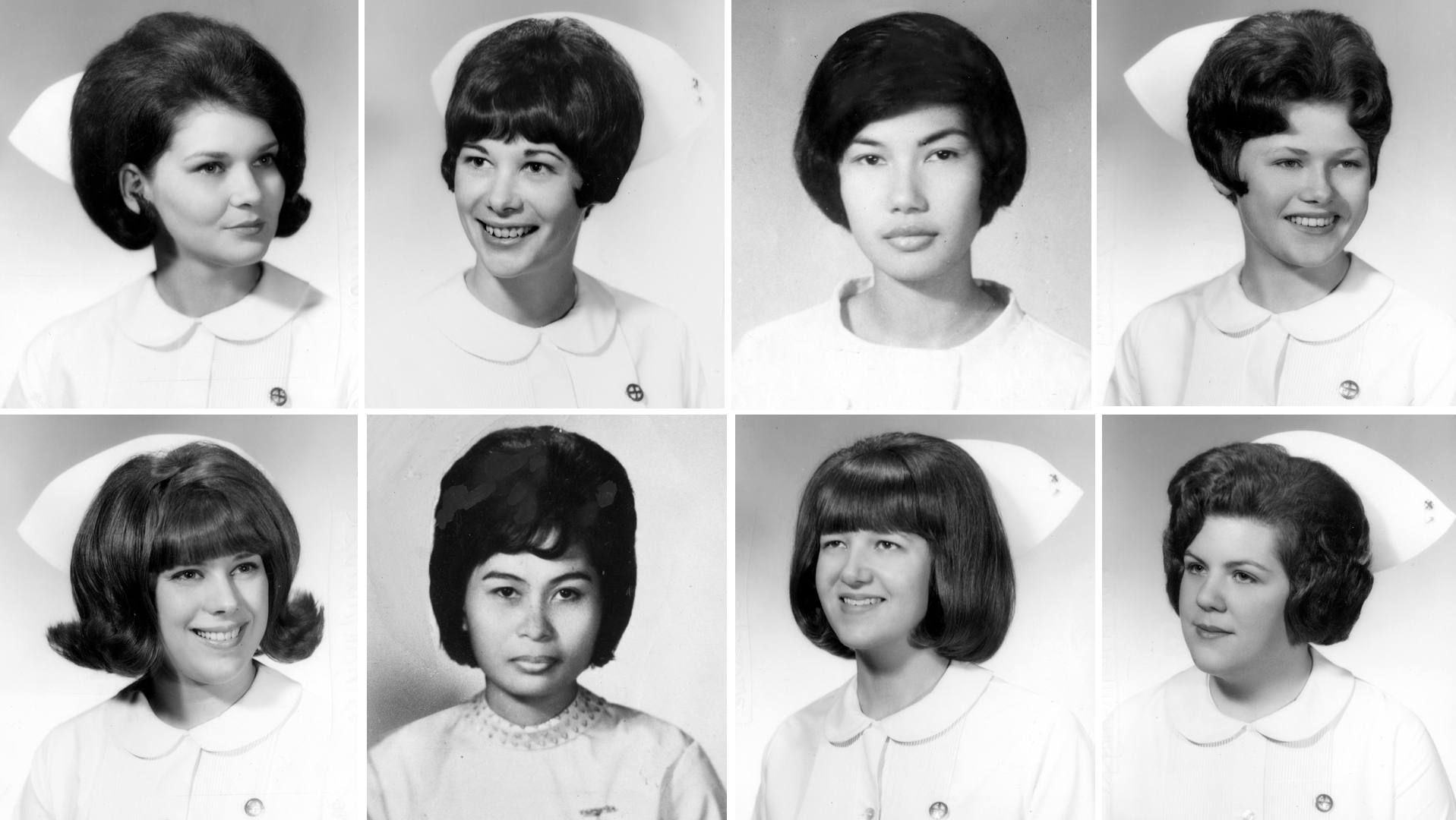
1966: Armed with a gun and a knife, Richard Speck broke into a townhouse in the 2300 block of East 100th Street on the South Side that served as housing for student nurses who worked at South Chicago Community Hospital. They were Nina Jo Schmale, Patricia Ann Matusek, Pamela Lee Wilkening, Mary Ann Jordan, Suzanne Bridget Farris, Valentina Pasion, Merlita Gargullo and Gloria Jean Davy.
Corazon Amurao Atienza managed to crawl under a bed and hide while Speck methodically stabbed and strangled eight of her roommates after telling them he would not hurt them, that he just needed money to get to New Orleans.
Speck was captured two days later when an emergency room doctor at Cook County Hospital thought a patient he was treating for self-inflicted gashes looked familiar. The doctor had just had a dinner break and had seen the front page of a newspaper featuring the killer’s face. As he was sponging blood off the patient’s arm, he saw that the man had a tattoo that said “Born to Raise Hell” that matched the description from the newspaper.

Though originally convicted then sentenced to die in the electric chair for the murders, Speck was resentenced to eight consecutive terms of 50 to 150 years each after the U.S. Supreme Court ruled in 1972 that the death penalty of Illinois and other states was unconstitutional.
Speck died of a heart attack at a Joliet hospital on Dec. 5, 1991 — the day before his 50th birthday.
1992: An employee of Savings of America Bank on the South Side, which was held up on March 5, 1990, was asked in court to identify the robber and picked out a Tribune reporter instead of defendant Jeffrey Erickson.

2024: Sanfurd Burris’ Maverick broke the 22-year-old time record in the Chicago Yacht Club Race to Mackinac, finishing the course of 289 nautical miles up Lake Michigan in 22 hours, 24 minutes and 23 seconds. That was 1 hour, 6 minutes and 11 seconds faster than the old record set by Roy P. Disney’s Pyewacket (named for the cat in the film “Bell, Book and Candle”) in 2002.
Want more vintage Chicago?
Subscribe to the free Vintage Chicago Tribune newsletter, join our Chicagoland history Facebook group, stay current with Today in Chicago History and follow us on Instagram for more from Chicago’s past.
Have an idea for Vintage Chicago Tribune? Share it with Kori Rumore and Marianne Mather at krumore@chicagotribune.com and mmather@chicagotribune.com