

Everyone wants to be mayor, or so it seems, as the list of candidates and potential, I’m-still-thinking-about-it, contenders swells. Election Day for the mayor’s race is Feb. 28, 2023. If no candidate receives a majority of votes, a runoff election will be held on April 4, 2023.
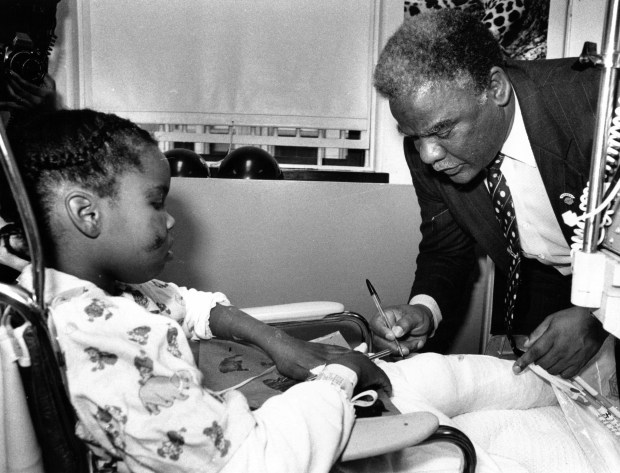
There have been, in the city’s long and politically colorful history, 56 mayors, drawn to the job for various reasons, venal and admirable. Few of them, I would argue, were as fascinating or important as Harold Washington, the city’s 51st mayor and the first Black mayor, who sat on the fifth floor at City Hall from his election on April 29, 1983, until his unexpected death on Nov. 25, 1987.
This complicated and charismatic character comes vividly back to life in a new documentary film, long in the works but well worth the wait. Titled “Punch 9 for Harold Washington,” it has been shown at a few film festivals and premiers here at the Gene Siskel Film Center as part of the Chicago International Film Festival before settling into a longer run on Oct. 7 at AMC theaters here and across the country.

“I am proud of what we have made,” director Joe Winston told me earlier this week. “Yes, it’s taken a long time. It was like what my wife went through giving birth to our two children.”
I’ve been observing Winston’s career for a long time. He was born and raised in Hyde Park, attended Kenwood Academy and grabbed a degree in psychology from Yale University before coming home and hosting and producing a cable access program called “This Week in Joe’s Basement.” I was this paper’s television critic at the time and greatly admired the show, describing it as “iconoclastic, witty and intellectually aggressive” and a “provocative, challenging, inventive and sometimes infuriating delight.”
Since then, Winston worked as a freelance editor for a variety of broadcast, corporate and advertising clients. He made a fascinating documentary about the then-relatively unknown event called “The Burning Man Festival,” a kooky gathering of thousands of people who watched the burning of a four-story “man” made of wood and neon; and “The Strange Little Man Who Lives in My Father’s Lab,” a true story of a man who, pretending to be a physics graduate student, conned his way into being allowed to camp at a desk in the lab of a University of Chicago physics professor who was Joe’s father, Roland Winston.
He then adapted Thomas Frank’s “What’s the Matter with Kansas?” which Roger Ebert named one of the best documentaries of 2009, and produced “Citizen Koch,” a documentary about big money’s political influence, focusing on the billionaire Koch brothers. He has won awards and prizes for his work and was first drawn to Washington by the election of Barack Obama as president.
Winston never met Washington but remembers “filming him when he was making a speech at Rockefeller Chapel and being captivated. It has been marvelous for me to watch old clips and hear recordings of him. He was brilliant and had so much to say.”
And so in 2015, he began in earnest the long road that has become “Punch 9.”
Should you see it? Of course you should.
For those of us alive during Washington’s time, it effectively refreshes our memories. For others, and there is a generation that has come of age with no memories of the man, it will be a revelation, fast-paced and wildly entertaining.
It makes brilliant use of archival footage, much of it coming from that repository of such cinematic treasures known as Media Burn. It gives us a finely paced overview of mayoral politics and its principal players, from Richard J. Daley to Jane Byrne to Richard M. Daley.

It is unconventional in that it spends very little time on Washington’s background or his personal life, though it does speak of rumors of homosexuality and tax troubles (he didn’t file for many years), and gives glancing attention to his relationship with the late Mary Ella Smith, the schoolteacher who was Washington’s companion for more than 20 years, becoming his fiancee the year he was elected mayor.
That focus is understandable since Washington was such a towering figure and there is enough footage of him to prove that point. “I had a very high opinion of the man going in but listening to the words of those who knew him has only increased my admiration,” says Winston.
Still, the film is not idolatrous but evenhanded. As with most documentaries, “Punch 9? is punctuated by talking heads, enough to populate the city council. There are big names, such as the Rev. Jesse Jackson, Obama, Don Rose and, at welcome length, David Axelrod, who covered Washington as a young reporter for the Tribune.
Though fierce Washington rivals, former 10th Ward Ald. Edward Vrdolyak and 14th Ward Ald. Edward Burke, did not participate, Winston was able to snare — “Remarkably easy to do too,” he says — former 33rd Ward Ald. Dick Mell, who memorably stood on his desk during the to do known as “Council Wars” and here proves a thoughtful commentator.
Among the best interviews is one with Alton Miller, the mayor’s former press secretary who spent considerable time with Washington and was alone with him when he died. (Do yourself a favor and find a copy of Miller’s insightful 1985 book, “Harold Washington: The Mayor, the Man.”)
One of the film’s most rough-and-tumble sections involved the wild primary battle against incumbent Byrne and state’s attorney Richard M. Daley. That was followed by the general election against Republican Bernie Epton, which was much closer than most remember, 51.7% to 48%.
There are few more touching moments in the film than watching Epton’s son Jeffrey talking about how the nasty racist invective of that race did not come from his father but from those who supported him. He cries on camera.
This is a film of chaos and conflicts, ugliness and joy.
It takes a lot of people to make a movie and Winston is ever expressing gratitude for his team, calling them “exceptionally talented and devoted to this story.” That group includes Raymond Lambert, who won a Peabody Award as executive producer on the PBS documentary about Maya Angelou.
Winston’s two children, Milo and Beckett, were little when the “Punch 9? journey began, which was when Winston told me “There is a tendency to look back at Harold in one-note terms. He should not be seen merely as some sort of icon, a Black Santa Claus. He was a titanic and progressive figure and he is in danger of being forgotten.”
His kids are older now and Milo, a freshman in high school, had this to say when his father showed him the finished film, “Dad, that’s the least boring documentary I have ever seen.”
One smart kid.