It has been a year since Operation Midway Blitz commenced with the detainment of a man selling flowers in nearby Archer Heights. What began there quickly spread throughout Chicago.
For 64 days, the city and its suburbs came to be under siege. For 64 days, starting with the detainment of the flower vendor on Sept. 7, 2025, and ending in November with Border Patrol agents posing for a mocking class picture in Millennium Park, their leader Gregory Bovino in the middle, the federal government carried out a militarized immigration enforcement operation under the guise of making Chicago safer.
How is it, then, that a year later, people can feel so unsafe?
A changed Chicago forges on after the resistance
People in Little Village used to go to Baltazar Enríquez’s office to get their whistles. He estimates he handed out thousands last year during the immigration raids that roiled Chicago and its surrounding suburbs.
When they walk in now, it’s not whistles they’re after. It’s empathy. Someone to listen. A moment to vent or to grieve in the aftermath of what the administration of President Donald Trump touted as Operation Midway Blitz.
“How do we heal?” Enríquez, the president of the Little Village Community Council, asked recently. “That’s the part we’re learning.”
Elvira Arzeta patrols the western suburbs before dawn on Sept. 10, 2026. For over a year, Arzeta has headed out of her home at 5 a.m. to patrol hot spots frequented by federal agents targeting immigrants. (Stacey Wescott/Chicago Tribune)
Dulce Porras-Goldstein, left, a librarian and Spanish language community liaison, speaks with community members at a resource fair on Aug. 26, 2026, in Bensenville. (Stacey Wescott/Chicago Tribune)
Joaquin Brito, owner of La Florencia Bakery in Chicago’s East Side neighborhood, recalls the day he spotted ICE helicopters overhead during a standoff between residents and federal agents in 2025. (Antonio Perez/Chicago Tribune)
Odilia Ochoa, left, stands on her balcony and waves with her daughter, Katherine Ayala, and two grandchildren, Ennis Ayala, 4, and Gael Saucedo, 3, at the Mulberry apartments on Aug. 17, 2026, in Elgin. Last year, this apartment complex was targeted by federal agents. The two women were part of a community effort to alert neighbors to keep them safe from detainment. (Stacey Wescott/Chicago Tribune)
Maria, who doesn’t want to share her last name or have her identity revealed, picks vegetables in the Community Garden near the Bensenville Community Library on Sept. 10, 2026. (Stacey Wescott/Chicago Tribune)
Elvira Arzeta stops to speak with Victoria Martinez about the benefits of joining a Signal channel alerting residents about federal agents targeting immigrants in her area on Sept. 10, 2026. (Stacey Wescott/Chicago Tribune)
Elvira Arzeta patrols the western suburbs before dawn on Sept. 10, 2026. For over a year, Arzeta has headed out of her home at 5 a.m. to patrol hot spots frequented by federal agents targeting immigrants. (Stacey Wescott/Chicago Tribune)
Alma Santamaria, owner of Pos' Yo restaurant, helps an employee dressed in a chicken costume cross the street during a Belmont Cragin neighborhood festival to promote area businesses on July 15, 2026. (John J. Kim/Chicago Tribune)
Leo Feler stands in front of his home, Aug. 11, 2026, in Chicago’s Lakeview neighborhood where federal immigration agents entered through his fence to detain men installing siding during Operation Midway Blitz. (Brian Cassella/Chicago Tribune)
Joaquin Brito prepares pastries at his business, La Florencia Bakery, on Aug. 31, 2026. Last fall, a few blocks from Brito’s bakery, dozens of residents stood off with federal agents following a car chase and crash. (Antonio Perez/Chicago Tribune)
Leo Feler shows image of an injured construction worker who had managed to escape ICE, as he describes the incident in which several construction workers working on his home were detained. (Antonio Perez/Chicago Tribune)
Alma Santamaria, owner of Pos' Yo restaurant, center, ducks under a balloon arch being installed to the storefront during a Belmont Cragin neighborhood festival on July 15, 2026. (John J. Kim/Chicago Tribune)
Odilia Ochoa, left, and Sherry Liske, right, of Vecinos Unidos, hug outside of the Mulberry apartments on Aug. 17, 2026, in Elgin. The two women met after federal agents targeted the neighborhood last year. (Stacey Wescott/Chicago Tribune)
1 of 13
Elvira Arzeta patrols the western suburbs before dawn on Sept. 10, 2026. For over a year, Arzeta has headed out of her home at 5 a.m. to patrol hot spots frequented by federal agents targeting immigrants. (Stacey Wescott/Chicago Tribune)
It has been a year this month since the Trump administration’s Operation Midway Blitz began.
What it left behind can be measured in the number of neighborhood patrollers, like Elvira Arzeta, who are still making their daily rounds. It can be measured in places still coming back to life, where people keep a wary eye from apartment balconies and from behind cracks in window curtains.
“I am scared,” Arzeta said, who still wears a whistle around her neck. “But if I can help, I will do it. Even if it’s just saving a single person from being deported.”
Freddy Cazares, who has lived in the United States for over 20 years, meets with his legal team at the Resurrection Project office in Chicago’s Pilsen neighborhood on Aug. 6, 2026, to sign documents related to the continuation of his work permit application. (Antonio Perez/Chicago Tribune)
Freddy Cazares signs documents related to the continuation of his work permit application at the Resurrection Project office on Aug. 6, 2026. (Antonio Perez/Chicago Tribune)
Freddy Cazares leaves the Resurrection Project offices after signing documents related to the continuation of his work permit application on Aug. 6, 2026. (Antonio Perez/Chicago Tribune)
Freddy Cazares looks over paperwork as he exits the building that houses immigration court in Chicago on Feb. 5, 2026, following his hearing and routine check in. (Antonio Perez/Chicago Tribune)
Freddy Cazares, who has lived in the United States for over 20 years, meets with his legal team at the Resurection Project office in Chicago’s Pilsen neighborhood, Thursday, Aug. 6, 2026, to sign documents related to the continuation of his work permit application. Cazares is from Mexico. (Antonio Perez/Chicago Tribune)
With help from paralegal Elizabeth Suarez, Freddy Cazares, signs documents related to the continuation of his work permit application at the Resurrection Project office on Aug. 6, 2026. (Antonio Perez/Chicago Tribune)
1 of 6
Freddy Cazares, who has lived in the United States for over 20 years, meets with his legal team at the Resurrection Project office in Chicago’s Pilsen neighborhood on Aug. 6, 2026, to sign documents related to the continuation of his work permit application. (Antonio Perez/Chicago Tribune)
Nearly 3,800 immigrants were arrested and detained during Operation Midway Blitz in the Chicago area, according to a Tribune analysis of ICE data provided by the research group Deportation Data Project. Among those, more than 1,000 ultimately won their release.
They soon learned that didn’t necessarily mean freedom.
For immigrants without legal status, release is often framed as a victory. In reality, it is usually temporary, conditional and far from secure. Years can pass before an initial court date. A final resolution can take much longer.
U.S. Border Patrol agents detain a person while community members and activists protest in Chicago's Brighton Park neighborhood on Oct. 4, 2025. (Armando L. Sanchez/Chicago Tribune)
Handcuffed detainees are led into a van by federal agents as protesters demonstrate on June 4, 2025, outside an Intensive Supervision Appearance Program office run by Immigration and Customs Enforcement in Chicago's South Loop. (Brian Cassella/Chicago Tribune)
A family walks away in tears after their mother was detained on June 4, 2025, outside an Intensive Supervision Appearance Program office run by U.S. Immigration and Customs Enforcement in Chicago's South Loop. (Brian Cassella/Chicago Tribune)
A protester is shot with a pepper ball outside the U.S. Immigration and Customs Enforcement holding facility on Sept. 19, 2025, in suburban Broadview. (Armando L. Sanchez/Chicago Tribune)
Lisa Porter screams at federal agents to leave as they sit in their SUV along East Busse Avenue on Oct. 19, 2025, in suburban Mount Prospect. Porter and several neighbors were upset to see so many federal agents in their community searching on public and private property for a man that agents claimed is a dangerous criminal. (Stacey Wescott/Chicago Tribune)
A woman has milk poured on her face after federal officers threw canisters of chemical agents at protesters from their vehicles while leaving Chicago's Brighton Park neighborhood on Oct. 4, 2025. (Armando L. Sanchez/Chicago Tribune)
Border Patrol agents detain painter Krzysztof Klim while verifying his identification on Oct. 31, 2025, next to Halloween decorations outside a house in Chicago’s Edison Park neighborhood. Klim, originally from Poland and now a U.S. citizen, was briefly detained and then released. (Brian Cassella/Chicago Tribune)
Ofelia Torres, 16, who was diagnosed with Stage 4 cancer, and her mother, Sandibell Hidalgo, sit in their Chicago home on Oct. 20, 2025. Torres' father and Hidalgo's husband, Rubén Torres Maldonado, was arrested by ICE officers at a Home Depot in suburban Niles. (Armando L. Sanchez/Chicago Tribune)
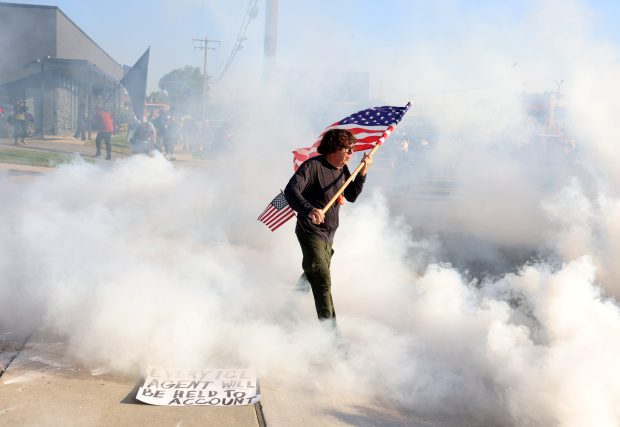
Curtis Evans, of Evanston, carries a U.S. flag through tear gas deployed by federal officers as they attempted to clear protesters from the entrance of the U.S. Immigration and Customs Enforcement holding facility in west suburban Broadview, on Sept. 19, 2025. Evans was a Marine during President Ronald Reagan’s term. (Stacey Wescott/Chicago Tribune)
Protesters tussle with federal agents as they block a vehicle from entering the ICE facility in west suburban Broadview, on Sept. 19, 2025. (Stacey Wescott/Chicago Tribune)
Illinois State Police detain a protester wearing a clown nose during a protest near the U.S. Immigration and Customs Enforcement holding facility on Oct. 17, 2025, in west suburban Broadview. (Stacey Wescott/Chicago Tribune)
Residents watch while U.S. Border Patrol Cmdr. Gregory Bovino and other federal agents finish their march along North Clark Street by the Newberry Library in Chicago’s Gold Coast area on Sept. 28, 2025, as part of a show of force. (Brian Cassella/Chicago Tribune)
Marimar Martínez is greeted by her family after being released from the Metropolitan Correctional Center on Oct. 6, 2026, in Chicago. Martínez was in custody after being shot by immigration agents and charged with assaulting federal officers during an incident in the city's Brighton Park neighborhood two days earlier. (E. Jason Wambsgans/Chicago Tribune)
Rubén Torres Maldonado is reunited with his children, Nathan, 4, and Ofelia, 16, along with his wife, Sandibell Hidalgo, left, at the family's home in Chicago’s Portage Park neighborhood on Oct. 30, 2025. An immigration judge granted bond to Torres the previous day. Torres was arrested by federal immigration agents at a Home Depot while daughter Ofelia was on a temporary break from treatment for Stage 4 cancer. (Chris Sweda/Chicago Tribune)
1 of 14
U.S. Border Patrol agents detain a person while community members and activists protest in Chicago's Brighton Park neighborhood on Oct. 4, 2025. (Armando L. Sanchez/Chicago Tribune)
The Chicago Tribune won the Pulitzer Prize on May 4, 2026, for local reporting on Monday for its coverage of Operation Midway Blitz, the Trump administration’s immigration enforcement mission in the Chicago area last fall.
The following stories, photographs and editorials were submitted to judges for consideration.