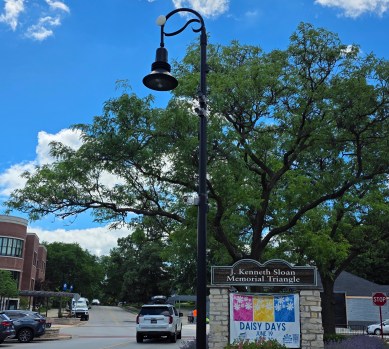
Mention the Barrington area and people are likely to picture big houses on large lots with pricey cars in the driveways, tree-lined streets, rolling hills and quiet lakes.
That picture lacks detail.
The area also has modest houses on smaller lots, an old downtown shopping district and a big new shopping center, lightly traveled rural roads and traffic-clogged highways, an uncommon commitment among area village boards to work together and one village board that sometimes drives itself apart.
Barrington, Barrington Hills, Deer Park, Inverness, Lake Barrington, North Barrington, South Barrington and Tower Lakes make up the greater Barrington area, communities that share a certain outlook.
That outlook is one of pride in how the area has developed and a desire to protect it from some of the high-density commercial and residential development that characterizes nearby communities.
With about 40,000 residents spread over 90 square miles, the Barrington area is one of the least densely populated in metropolitan Chicago. It’s a safe bet that most residents want to keep it that way.
“There’s an underlying feeling here that people want to keep density, even in downtown Barrington, not as high as it is in Arlington Heights or some of those other towns,” said Jeanne Yeagley, a Barrington village trustee.
Karen Darch, a fellow Barrington trustee, said: “There is a lot of fear on the part of citizens, especially ones who have been here a long time, that the village is going to become too urban instead of remain our small town.”
The Barrington area has a reputation for wealth. Seven of the eight communities have median household incomes that exceed $100,000, according to the 2000 U.S. Census. The median household income for Illinois is $46,990. Barrington has the lowest median household income among the towns–$83,065–and still exceeds the state median by more than 75 percent.
Household income gains in the Barrington area largely kept pace with or exceeded the 35 percent rise in the consumer price index from 1990 to 2000, said Mark Thomas, Northeastern Illinois Planning Commission spokesman.
Population stable
The area’s population, which includes people living in unincorporated areas, is only slightly changed from 10 years ago, said Janet Agnoletti, executive director of the Barrington Area Council of Governments (BACOG).
“One of the goals of BACOG is to manage growth,” she said. “That was all part of the intent. We don’t want to overheat our school population or overtax infrastructure. McHenry, Kane, DuPage are all growing. Relative to the growth that’s occurring elsewhere to the north and northwest of Chicago, we’re pretty stable, and that’s by design.”
She does not believe the area’s stability is necessarily tied to its wealth.
“If you say it is a philosophy of the community to manage growth and act on it, it can be done,” she said. “I don’t see a big relationship between income and our planning.”
Barrington is the only village with a downtown. While most of the other communities have little commercial or retail development and feature the large homes on estate lots that many people picture, Barrington also offers small homes on quarter-acre or smaller lots in the old part of town. Tower Lakes also has many small homes. And in Lake Barrington, the bulk of the village’s residents live in Lake Barrington Shores, a gated condominium development.
With more than 10,000 residents, Barrington is the most populous of the communities, the area’s commercial hub and the one with the most lively political debates, most of which focus on development and traffic issues.
Divisive election
The divisions were reflected in last year’s municipal election, which saw Marshall Reagle defeat incumbent Village President Ron Hamelberg by 19 votes. A majority of trustees loyal to Hamelberg retained their seats.
The two sides have been at odds to varying degrees ever since. In April trustees rejected Reagle’s appointee to fill a vacancy on the Plan Commission.
Late last year Reagle sued the Village Board to remove three members of the Village Center Redevelopment Commission who had been appointed by Hamelberg. Reagle argued they should be removed because their terms of service were given the wrong expiration dates. That lawsuit is pending.
Trustee Greg Furda resigned last month from the Village Board because of the repeated squabbles. Hamelberg had appointed him to the board to fill a vacancy shortly before Reagle took over as president. Reagle is considering whom he will appoint as Furda’s successor.
“I have concluded that my ability to influence policy on this board has been undermined,” Furda said from a prepared statement as he announced his resignation at the May 13 board meeting. “The people of this village have found themselves in the middle of partisan political infighting.”
A Transportation Advisory Committee that Hamelberg created to study Illinois Highway 59, including options for bypasses around the village, broke open the divisions.
“The town was galvanized by the [committee],” Darch said. “The town went up in arms. What had been a quiet process in prior years blew wide open. It got really bad, really ugly. The election was horrible.”
Another major issue has been downtown redevelopment. A 1,900-square-foot expansion and renovation of the Barrington Metra station recently began. The bulk of the $3.7 million cost will be paid for by the Federal Transit Administration, Illinois Department of Transportation, Regional Transportation Authority and Metra.
Metra project an issue
That project also was an election issue. Hamelberg delayed the project in hopes of building a new station in the area known as the Golden Triangle, a few blocks west of the station. Neighbors of the proposed station objected. That station has not been built.
The Golden Triangle is a 14-acre parcel on the west side of Illinois 59 between the two railroad lines that cross through town. The former Seigle’s Lumber, ADCO Van & Storage Inc. and Burpee Co. buildings are among those that occupy the site.
Village officials are hoping to stimulate redevelopment in the triangle. They have the backing of the Barrington Area Chamber of Commerce, which several years ago voted to support redevelopment.
“Since that time, there has been much controversy and negotiation over that site,” said chamber president Janet Meyer. In February the Village Board backed away from plans to condemn the former Seigle’s building and instead decided to negotiate with the building owner to acquire it.
Another downtown project is the proposed Cook Street Plaza retail and condominium development at the corner of Cook and Station Streets, which has been discussed for nearly 10 years. Plans are to provide the project $1.7 million from the village’s tax-increment-finance (TIF) district, which was created a few years ago to promote downtown redevelopment. The Village Board is scheduled to vote on the project in July.
Cook Street plan opposed
Reagle said he favors redevelopment, but not always along the lines proposed by previous village officials. For example, he supports the opening of Panera Bread and Borders Books, Music and Cafe, two stores that have recently decided to move to Barrington.
But he opposes the village giving money to the Cook Street Plaza project. That project calls for 24 residential condominiums atop a first-floor retail area. Underground parking would be built, but the above-ground portion of the project would eliminate parking spaces, leaving the downtown with four fewer parking spaces than are there now, Reagle said.
“We desperately need parking downtown,” he said. “I can’t see giving up spaces and giving away nearly $2 million of TIF money to Cook Street Plaza.”
In Deer Park, the Deer Park Town Center shopping center opened about 18 months ago. The center, on Rand Road, has more than 50 stores and seven restaurants occupying about 350,000 square feet.
An expansion is already in the works, said Terry McEwen, president of Poag & McEwen Lifestyle Centers Inc. in Memphis, which built the center. It has extensive landscaping, including 1,600 trees.
North Barrington and neighboring Hawthorn Woods recently agreed to allow commercial development, buffered with town homes and single-family homes on 1-acre lots, on 110 acres at U.S. Highway 12 and Old McHenry Road. The property would be in Hawthorn Woods, but North Barrington would receive a share of the sales tax revenues. There is no proposed development at the moment.
Though South Barrington is primarily estate housing, its location along the Northwest Tollway makes it an attractive location for commercial development. Rose Packing, Millrose Restaurant and Brewing Co., an Allstate Insurance office complex, a 30-screen movie theater and the 17,000-member Willow Creek Community Church are all in the village.
Sixteen lots on Barrington Road are being developed as an office complex, said South Barrington Village President Frank Munao. In keeping with the area’s character, the offices are designed to look like large homes on 1-acre lots.
The biggest non-residential complex in the village is Willow Creek Community Church, at Barrington and Algonquin Roads, which can cause traffic tie-ups when services or other events are held.
“Willow Creek is a huge complex,” Munao said. “We’re trying to alleviate traffic problems there, but it’s not easy.”
Large residential lots
As for residential development, Village Administrator David Pierce said: “Our goal is to provide developments with one house for every 2 acres. That does not necessarily mean 2-acre lots because most developments have water features and lakes as well as wetlands that add to the ambience.”
Though the Barrington Village Board sometimes has trouble working together, the Barrington Area Council of Governments, which has representatives from all the communities except Inverness, demonstrates a great deal of cooperation.
Issues the council addresses include:
– Updates of a geographical information system that pinpoints utility lines, aquifers for wells, land ownership, land valuations, legal descriptions and a wealth of other information useful to municipal planners, police and fire departments, real estate developers and others.
“We have taken it through the most fundamental questions of who can use it, how they can use it, controls on distributing data, if any, and how to get staff trained to print maps and make the system useful for all villages,” Agnoletti said. “As a result we have a cutting-edge data manager and map manager and planning tool.”
– Creation of a model developer impact fee program. Some communities do not collect developer impact fees. Others collect fees, but they differ significantly from one community to another.
“We want to see consistency,” Agnoletti said. “We want to remove all incentives for developers to go to one village instead of another because of impact fees. Instead of developers playing villages off each other, we want to be able to say, `There’s nothing you can get from us that you can’t get from them.’ We’re not putting it out as something a village must adopt. It’s up to each village board, if it’s right for them.”
– An analysis of aquifers for wells, groundwater recharge areas and related issues. Groundwater is vital to the area because all homes and businesses rely on well water. The study could be used to guide development to protect important groundwater areas, Agnoletti said.
Since 1993 some Barrington homes have been found to have elevated levels of lead in their water, requiring the village to send warnings to residents. The lead appears to be coming from some lines that deliver water to homes and from plumbing pipes. Ordinarily, mineral deposits build up over time, stopping lead from leaching into the water. Local and state officials are not sure why this has not happened at these homes.
– A regional approach to emergency response. BACOG sponsored a symposium in April with all the area’s police and fire chiefs, the Illinois Emergency Management Agency and village officials.
“Some good ideas came out of that,” Agnoletti said. “We won’t move at lightning speed. We want to see if we can improve communication. A centralized command center is a possibility. We’re looking for a way to collaborate better in a 90-square-mile area.”
– Transportation. “This always has been and always will be a challenge,” Agnoletti said. “BACOG as a whole is in favor of supporting the really major roads. We’d be happy to see a western Route 31 or Randall Road expansion. BACOG supports the Route 53 extension. Without those major regional roads in place, the BACOG area and other towns will carry more traffic than they should.”
On the issue of open space, Barrington residents showed their feelings in March when they approved an $11.5 million tax-increase proposal for the Park District to buy the former Jewel Tea Co. headquarters property, which abuts the 600-acre Cuba Marsh. The property covers nearly 56 acres and includes a five-story, 640,000-square-foot building. Jewel used the property as its headquarters from 1930 until moving to Melrose Park in the mid-1950s. The building is vacant.
“There are quite a few wetlands and trees that will stay natural,” said Terry Jennings, executive director of the Barrington Park District. “We are lacking in a severe way of land and facilities. Programming revenues have nearly doubled because we’re offering more programs. Our growth has been incredible in recent years.”
The park could be ready in three to four years, she said.
Open space advocates
Hundreds of volunteers in the area are working to save or improve local wetlands, woods and prairies. A devoted volunteer is Waid Vanderpoel, 80, of unincorporated Cuba Township in Lake County. He has been a member of Citizens for Conservation, a local conservationist group, for more than 20 years, included two stints as president.
“A lot of people in the Barrington area do have, I’d say, an unusual land ethic,” said Vanderpoel, who lives near Lake Barrington. “It comes out every time we have an open space or forest preserve referendum. Almost always, our area has the highest favorable vote.”
Citizens for Conservation backed the Jewel Tea Co. referendum proposal and has been involved in many other projects. Ongoing ones include Cuba Marsh, where the group and the Nature Conservancy regularly burn invasive plants and reseed a black soil prairie with native plants.
In Barrington Hills, bird lover Peggy Richards has given the group 37 acres at Oak Knoll and Buckley Roads for a prairie restoration. The property, called Grigsby Prairie, is in its 15th year of restoration and is home to more than 75 species of native flowers and at least two dozen species of native sedges and grasses, Vanderpoel said.
The biggest project is the restoration of Flint Creek Savanna, about 103 acres in Lake Barrington near Good Shepherd Hospital on Illinois Highway 22. The village, Village of Lake Zurich, Lake County Forest Preserve District, hospital and home builder Lakewood Homes, which owned 65 acres of the preserve, have helped stabilize the stream banks, plant native water-loving vegetation and take other measures to protect the stream and nearby habitat, Vanderpoel said.
“BACOG has been pro-conservation, and most of the villages have been,” he said. “So much of the Chicago area is as flat as a board. We’re glad to have hills, glad to have the little lakes and streams that cover the area. People here seem to recognize that it’s a special area.”
– – –
Barrington area demographics
U.S. census figures show that the population in the Barrington area has grown modestly while household incomes have risen at a rate near or above the consumer price index. Governments in the wealthy area have mostly succeeded in keeping growth under control.
POPULATION
In percent change from previous decade
BARRINGTON (+7%)
1990: 9,504
2000: 10,168
BARRINGTON HILLS (-7%)
1990: 4,202
2000: 3,915
DEER PARK (+7.5%)
1990: 2,887
2000: 3,102
INVERNESS (+3.8%)
1990: 6,503
2000: 6,749
LAKE BARRINGTON (+23.4%)
1990: 3,855
2000: 4,757
NORTH BARRINGTON (+63.3%)
1990: 1,787
2000: 2,918
SOUTH BARRINGTON (+28%)
1990: 2,937
2000: 3,760
TOWER LAKES (-1.7%)
1990: 1,333
2000: 1,310
MEDIAN HOUSEHOLD INCOME
BARRINGTON (+30%)
1990: $63,987
2000: $83,065
BARRINGTON HILLS (+40%)
1990: $104,002
2000: $145,330
DEER PARK (+53%)
1990: $97,533
2000: $149,233
INVERNESS (+24.5%)
1990: $113,799
2000: $141,672
LAKE BARRINGTON (+22%)
1990: $87,767
2000: $106,951
NORTH BARRINGTON (+42.6%)
1990: $102,582
2000: $146,251
SOUTH BARRINGTON (+39%)
1990: $122,487
2000: $170,755
TOWER LAKES (+27%)
1990: $102,606
2000: $130,388
Source: Northeastern Illinois Planning Commission.
Chicago Tribune.