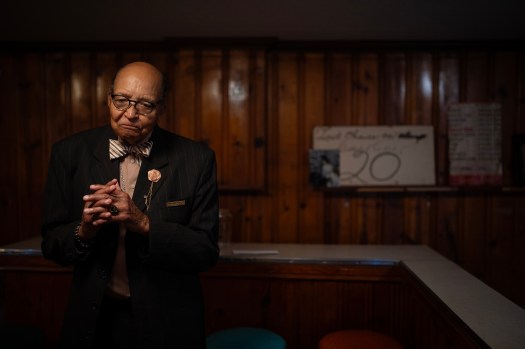
Here’s William Yang’s challenge — he’ll be presenting his show “Shadows,” a combination of photographs and monologue on the topic of dispossessed peoples, this weekend at the Museum of Contemporary Art. His challenge is getting people to show up.
It’s like a slide show? On oppression? I’m sure it’s a fine performance, but …
Yang acknowledges getting audiences in the door can be difficult, but given the chance, he doesn’t exactly leap in with a hard sell. “People seem to be moved by the show,” he says, adding with a soft laugh, “They find it ‘engaging.'”
Yang, from Australia, has made a name for himself internationally as a storyteller, photographer and performance artist who takes on topics of alienation and identity. His previous shows have focused on his own life as a gay, third-generation Chinese immigrant in Australia; in “Shadows,” he turns his struggles with personal identity outward, focusing on Australian Aborigines and German immigrant communities in Australia.
The former have only begun to have their stories told. In February, Australia’s new prime minister Kevin Rudd made the first official act of his Labor government a formal apology to Australia’s Aborigines and Torres Strait Islanders. His remarks went in particular to the so-called Stolen Generation, the tens of thousands of indigenous and mixed-descent citizens who were taken as children from their families in a policy of assimilation that only ended in the 1970s.
The experiences of the latter group are even less well-known. As former nationals of an enemy state, thousands of German immigrants in Australia were rounded up and interned in camps — not just once, but twice during World War I and II.
In his performance, Yang doesn’t try to tell history or add overarching elements or invented narratives. He simply tells stories about people he’s met. His words are accompanied by his photographs projected on a screen and by live music by Colin Offord.
The combination has an unexpected effect, says the MCA’s Peter Taub, who has seen Yang in previous tours. “He and his words are both quiet and quite forceful,” Taub says. “It takes you by surprise.”
But what do these two groups of people have to do with each other?
“Just having your story told can be so liberating,” Yang says. When he first met with surviving members of the German communities, for example, nobody wanted the subject of internment brought up. It had been thoroughly suppressed. And a lot of anger and despair remains in Aborigine communities. “Just having what you’ve been through acknowledged is so important.”
WILLIAM YANG: SHADOWS
Storytelling about Australian Aborigines and immigrant German communities
When: Saturday and Sunday
Where: Museum of Contemporary Art Chicago, 220 E. Chicago Ave.
Price: $19-$24; 312-397-4010 and www.mcachicago.org
———-
dgeorge@tribune.com