

LUTHER, Oklahoma — It is, at first glance, an unassuming building that stands along Route 66 in this central Oklahoma town, a bungalow with a gabled roof and sandstone walls etched with the names of the many visitors who have stopped here over the last century.
Look through the Rev. Allen Threatt III’s eyes, though, and something else comes into focus.
We first meet the 86-year-old family patriarch at his church, 10 miles west in Acadia. It’s Father’s Day, and the Sunday service includes gift bags filled with cookies for the fathers. The reverend stands tall at the pulpit and reads from the Gospel of Matthew. He points with his left hand, palm open, sweeping the air with every word. His voice starts quiet and then climbs to fierce crescendos as he stresses the importance of fathers and families. Then he goes silent, catches his breath and begins again.
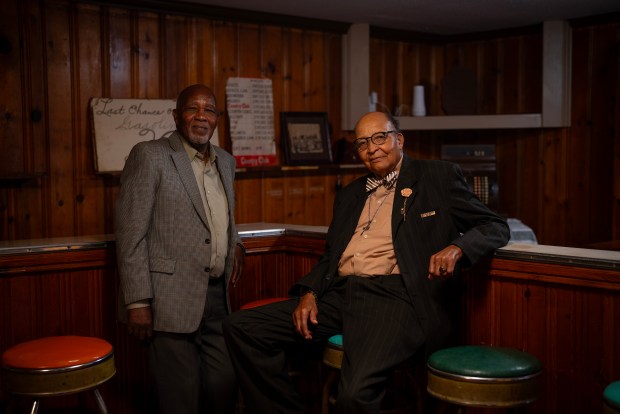
Later, after greeting his congregation, he joins us at his grandfather’s service station in Luther, where he shows us what we cannot see.
Follow our road trip: Route 66, ‘The Main Street of America,’ turns 100
He can see rows of cars parked along the famed highway and people streaming toward his grandfather’s service station to buy a hot dog and a beer before walking across the street to catch a Negro Baseball League game.
He can see his grandfather standing just outside the front door, neatly dressed in overalls, chomping a cigar and greeting everyone who pulled off Route 66 for gas or food or to spend the night, because they heard that they could take refuge at the Threatt Filling Station.

“This right here is part of history — Black history,” he tells us, sitting on a bar stool inside the station. “This was their rescue place where they could stop and relax … here you could stay all night if you wanted to.”
Route 66 has been called America’s Main Street, a moniker that fuels nostalgics who like to talk about simpler times and good days gone by. Of course, that wasn’t always true for everyone.
Forty-four of the 89 counties that touched the route were thought to be sundown towns — that is, places where Black people were explicitly or implicitly told to leave before sunset, said Candacy Taylor, an author and photographer who wrote about the highway in her book “Overground Railroad: The Green Book and the Roots of Black Travel in America.”
For Black travelers along Route 66, that put a vital importance on knowing where to find places listed in the Green Book, or places like the Threatt Filling Station, between long, perilous stretches of their journeys.
“The consequences were deadly if you didn’t have a good plan,” Taylor said.
Allen Threatt Sr. came from Alabama to Oklahoma around the turn of the 20th century. He sharecropped for a white farmer who eventually turned the land over to Threatt, about 150 acres in total.
Threatt built a service station on the property around 1915. After a fire destroyed it, he rebuilt it in 1933, using sandstone quarried from his farm. He eventually expanded its offerings into something that resembles the convenience stores and dive bars of today.
Along the west wall, shelves and cabinets that now hold T-shirts and other souvenirs once held canned goods, bread and produce for sale. A narrow bar separated the shelves from a pool table at the center of the pine floor, opposite two booths.
Outside, there used to be a pit, maybe 10 feet deep, filled with rattlesnakes. People would toss coins in the pit, like a fountain at a shopping mall. Neither the Rev. Threatt nor his cousin Edward Threatt could remember how the coins were collected.
In the field behind the station, the Threatts set up tables with benches under a canopy of lights strung between trees. A wooden platform served as the dance floor. A jukebox supplied the music. The crowds that came danced the jitterbug with such excitement on Saturday night that by Sunday morning, the Rev. Threatt remembered, he and a cousin would find the platform littered with quarters and nickels that fell out of the dancers’ pockets.
Family stories tell of the filling station being visited by Joe Louis and Pearl Bailey, of bank robber George “Baby Face” Nelson hiding in a barn on the property — he’s rumored to have told Threatt Sr.: When I leave here, don’t pay any attention to the direction I go.
Threatt Sr. died in December 1950. His son, Ulysses Grant Threatt, took over the filling station until his death six years later. Ulysses Threatt’s wife, Elizabeth Hilton Threatt, kept it running until she closed it in the mid-1970s. A school teacher, Elizabeth Threatt was one of five students to integrate the University of Central Oklahoma. The library in Luther is named in her honor. She died in 2009 at 98.
The station was added to the National Register of Historic Places in 1995. Twenty years later, Edward Threatt, whose father once ran a bar and restaurant next to the station, led his family’s efforts to restore the building, aided by grants from the National Trust for Historic Preservation and other organizations.
“It’s been a labor to get all of this put back together again,” he says. “A lot of time (and) a lot of money just to get to where we are.”
Much of the interior is original to the building: The pine floors and walls, the bar stools and the counter. The cash register, also original, had been returned a few weeks before our visit, after having been on loan to the Smithsonian Institution.
The plan is to turn the station into an interpretive center, where people can learn about the family’s story and the stories of Black travelers during Jim Crow. Edward Threatt wants to reopen his father’s restaurant and bar and call it Brown Bomber Bar and Grill. He can see an RV park on the property, perhaps near the pond farther west of the station, which they could stock with fish.
“We don’t want you to come here, buy a shirt, take pictures and leave,” he says. “We want this to be a destination.”
Two months after our visit, the station once again drew a crowd, as the Threatt family celebrated the installation of a monument, 14 feet high, to the unassuming building’s significance on Route 66.