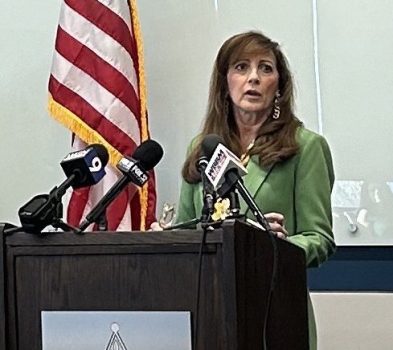
A 2003 graduate of Lincoln-Way High School District 210, Christina Scanlan dreamed of becoming a teacher at her alma mater.
She did her student teaching and volunteered as a cheerleading coach at Lincoln-Way East in Frankfort and, when she didn’t get a job after college, became a substitute at Lincoln-Way Central in New Lenox. Finally, this school year she landed a full-time job as an English teacher at East.
“I knew that I had to be persistent and work for it, that it wasn’t just going to fall in my lap,” said Scanlan, 24. Still, she was surprised at how tough it was to get a full-time position.
Statewide, a glut of new teachers has created a deluge of applications and daunting competition for aspiring teachers, delaying and even ending dreams of teaching.
Illinois is producing thousands more new teachers than public school districts are hiring, with oversupplies in all subject areas except bilingual education, according to a 2008 analysis by the Illinois Department of Education. The “overproduction” of teachers is highest in social science, according to the state.
And local districts are reporting an oversupply of applicants for elementary school teaching jobs, as well as for English language arts and physical education positions.
The situation may come as a surprise to education majors and their parents, but it is no secret to school personnel officials who say the hiring process has become so intense that hundreds — sometimes thousands — of teacher applicants are weeded out before they even get to the school door for an interview.
“We are just inundated every day,” said Thomas Eddy, the deputy superintendent in District 210. He estimated that up to 2,000 teacher applications are on file, though the district hired only 56 teachers last year.
Likewise, in Orland Park’s School District 135, there are thousands of applications on file, and “we have a plethora of very qualified people for every opening,” said Julie Oberwise, director of human resources.
Even the Chicago Public Schools, where high poverty and other factors make teaching particularly challenging, have had a surge of applications — 23,568 in 2008-09 — more than double the applications five years ago.
Nancy Slavin, chief officer for teacher recruitment in the Chicago Public Schools, said top officials met last fall with officials from universities that train teachers. “What we were trying to get at was, ‘Hey, guys, we don’t need social studies, English teachers and straight elementary teachers [with no specialties],'” she said. Chicago needs more teachers in select areas such as special education, Slavin said.
Deborah Curtis, dean of Illinois State University’s College of Education, said Illinois has traditionally been known as a “big exporter” of teachers because it produces more new teachers than available teaching jobs within the state.
That said, her college is paying attention to the needs of districts and is “sculpting” the pool of students admitted to the College of Education, Curtis said. For example, the college has been limiting the number of students who want to pursue elementary education in favor of those interested in areas such as special education and bilingual education.
District 210’s Scanlan, an ISU graduate, said she noticed that many fellow students were pursuing teaching history and English, but she didn’t realize how tough the competition would be until she started student teaching.
For some students, the situation can be bleak.
“You’re graduating from college with loans the equivalent of buying a new car, and then you find out you’ve gone to school and you’re trained and there’s an oversupply of people and you feel almost betrayed,” said Craig von Behren, assistant superintendent for human resources in Naperville’s School District 203. “And you say, what do I do now?”
State officials emphasize that just because there’s an oversupply of new teachers statewide doesn’t mean some districts aren’t struggling to find qualified applicants.
A number of factors can affect the number of applications received, said Jim Sweeney, who oversees the state Board of Education’s annual educator supply and demand report.
“One district, A, can have an oversupply and B can have a dearth of applicants because of base pay and working conditions,” Sweeney said.
For applicants, the odds of getting a teaching job depend in part on the subject area.
In the fiscal year ending June 30, 2007, for example, 5,033 new teachers got certified to teach social science statewide, but only 373 were hired by public school districts for the 2007-08 school year, according to the state board. Than means 13.5 times more new social science teachers were certified than hired.
Adding to the challenge is that first-time teachers make up only a small portion of the teaching force — 6 percent in 2007-08. Most of the teaching pool is made up of teachers retained from the prior academic year.
The state board compares the number of teachers certified for the first time to the number of first-time teachers hired for the coming school year.
The state doesn’t track whether newly certified teachers get jobs out of state, in private schools or in private industry, focusing instead on public school districts in Illinois. The state looks for a 2-1 ratio — at least two newly certified teachers for every opening — to make sure public school districts have enough qualified applicants.
In the 2008 analysis, only one teaching area did not meet the ratio: bilingual education. Special education, which has experienced shortages in the past, met the 2-1 ratio, though state officials remain concerned about the supply as special education enrollment grows.
The state also tracks teaching jobs and other school positions, such as speech pathologists, that remain vacant though they were budgeted to be filled. That happens for a variety reasons, including a lack of qualified applicants.
In that analysis, the Chicago Public Schools had the largest number of unfilled positions in 2007-08, with 570. Districts also report what they consider to be shortages of qualified teacher applicants despite the oversupply that exists statewide. In 2008, the shortages mostly were reported in special education areas but also included physics, chemistry, math and foreign language.
Overall, the competition is expected to remain tough for new teachers, in part because school enrollment in Illinois has begun to decline, and fewer students likely will mean fewer teachers are needed.
The state board’s supply and demand report said that K-12 enrollment in Illinois went down in 2008 for the first time in 17 years and is expected to decline for the next four years by about 6,500 students a year.
– – –
Teacher surplus?
Far more teachers were certified in the 2006-07 school year than could be hired for the 2007-08 year in Illinois public schools.
Elementary
Certified: 9,639
Hired: 1,821 18.9%
Social Science
Certified: 5,033
Hired: 7.4%
English Language-Arts
Certified: 4,321
Hired: 19.6%
Special Education
Certified: 1,931
Hired: 50.5%
Math
Certified: 1,741
Hired: 32.5%
Science
Certified: 1,577
Hired: 28.8%
Early Childhood
Certified: 1,056
Hired: 18.4%
Physical Education
Certified: 901
Hired: 39.7%
Foreign Language-Spanish
Certified: 848
Hired: 21.1%
Music
Certified: 741
Hired: 33.8%
Art
Certified: 613
Hired: 26.8%
Bilingual
Certified: 447
Hired: 69.2%
Health
Certified: 339
Hired: 14.2%
Foreign Language-Other
Certified: 209
Hired: 19.6%
SOURCE: Data from Educator Supply and Demand in Illinois, 2008 Annual Report, Illinois State Board of Education
TRIBUNE
– – –
Too few teachers?
Despite the glut of new teachers statewide, some school districts have a shortage of applicants in certain disciplines.
TEACHER SHORTAGE
In order of most need
1. Special Education, Speech and Language teacher
2. Special Education, Cross Categorical
3. Foreign Language, Spanish
4. Bilingual Education
5. Special Education, Learning and Behavior Specialist
6. Special Education, Emotionally Disturbed
7. Special Education, Specific Learning Disability
8. Mathematics
9. Science, Physics
10. Special Education, Bilingual
Note: The analysis compares the number of teachers getting their first teaching certificate in the 2007 budget year (July 1, 2006 to June 30, 2007) to the number of new hires by Illinois public school districts for the 2007-08 school year.
SOURCE: Data from Educator Supply and Demand in Illinois, 2008 Annual Report, Illinois Board of Education
TRIBUNE