
The quiet little Fairmont community has become increasingly vocal in its opposition to a new road through its community that was approved seven years ago.
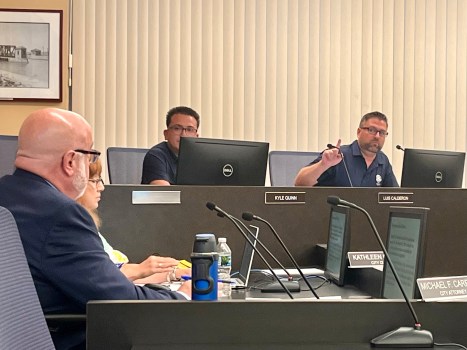
Fairmont Community Partnership (FCP) spokeswoman Valerie Broadhurst and Fairmont School District 89 Superintendent Sonya Whitaker presented resolutions to the Will County Board Thursday, along with 900 signatures on petitions, opposing the expansion of Oak Avenue, and asking that the road alignment be re-evaluated.
The widening of Oak is part of a new $600 million, 12-mile, four-lane corridor connecting Caton Farm Road and U.S. 30 in Crest Hill to 159th and Cedar Road in Homer Glen, over a new Des Plaines River bridge in Lockport.
It is known as the Caton Farm/Bruce Road project and was approved in 2009, following a series of public hearings, by the Transportation Corridor Committee, comprised of local government leaders.
But Fairmont folks said people were not aware of the hearings, or of the widening of Oak, until recently, and they are concerned about the way those public sessions were handled.
“They might have done everything legally, but they did it as quietly as they could,” said Terry Broadhurst of FCP.
While everyone said they support the need for a second bridge in Lockport — due to the congestion on the Ninth Street Bridge — they don’t want Oak Avenue to be part of the connecting corridor. It would divide this small, unincorporated, impoverished community in Lockport Township, resulting in a loss of affordable housing and creating an unsafe environment, especially for students who all walk to school, according to the resolutions.
Oak is now a two-lane, rural road.
Fairmont residents previously voiced concerns about the road last summer, but now they want to go officially on record as opposing it, said DeLinda Herod of the FCP.
During those public hearings, six possible alignments were presented, and all went through Fairmont, said Bruce Gould, director of the Will County Division of Transportation.
According to the approved alignment, the new bridge would connect on the east to Bruce Road, then veer south to Oak Avenue to avoid a habitat of the endangered dragonfly, and jog back north to Bruce and connect to 159th Street by creating a new “Middle Road.”
The approved alignment also has been questioned by officials in Lockport and Homer Glen, who seek to change that “Middle Road” — between Gougar and Cedar roads.
FCP members are trying to meet with the Federal Highway Administration to see if just that segment of the proposed alignment can be changed, to use Gougar, Cedar or Interstate 355 instead, and they are willing to pay for new engineering studies on topography, drainage and environmental issues — a process that could take up to 18 months at a cost of $400,000.
Federal funds may be available for the project, but first an environmental impact study would have to be approved by the FHWA.
But if Oak Avenue is to be re-evaluated, the project would have to be “scrapped” and started over, Gould said.
“Everyone wants the bridge, but not the road. We had public hearings, and no one objected until six years later. There will be objections regardless of where we put it,” he said.
The Caton Farm/Bruce Road project has been included in the county’s 2030 transportation plan, and is included in the proposed 2040 plan, which is now being presented to county residents in a series of open houses. Upcoming open houses seeking public input on all county transportation issues will be held from 4-7 p.m. Jan. 26 at Governors State University; Jan. 27 at Romeoville Village Hall; and Jan. 28 at New Lenox Village Hall.
Will County board member Annette Parker, R-Crest Hill, who represents the Fairmont area, said she has been and will continue to meet with residents to hear their concerns.
“We are trying to figure out the best solution. Safety is a foremost concern,” she said after the meeting.
But not everyone in Fairmont is opposed to the road. Parker said she has had conversations with a “handful of people who want the road” and believe it will bring much needed economic development to the community.
By talking to both sides, Parker said, “We can figure this out together.”
Filing the resolutions opposing the expansion of Oak Avenue is “part of the process,” she said. “It is good that people are involved.”