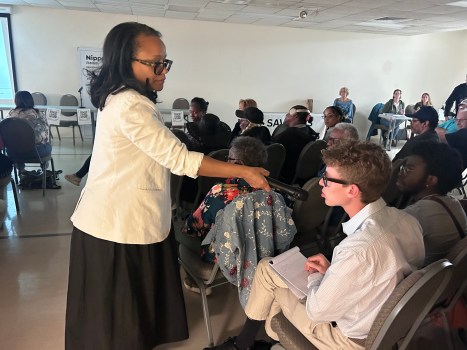
After spending three hours inside the Hammond City Court room Thursday morning, Joel McSwain was finally called before Judge Jeffrey Harkin.
The Purdue University Calumet student, who had received tickets for traffic violations, had to miss a class for the hearing and will likely have to miss another one for a second court date in two months.
McSwain, of Hammond, was one of the last out of a long line of about 80 to 100 defendants to have their case heard during the general call, which started at 9 a.m. and didn’t end until 12:20 p.m.
“I don’t know why they called me in at 9 (a.m.),” McSwain said.
Long waits for defendants at the court are common, and the issue has gotten the attention of Mayor Thomas McDermott Jr. and the Hammond City Council, who took the unusual step at the most recent City Council meeting on Jan. 11 of not approving a routine budget move to pay the court’s part-time employees.
The Council had initially approved in December the request to move funds from one court budget to another in order to pay the part-time employees, but McDermott then vetoed the ordinance.
He explained during the Jan. 11 Council meeting that he was upset with Harkin regarding how the court handles court calls.
“It’s ridiculous,” McDermott said during a later interview. “It’s got to stop.”
The mayor noted that Thursday morning court calls, which include dozens and sometimes hundreds of defendants ranging from those in custody to those dealing with moving violations, are often the worst .
As in other courts, defendants are all given the same time to appear in court. Because everyone arrives at the same time, the second floor of City Hall becomes jammed as people wait to go through security.
“We’re filling the courtroom, and it’s spilling over,” he said, adding that the problem has existed for the past several years.
McDermott and his staff, whose office sits nearby the courtroom, often hear the brunt of the frustrations from defendants who have to wait hours for their case to be heard, the mayor said.
McDermott told the council about one recent case of a man from Portage who drove an hour in snow because he was afraid of being punished for missing his court hearing, only to find out when he arrived that court had been canceled for the day.
“I understand his frustration,” McDermott said.
The wait continued Thursday morning for other defendants like McSwain. Hammond resident Carrie Williams sat in the court for about two hours and 15 minutes before her case was heard. She had to take the entire day off work to appear. She noted that she’s had long waits during previous times she’s had to appear in court.
“This is not out of the ordinary for me, but it is annoying,” Williams said.
She noted that the defendants in custody often get their cases heard first and said one solution could be having them make their court appearances at a different time.
The wait didn’t force Terry McMillan, of Matteson, Ill., to miss work, but he said it was still a long time to sit through, especially as he is deaf in one ear and couldn’t hear most of what was going on.
“I feel like I really wasted a lot of time,” he said.
McDermott noted that his office arranged a meeting with Harkin, Lake County Prosecutor Bernard Carter and representatives from the Hammond Police Department in December to talk about ways to address the problem. Harkin didn’t show, McDermott said, but they sent a list of about 15 recommendations back with an employee from Harkin’s staff.
McDermott said he learned earlier this month that Harkin had not implemented any of the recommendations, which is when the mayor decided to veto the ordinance.
McDermott said he would continue to veto any monetary ordinance request from Harkin until changes are made.
Councilwoman Janet Venecz, who moved to override the mayor’s veto, said she did so because she had originally sponsored the ordinance and noted that the money had already been spent. However, she says she understands why McDermott vetoed it and was concerned herself about the court and how packed City Hall can get.
“It’s not only not safe, but people’s tempers grow,” she said, adding that she would have to talk with him about changes before sponsoring further ordinances for the court.
Harkin doesn’t deny that his court struggles to handle the number of defendants coming in, saying at one point some court calls were as large as 400 to 600 people.
“I don’t think that anyone ever, ever, ever anticipated the kind of volume that would go through the Hammond City Court,” he said.
He said that his staff has made changes in the past year and is looking to make more.
Harkin said one issue is that police officers schedule the court dates when they issue tickets, meaning the court doesn’t control its schedule. The court has worked with police in the past year to address the issue.
“It certainly has relieved the pressure,” Harkin said.
Other proposed changes aren’t as easy to make, however, Harkin argues. For instance, he said better software is needed to arrange more court calls and a broken video conferencing system means all inmates have to be bused over from the Hammond City Jail. The judge also said he’s had to reduce his budget in the past few years from about $1 million to $700,000, which also makes it harder to operate.
Harkin said he is considering one recommendation by the mayor, which is to not require so many people to attend court and instead let them just pay a fine without appearing. McDermott had complained that some people are being required to attend for something as simple as running a stop sign.
However, Harkin said he thinks some people need to appear in court to prove they’ve made the necessary changes, such as getting a driver’s license, to ensure the public’s safety.
“I think it’s more important that they continue coming to court until they produce a valid driver’s license,” he said.
He did promise that more changes would be coming, as soon as in a month.