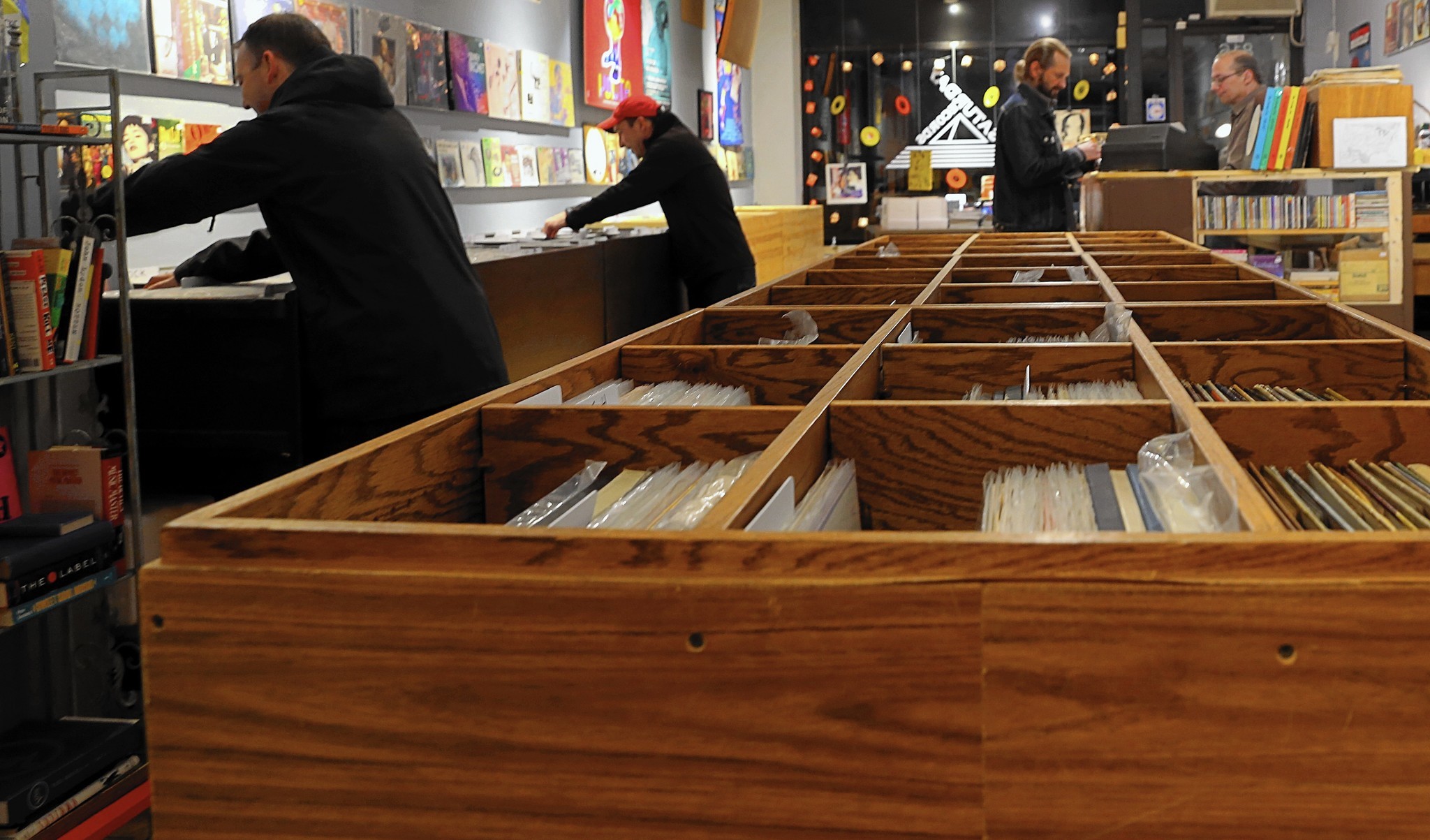

In a booming era of technological advances, there remains something special and uniquely appealing about vinyl records.
What audiophiles describe as a truer sound, as well as other sensory qualities of the record-buying experience, has attracted a generation of young buyers, as well as older collectors who’ve dusted off the turntable in the attic and are adding to their record collections.
David Quigley, owner of Saturday Records in Evanston, said digital lacks the highs and lows and “depth” of a vinyl recording. Quigley, 60, said he gained an early appreciation of vinyl from his father, a radio station sound engineer in Milwaukee.
“It’s more of a three-dimensional sound on vinyl,” said Quigley. “And classical audiophiles won’t buy digital. If it was made 1980 or later they won’t even look at it. But 1979 and before, they’ll like it.”
Quigley and Saturday Records aren’t alone in the area when it comes to vinyl. Also in Evanston are independent sellers Vintage Vinyl, Squeezebox Books & Music, and Barnes & Noble, which buys new stock. This concentration of record stores has made “Evanston a destination,” Quigley said.
In Niles, Half Price Books has a healthy and growing used vinyl section up front, near the cash registers. Some LPs for sale on a recent Saturday were by Elvis, The Beatles, The Doors, Jimmie Hendrix, Bob Marley, Miles Davis and Johnny Cash.
Laurey Anicka, district manager of the national chain’s nine Chicago-area stores, said the majority of their stores have grown their vinyl record displays.
“If the store had one bin two years ago, now it has two,” Anicka said. “We do especially well with vinyl records in Chicago. We get very good used merchandise from our customers. Ever since we opened 40 years ago, we’ve always sold vinyl.”
Alex Rowe, 17, of Lincolnwood, recently browsed the LP bins at Half Price Books, looking for his favorite group, The Beatles. He said he used Christmas money at age 12 to buy his first vinyl albums, playing them on his parents’ turntable. He later bought his own modern Crosley turntable.
Rowe said he embraces the whole sensory experience, the feel and sound of the records, the jacket art, album notes and a sense of “what the past was like and other generations were like.”
When Quigley opened shop in Evanston earlier this year, he used carpentry skills his father taught him to build bins and renovate the space.
“Part of the reason I opened a new store is that sales of vinyl records have gone up 30 percent, three years in a row,” said Quigley, who said he has close to 6,000 individual used records at his shop, with no duplicates. The average cost of a used LP at Saturday Records is $10.
Quigley said many of his younger buyers come in for “Foreigner and The Eagles, Pink Floyd, Rolling Stones and all the big ’70s superstar groups. They’re superstars again.”
“That’s some of the passion the millennials are getting now,” Quigley said. “They just hadn’t heard (a favorite artist or group) sound that good before hearing it on vinyl. With an analog recording (on vinyl), you feel like you’re in the same room with the music. People say it doesn’t matter, but yeah, it does.”
Quigley said, “Anything can be lost in digital. There’s a duet (on vinyl) between Duke Ellington and a baritone player. And all Duke is doing on the record is snapping his fingers. But on digital, you can’t hear the snapping.”
The playing speed of an LP record can also matter.
“The 78s don’t have highs and lows, like the 33s, but the mid-range on a 78 is golden,” Quigley said.
Quigley prepares used records for resale with a commercial grade record-cleaning machine that vacuums the “mud,” dust and moisture from the bottom of the grooves, and a record flattener, which can fix warped records.
Evanston resident John Noyes said he had records growing up and then moved to tapes and then CDs.
“But I always had a bunch of my old records,” Noyes said. “So right after college in the early ’90s is when I started buying records again.
“You can distinguish the different instruments in the mix on vinyl more than you can digitally, which is why I love it,” he said.
According to German research firm Statista’s website, the introduction of vinyl records in 1948 enjoyed peak years from the mid-1950s to the late 1980s. By the 1990s, digital sales had nearly killed the vinyl market.
Statista researchers found global sales of new or re-released vinyl LPs increasing “from 34 million U.S. dollars in 2006 to 327 million U.S. dollars in 2014.”
And in line with global trends, nearly 12 million vinyl albums were sold in the U.S. in 2015, up from a million units sold in 2007, according to the website. Between 2009 and 2015, while other music sale categories were stagnant, sales of vinyl saw annual increases each year.
Since 2008, audiophiles and independent stores have had Record Store Day each year – the third Saturday in April – as a worldwide celebration of vinyl records. The Record Store Day website claims an estimated 1,400 independent stores in the U.S. and refers to hotbeds of vinyl collectors in Europe and every continent “except Antarctica.”
Music executive Michael Kurtz, a co-founder of RSD, said, “When Record Store Day began, there were almost no vinyl sales left. Outside of audiophile websites and a few bands (selling records), sales were down to a half, a quarter million (dollars) a year.”
For the under-30 crowd, said Kurtz, an appreciation for LP records “Is a way to define themselves. For a younger person, it’s finding great stuff like The Beatles, Hendrix and Miles Davis. Younger women are also starting to get into it.”
Chicago-area musician Scott Tipping tours with Cornmeal and other jam bands, and takes along a turntable and LPs on the road.
“I grew up in a house with not much TV. Instead, we spun records and my dad, a part-time guitar player, helped me really develop my ear. My parents always had a turntable and I always had one,” Tipping said.
“Depending on what’s been done to it, music on CD can sound good, but with vinyl, it’s like taking the Saran Wrap off a piece of music to hear the real sound. My wife Emily collects a lot of vinyl. We really like to listen to music together,” he added.
Northern Cook County public libraries no longer carry vinyl records, but Northbrook Public Library has a section of newer LPs and regional borrowers can check out the records using North Suburban Library System privileges.
Reva Auerbach, manager of Northbrook’s multimedia department, said about 10-15 LPs are checked out each month. She said in October many LP records that had been sitting too long were weeded out.
“But we’re also still buying new vinyl,” she added, as the library tracks the resurgence of vinyl records.
Denys Bucksten is a freelancer.