
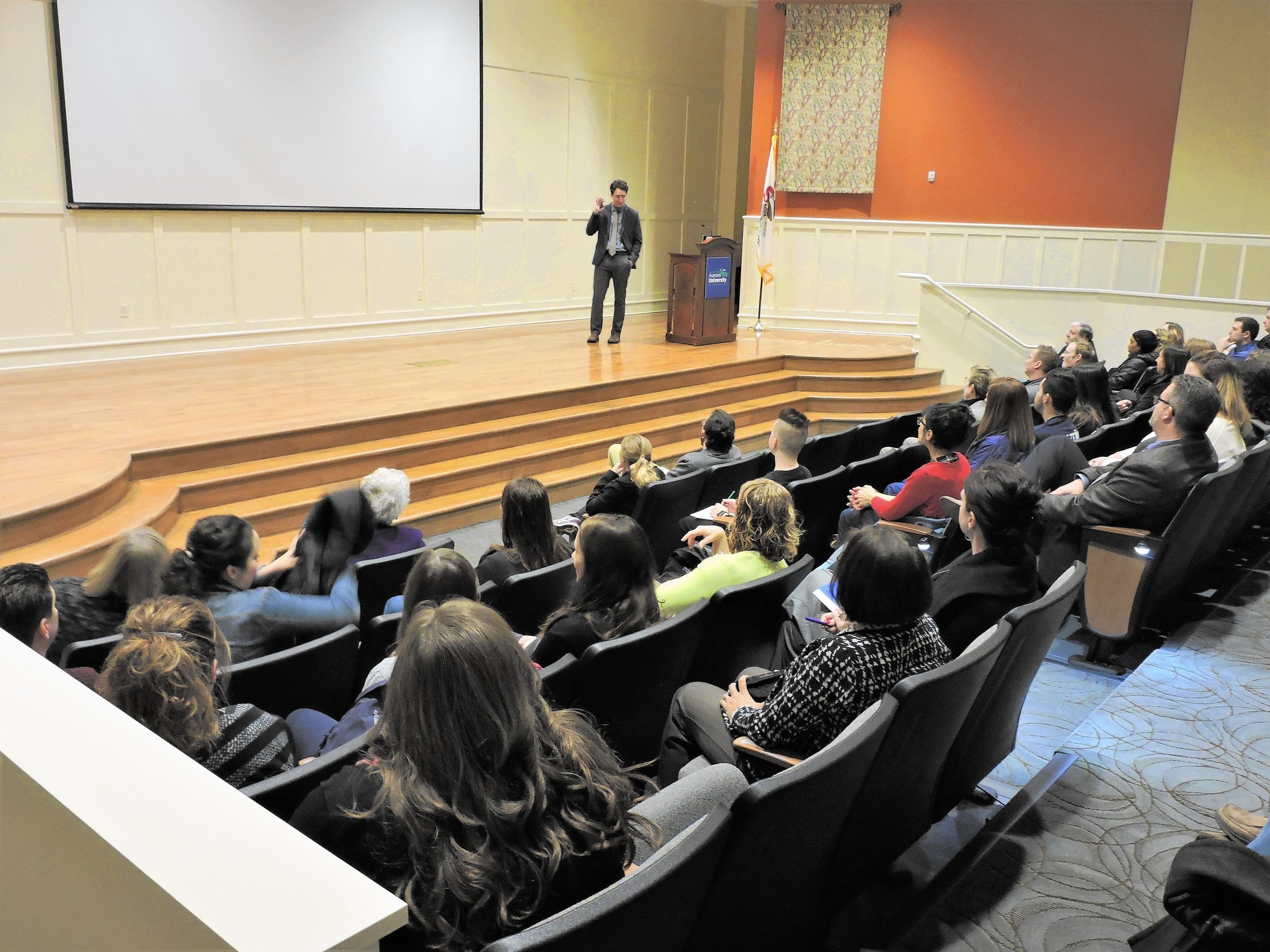

Russia — and its relationship with America and President Donald Trump — was in the spotlight in Aurora during a recent program at Aurora University.
Mark Soderstrom, an assistant professor of history at Aurora University, offered a program entitled “Making America/Russia Great Again? Nostalgia and Democratic Discourse.”
Soderstrom’s presentation featured film clips as well as a number of slides that showed Trump tweets and media cartoons related both to Russian President Vladimir Putin and Trump.
Aurora University President Rebecca Sherrick introduced the faculty speaker by telling the audience she and others like her “were from the duck-and-cover generation.”
“When we were growing up, we practiced ducking and covering our heads in school in preparation for a Russian nuclear attack,” Sherrick told the audience. “Given the intensive dialogue that is now going on, this geopolitical event is a significant one, especially given the reactions people are having.”
Soderstrom said he wasn’t going to dwell much on events like Russia’s alleged hacking activities and its role in the recent election, but rather focus more on the history of Russia and how Putin uses populism.
“Regarding the election and the hacking — people are familiar with that, and it’s an important story — but if you look at Russian history, both Putin and Trump have hit people by using nostalgia to gin up support,” Soderstrom said. “Putin himself is legitimately popular thanks to the economic growth his country has enjoyed, although they have been in a recession the past two years. He has deftly told stories about the Russian empire and given people something to identify with.”
Soderstrom argued that a lot of Putin’s message harks back to an imagined “Russia of the good old days.”
“The 1990s were the worst time for (many) Russian people in their lifetime, and both Trump and Putin play the politics of nostalgia,” he said. “Putin likes to refer to the 19th century and the imperial period, while Trump talks about ‘making America great again’ but doesn’t say what the good old days were.”
Sarah Herbik, of Oswego, said she has been taking classes from Soderstrom “for four years” and wanted to hear her professor’s perspective as opposed to that from journalists.
“We know that Dr. Soderstrom knows Russian history and that the media sometimes controls stories,” Herbik said. “It’s hard at times to know what the truth is.”
Mitch Carter, of Plano, said he has a different perspective on Russia as he is a third-generation Hungarian-American.
“My grandfather was born in Hungary, and I identity with that part of my heritage strongly,” Carter said. “I’ve known for years that Russia enjoys meddling, and they are now. As far as what will happen from this point, it’s hard to predict, but getting any kind of historical perspective is good.”
Freshman Jocelyn Rosales, of West Chicago, said she thought it “was weird that Trump and Putin are supposedly good friends” and that it was strange after President Barack Obama ordered Russian diplomats be sent back to Russia.
“I generally feel there is a lack of trust about what we hear and feel that some of the things that have happened aren’t just coincidence,” she said.
David Sharos is a freelance reporter for The Beacon-News.
This article has been updated to clarify points in the sixth, eighth and ninth paragraphs.