
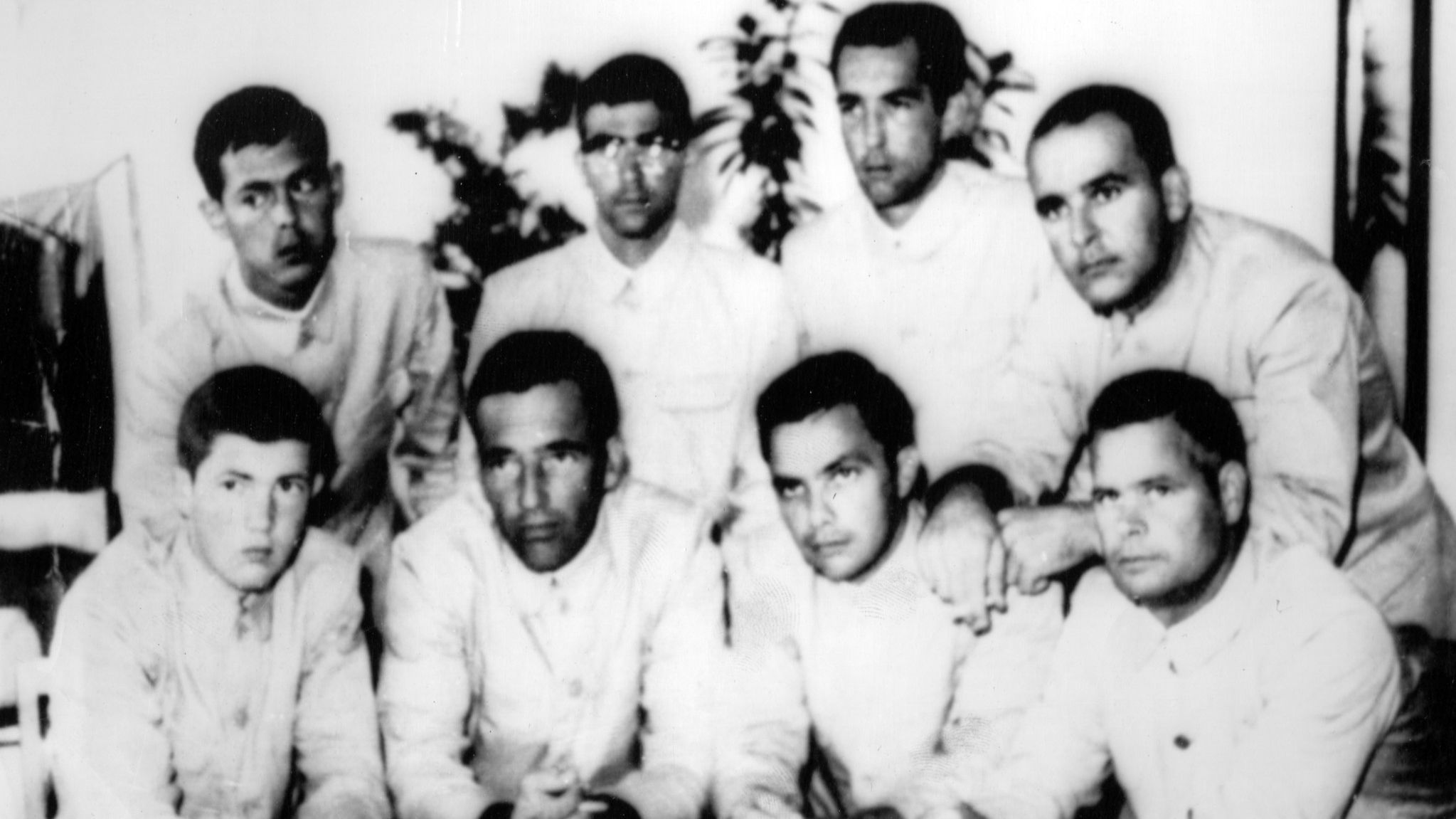

Edward Murphy’s memories of the USS Pueblo are especially poignant and painful this year, as 2018 marks the 50th anniversary of North Korea’s seizure of the American spy ship on which he served. It was one of a series of tragic incidents that made 1968 seem like a year of endless disasters. At the time, though, Murphy knew nothing of what else was happening in the world.
“The North Korean guards only told us a few derogatory things about America,” Murphy recalled in a recent phone interview. Until he was released on Dec. 23, 1968, he didn’t know that the Viet Cong’s Tet Offensive had undermined White House claims that victory was at hand in Vietnam. Or that, as a corollary, President Lyndon Johnson threw in the towel, declining to run for re-election.
Murphy and his shipmates knew little of the assassinations of the Rev. Martin Luther King Jr. and U.S. Sen. Robert Kennedy, the bloody urban riots of 1968 or the tumultuous Democratic National Convention, when police and anti-war protesters clashed on Chicago’s streets.
For 11 months after the Pueblo’s capture on Jan. 23, its crew was cut off from the outside world.
On May 25, the Tribune reported that the parents of crew member Richard Rogala, who lived in Niles, had received a letter from him. He asked them to seek a formal apology from the U.S. government for the Pueblo incident.
“Dick’s phrasing was not like he usually writes,” his father said. “But it is similar to the way he writes when he is under tension.”
Rogala ominously noted that the North Koreans “have been lenient with us so far.” In fact, torture was an ever-present reality for the Pueblo’s crew.
Another crew member, Lee Roy Hayes, said in an interview a few days after their release: “One day, they would treat you nice and the next day beat you for no apparent reason.”
When the 83-man crew’s ordeal began, the Pueblo, a freighter newly outfitted with sophisticated electronic equipment, was monitoring North Korean communications from a position just offshore. Murphy, who was second in command, was wary of the mission. He questioned the judgment of the ship’s captain, Lloyd Bucher, and thus his fitness for command. Bucher died in 2004.
“I wrote a letter of resignation,” Murphy said in the recent phone interview. “It was still in the ship’s ‘out box’ when we were captured.”
From the start, things hadn’t gone according to plan. Murphy said they were supposed to abort the assignment if the ship was detected by the North Koreans, which occurred Jan. 22. But after Bucher moved the Pueblo farther out to sea for the night, he returned the ship to its listening post the following day.
Several North Korean vessels surrounded the Pueblo and demanded its surrender. When Bucher stalled for time, they opened fire, killing one crew member and wounding several others. The Pueblo was hopelessly outgunned and offered no resistance to a boarding party that bound and blindfolded the Americans, then brought their ship to a North Korean port.
The news hit the U.S. like a shock wave. No American ship had been captured in international waters since 1812. Taking note of how the crew in that earlier case put up a stubborn fight against a British boarding party, a Tribune editorial sadly concluded: “The old breed had a tradition of intelligence as well as courage.”
The Pueblo’s crew had become pawns in the Cold War.
In the 1950s, the U.S. had fought a bitter war to keep North Korea from taking over South Korea. In the 1960s, it was fighting to keep North Vietnam from taking over South Vietnam. It was tempting to see a link between the U.S. struggles with the two communist regimes, the Tet Offensive so closely following the Pueblo incident.
The Tribune reported that U.S. Sen. Everett Dirksen, R-Ill., insisted that the capture of the Pueblo and developments in Vietnam were related. “There are facts and circumstances … which certainly give validity to the belief that this was part of a package involving North Korea, North Vietnam and the Viet Cong,” Dirksen said.
Dirksen’s fellow Republicans pounded away on the theme that force must be met with force. California Gov. Ronald Reagan wanted the U.S. to say “that ship better come out of that harbor in 24 hours or we are coming in after it.” Richard Nixon, who would be the Republican presidential candidate that year, said the communists discounted the United States as “overextended, overcommitted and underprepared to act.”
In his memoirs, President Johnson would say that the Pueblo incident began a series of tragic events “that added up to one of the most agonizing years any president has ever spent in the White House.”
Initially, Johnson gave the impression he contemplated military action. Ships were moved into position before the White House decided that diplomacy was the better choice. That led to months of fruitless negotiations, the North Koreans demanding that the U.S. admit its ship had violated that nation’s territorial waters. The U.S. insisted the Pueblo was in international waters.
For the crew’s families, it was nearly a year of agony.
Shortly after the Pueblo’s capture, Our Lady of Ransom grade school in Niles sent students home with letters for their parents to send to Sen. Charles Percy, R-Ill., and Rep. Roman Pucinski, D-Ill., asking them to support their effort to free Niles’ Richard Rogola.
On May 26, the Tribune reported on a Chicago march around the Picasso sculpture in what is now Daley Plaza, where a Prospect Heights clergyman accused Washington liberals of betraying the ship’s crew. “Remember the Alamo. Remember the Pueblo,” the Rev. Paul Lindstrom chanted.
In September in Roscoe, Ill., friends and family of Pueblo crew member Tom Massie blanketed the town with banners urging Americans to “remember the Pueblo because we remember Tom.”
In captivity, the Pueblo’s crew members sustained themselves by playing tricks on their captors. Put on display, they “flipped a bird” as the camera clicked. Unfortunately, Time magazine explained the defiant gesture, provoking the North Koreans to beat the Americans.
Edward Murphy recalled that other beatings resulted simply from their captors’ deep hatred of America.
His beatings also derived from the guards’ ignorance of the outside world, he said. Because units in communist military forces have a “political officer” as a second in command, they assumed America did too.
“As I was second in command on the Pueblo, they were convinced I was a CIA agent,” Murphy recalled.
Finally, in late December, the torture and interrogations came to an end. Pen in hand, the American negotiator said: “I will sign this document to free the crew, and only to free the crew.” And with that, the U.S. accepted full responsibility for the affair, and on Dec. 23, the Pueblo’s crew was allowed to walk across a bridge to South Korea.
There were some loose ends. North Korea kept the USS Pueblo and turned it into a regime tourist attraction. Murphy refused to accept the Navy Commendation Medal given to the ship’s crew members. And Navy brass made Bucher the affair’s scapegoat.
But for the moment, at the end of 1968, all that mattered was that the 82 surviving crew members were home, as the Tribune reported of their Christmas Eve arrival at a California airport. Bucher debarked first, reporting that their fallen comrade’s last words were that he had been privileged to serve in the U.S. Navy.
“The other men followed quickly behind him, and within a few moments they were bouncing children, some they had never seen before, and reassuring mothers that they were all right.”
rgrossman@chicagotribune.com


