
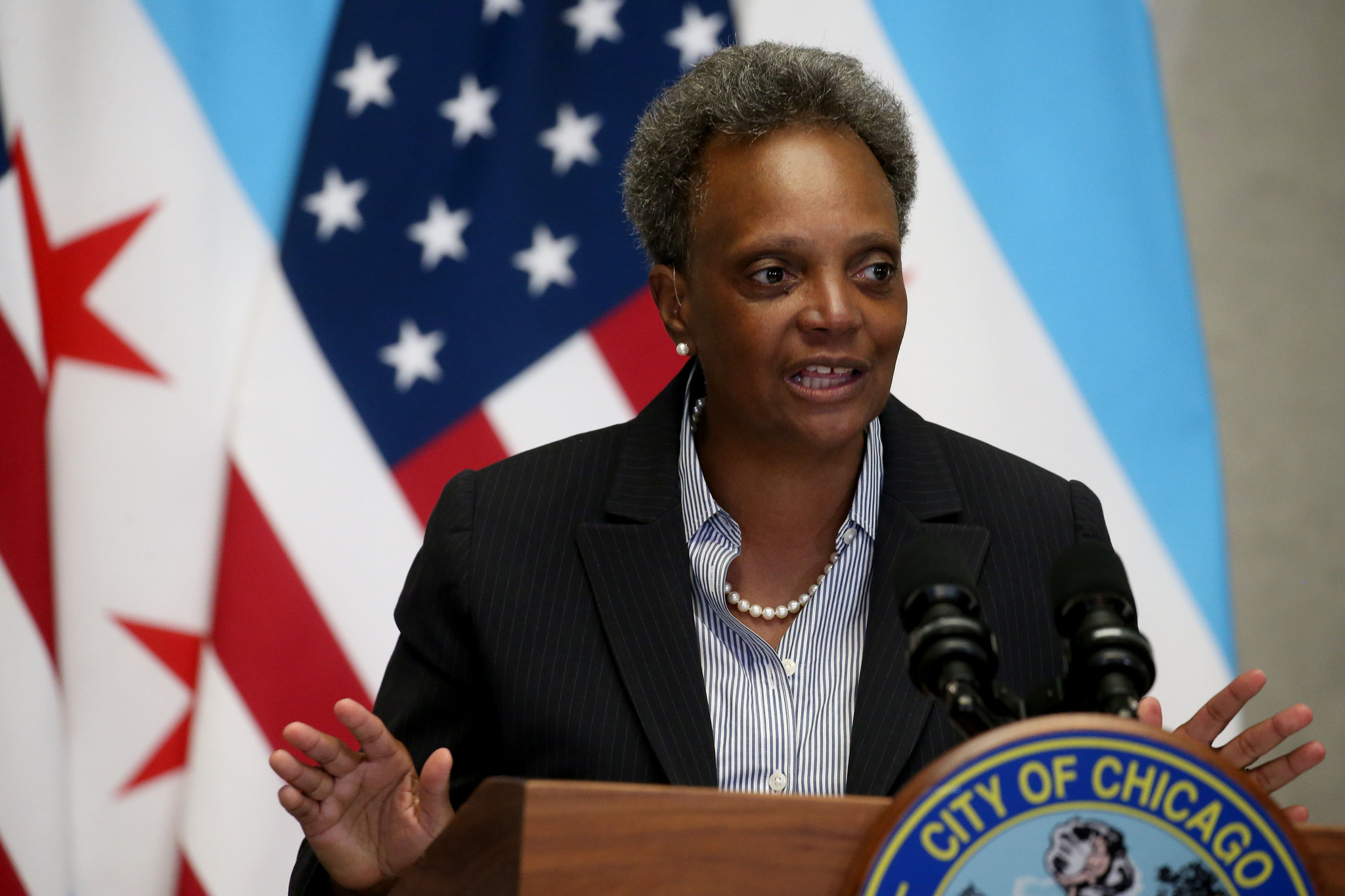

I wholeheartedly agree with the Tribune Editorial Board’s recommendation that city government look to cut personnel and expenses (“For Lightfoot, Pritzker dire budgets mean job cuts are necessary,” Sept. 10). Why not start with the Chicago City Council? Cities larger than Chicago are governed by a handful of representatives. The City Council structure is bloated and unnecessary.
Cutting the City Council could be a gradual process, but it must begin now, preferably by deciding before the next election to cut the size from 50 aldermen to 25. Most aldermen have staffs of six to eight employees. We’d save a fortune on salaries and benefits by cutting the City Council to 25 and cutting staffs to a reasonable number. Most aldermen are making $120,000 per year ($10,000 per month) and many of their staff members are making upward of $50,000. Plus benefits.
Many staff members spend their time on matters better handled by 311 requests, such as trimming trees and cleaning sewers. Wasn’t that supposed to be the impetus behind the recently revamped 311 system? A streamlined City Council would likely be more efficient and more responsive to constituents. Cutting from the top is way overdue. Let’s have a frank, honest, and open discussion, and then let’s get it done.
— Kathleen Reyes, Chicago
The tax cut debate
In a back-and-forth among readers, one person defending the Republican Party’s handling of the national debt and taxes wrote that “tax cuts generally increase tax revenues.”
While this is true, generally, it is not true of the Trump/Republican tax plan of 2017. The vast majority of tax benefit went to wealthy individuals and large corporations. The benefit to individuals went directly to their personal bottom lines. Those that went to corporations were not used to any large extent to fund expansions or hire workers, but rather for stock buybacks that went to the bottom lines of shareholders. No tax revenue benefit occurred, it was a deficit-increasing measure.
— Matt Foster, Orland Park
A role for the National Guard
John Kass’ recent column (“Is there a rain hard enough to cleanse Chicago of its sins against children?” Sept. 9) was spot on. The Tribune Editorial the same day (“Listening for answers after another child killed”) also addressed the murders of innocent children. There is one significant action that could certainly help, but the mayor and governor simply won’t act as they need to. The National Guard needs to be brought in to assist local authorities. Plain and simple. Anyone who has lived here as long as I have knows the real reason — both of them will not do this as it would potentially put the federal government in a positive light if it works. Politics as usual in Illinois. They will not do anything to put the current administration in a favorable position, even if it means more murdered children. Simply reprehensible!
— Mike Siemann, Naperville
How to stop the shooting
The Sept. 9 editorial asks how to end gun violence in Chicago. We already know how to do it. The only questions are whether we actually want to, and if we are willing to pay the necessary price.
We know where gun violence happens. We know its likely perpetrators, and we know its likely victims. We know how to interrupt gun violence because we’ve done it. We know how to help those who have been victims of violence and those who have been perpetrators. Likewise we know how to provide career training and a path to a job. We know how to do all of it, and all of it is necessary, because nothing else addresses the reality of so many battered human souls.
The question is: Do we really want to make the necessary investments? That answer depends on who we think is pulling the trigger. Is it the multiple-offending lowlife who shoots into a crowd of kids? Or, is it one of those same kids, now an adult, who years earlier witnessed that same kind of violence, grew up in a rundown house, went to a bad school, had no job training, has nothing to look forward to, and has PTSD to boot? If so, then ending gun violence depends on doing all the things we already know how to do, but doing them at a scale that matches the size of the problem.
How much will that cost? If we asked our city community leaders and violence interrupters to estimate the costs of funding all the necessary programs at the necessary scale, we’d have a ballpark cost. I’m guessing it’s in the billions. A citywide plan for ending gun violence is really something we should already have.
And why should we pay for it? Let’s start by estimating the wealth that has been extracted over the past 90 years or so from our fellow Chicagoans through redlining, job and financial discrimination and the rest, as well as the time value of that money. That will put the cost of the solution in perspective. Solving gun violence and restoring these neighborhoods to what they should be is a debt that as a city, we owe.
Finally, let’s imagine what Chicago could be with all of its neighborhoods and downtown in vibrant economic and cultural bloom. And the dismal alternative.
— Jeanne Follman, Wilmette
Climate change and the Midwest
Thank you for publishing “Big problem for smallest Great Lake” by Patrick M. O’Connell. We often think of climate change as a problem impacting the U.S. coasts. But this article highlights risks impacting our region. Climate change is dramatically compressing the water level cycles of the Great Lakes. The related high water levels cause significant property destruction and damage to sectors of the tourist economy.
As our Illinois climate continues to warm, we will see more extreme rain events in the spring that will drive additional flooding. We can expect economic impacts to include continued crop yield loss, expensive infrastructure investment to handle increased stormwater runoff, and lake water degradation. Hotter and dryer summers will cause health impacts resulting from increased levels of smog.
These are the costs of “doing nothing” about climate change according to research. The “something” we can do is to call or write our Congressional representatives to put a price on the carbon emissions that are warming our climate. Bipartisan introduced legislation called the Energy Innovation and Carbon Dividend Act (HR 763) prices carbon emissions and promotes “clean” energy without harming the economy, jobs or consumers. Acting now will reduce cost impacts and increase long-term quality of life.
— Andrew Panelli, Homer Glen
Join the conversation in our Letters to the Editor Facebook group.
Submit a letter, of no more than 400 words, to the editor here or email letters@chicagotribune.com.


