

“Tenuous.”
That is a word to which Bookie’s owner Keith Lewis keeps coming back when describing what it is like to run independent bookstores in the 21st century, besieged by thin profit margins, declines in physical book sales and, of course, Amazon.
“Everything’s always up in the air about what’s going to happen next,” Lewis said. “If one thing goes wrong, you lose your whole business.”
And that is just during typical times. Bookie’s, which has stores in Homewood and Chicago’s Beverly neighborhood, was at the doorstep of shuttering for good during the COVID-19 pandemic.
“Frankly, we were very close,” Lewis said. “We were really close. It was dire. I think I probably had a few hundred bucks in the bank account. But then things started to happen a bit.”
Those things include Paycheck Protection Program funds, as well as municipal, state and county grants that totaled roughly $64,000. The grants allowed Bookie’s to pay off the debt it was accumulating, as well as revamp its computer systems to better handle the online sales that became Bookie’s bread and butter while browsing the store was off-limits.
“They helped to keep me afloat, very much,” Lewis said.

Bookie’s also got the Book Industry Charitable Foundation’s $10,0000 Survive to Thrive grant in late June, aimed at “assisting stores … poised to make a strong recovery from the pandemic,” according to the foundation. Binc, as the foundation is otherwise known, helps independent bookstores and comic book shops facing tough business situations.
“They’re fantastic,” Lewis said.
The money from Binc helped Lewis hire new people at both Bookie’s locations and get closer to returning to normal store hours. He is also hoping to use some of that money to create a mailer to market the Homewood store, in particular, to the community.
“There’s still so many people who say, ‘I didn’t know there was a bookstore here,'” Lewis said. “And we’ve been there almost 3 years.”
That awareness is just one skirmish in the battle Bookie’s faces. For Lewis, the bigger fights are against the trend toward online sales, the “detrimental business practices” of Amazon and customers’ innate urge to find a better deal, even if that means driving from Beverly to Orland Park to save 50 cents on a book. Lewis wants people to see the value in a local bookshop the way he does.
“Sometimes it’s just worth it to pay a little extra,” he said. “I think every community should have a bookstore, but everyone in the community needs to utilize that bookstore.”
Starting a new chapter
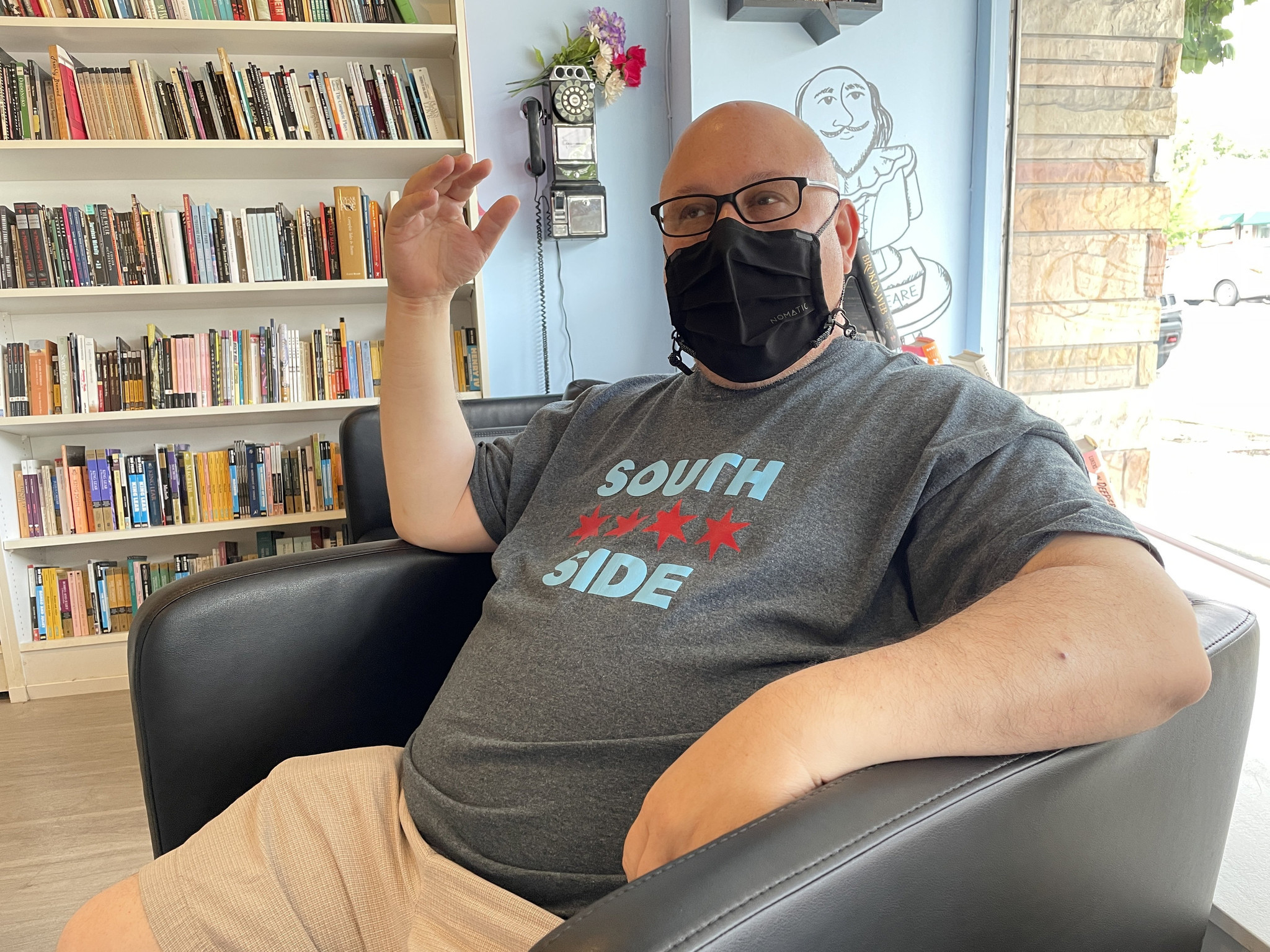
Bookie’s has been around for 32 years in Beverly, but Lewis did not always own it. A resident of the neighborhood, he regularly shopped at the old location next to a 7-Eleven on 103rd Street.
He left his role as a high school English teacher at the end of 2014 with no plans for the subsequent chapter.
“I was just going to take a year and figure out what’s next,” Lewis said.
Four months into that year, then Bookie’s owner Allison Platt asked Lewis if he ever thought about running a bookstore. He took over a month later, and on Jan. 2, 2015, reopened the store. By then, it was already facing hardships largely attributable to competition from Amazon.
“It’s not an easy task,” Lewis said of running an independent bookstore. “There have been challenges since I took over. … It’s been very, very hard.”
On July 1, 2017, Lewis moved Bookie’s around the corner, where it now holds two connected storefronts along the west side of Western Avenue, just south of 103rd Street.
“Business in general was in decline until I moved here,” Lewis said. “It’s helped quite a bit.”
Though, Lewis admits the bigger store is something of a “novelty” that seems to be wearing off, and it also comes with higher rent. The pricing competition from Amazon remains a problem, and despite the relative scarcity of bookstores in the Chicago Southland, it can be hard to emphasize the importance of them.
“It’s really hard to keep people’s interest up,” Lewis said. “I’ve learned over the last couple of years that just existing isn’t enough. We have to constantly be out there and explain things whenever we can.”
Lewis said he hires people who are reading all the time. One of the ways Bookie’s tries to make its bookstores different is by having real people who can recommend books on experience and the tastes of their customers.
“Just talking is the main key,” he said. “Letting them know we’re here, helping them find books in a way that is better than some algorithm. … It’s hard. There’s never enough I can do to change everyone’s mind. But I have a lot of loyal customers who wouldn’t shop anywhere else.”
Playing it safe
“When COVID started, we didn’t know what was going to happen,” Lewis said.
But he had a pretty good idea that the state was going to shut things down at some point. Lewis figured Bookie’s could be classified as an essential business, especially with schools shifting to remote learning but still in need of access to books.
“But there was no way I was going to have other employees come in and run the store,” Lewis said. “I couldn’t ask that.
“For as long as I could, I still kept paying wages. I think I managed to get maybe six weeks before I ran out of money.”
Lewis started burning the candle at both ends. He would spend a few hours each morning at the Beverly store, processing orders and doing curbside deliveries. Then he would go over to the Homewood location to do the same thing. At that point, he was only doing 10% to 20% of his typical business.
During the early ebb and flow of lockdowns that started in March 2020, Lewis decided to keep his stores closed for browsing, not yet comfortable with the idea that COVID-19 was on the ropes. He finally reopened for browsing last August, with one employee returning to Homewood while he manned Beverly with reduced hours.
A cliffhanger
Despite the help Bookie’s received over the past year, bookstores are still a difficult business. The grant money he received is long gone, and opportunities to get further assistance are drying up.
“The troubles aren’t over,” Lewis said. “Right now, sales are about double of when we were closed, but they’re still about half of 2019.”
After some Bookie’s employees were left unemployed, they moved on to other jobs. Lewis has an almost entirely new staff now in Beverly, while two mainstays from the beginning of the Homewood store remain. Business is still a “tenuous” affair.
“You never know what’s going to happen,” Lewis said. “I still have to figure things out. … It’s not over. I am still consistently and constantly worried about finances. Still.”
But Lewis is determined to find a way. Frankly, he does not want to live somewhere that does not have an independent shop like Bookie’s. He just needs to convince others that there is value in ditching Amazon as he did “literally years” ago and shopping in their own communities.
“I still believe this neighborhood needs a bookstore,” Lewis said of Beverly. “I still believe that Homewood needs a bookstore. … It really is, in my opinion, a privilege to have a bookstore in your neighborhood. Physical stores make communities better. They do.”
Bill Jones is a freelance reporter for the Daily Southtown.