


Backlash over a Tennessee school district’s decision to ban a graphic novel about the Holocaust has reached the Southland.
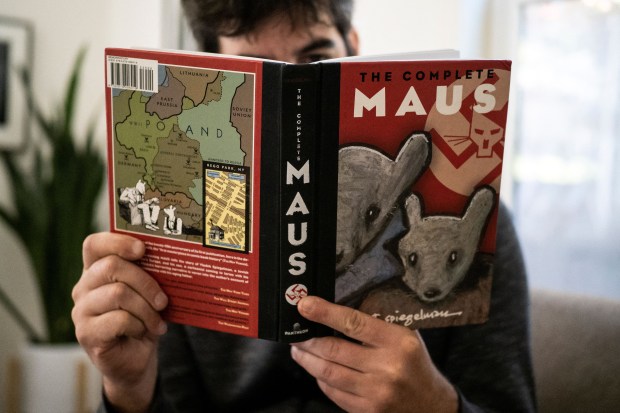
Organizers in Beverly are raising money to buy copies of Art Spiegelman’s book “Maus.” They want to acquire more than 100 copies and give them to libraries in every public and private school in the 19th Ward.
“The banning of books, taking them out of the curriculum because they make people uncomfortable, is really frightening in a way,” said Tim Noonan of the group 19th Ward Mutual Aid. “These are things that happened. They need to be learned about so it doesn’t happen again.”
Spiegelman’s book is a memoir about his father’s experiences as a Polish Jew and Holocaust survivor. The story is told through text and comics-style illustrations depicting Nazis as cats and Jews as mice. It won the Pulitzer Prize in 1992 and remains the only graphic novel to earn the honor.
In January, the McMinn County School Board in Tennessee unanimously voted to remove the book from its curriculum. Last week, the school board affirmed its decision during a public meeting packed with demonstrators protesting the ban.
The move made headlines and catapulted the book back to the top of bestseller lists. Bookstores, Jewish groups, free-speech advocates and others nationwide are trying to acquire copies so young adult readers have access to “Maus.”
“The books are really difficult to get right now,” Noonan told me.

His 19th Ward group is working with the organization Jews of Beverly and Bookie’s Bookstore, he said. There are 21 public and private schools in the ward serving middle and high school students, he said. Organizers want to give five copies to each school library.
“We just started Friday and we’ve already raised over $1,000,” Noonan said Tuesday.
Book banning is sweeping the nation as culture wars expose the depth of partisan divides. Boards overseeing public schools and libraries have acted to remove many controversial titles. Some state legislatures are considering laws that might make librarian and teachers civilly liable for exposing children to controversial ideas.
Subjects of banned books often deal with such sensitive or contentious topics as sex, gender identity, race, profanity and drug and alcohol use. According to the American Library Association, some of the most frequently challenged titles in recent years have included “To Kill a Mockingbird” by Harper Lee, “The Bluest Eye” by Toni Morrison and “The Handmaid’s Tale” by Margaret Atwood.
“It’s insane,” Noonan said. “You read the list, you’ve read half of them yourself.”
Members of the Tennessee school board said the decision to ban “Maus” was based on the book’s use of language and nudity. In one small frame of the comic, naked mice are depicted in a concentration camp. Spiegelman used profanity when recounting a confrontation with his father about his mother’s suicide.
Scholars and free speech advocates have said the value of the book’s description of the Holocaust outweighs potential harm of reading parts that could be considered offensive.
“No one has yet figured out how to depict the Holocaust without ugliness, for the very obvious reason that it was one of the greatest crimes in human history,” The Atlantic said this month in a piece about the “Maus” controversy.
Under Adolf Hitler’s Nazi rule of Germany during World War II, more than 6 million European Jews and others were killed during the Holocaust genocide. Many died in gas chambers at concentration camps.

When Supreme Allied Commander Dwight D. Eisenhower discovered atrocities during liberation in 1945, he invited the press and filmmakers to document the scenes, according to the United States Holocaust Memorial Museum.
“Bodies were piled like wood and living skeletons struggled to survive,” the museum said on its website. “Eisenhower foresaw a day when the horrors of the Holocaust might be denied.”
More than 57,000 people in the south and southwest suburbs voted for Holocaust denier Art Jones in a 2018 congressional race. Jones was the Republican nominee for the 3rd District and lost to then-Rep. Dan Lipinski.
I believe few of the votes for Jones were by accident. Many would rather vote for a Holocaust denier than a Democrat. National media were all over the story about how Jones, a former Nazi, was running for Congress.
Jones told me he didn’t deny that 6 million people died. He believed they died from disease, not genocide.
In 2018, I found it tough to imagine how anyone could believe such a distorted, alternate view of historical facts. Now that the world has endured two years of a pandemic that has killed more than 5.8 million people worldwide, I feel less confident that future generations will believe the whole truth about the Holocaust.
I give credit to 19th Ward organizers for responding to the “Maus” controversy with its campaign to donate books to school libraries. We have become incrementally desensitized to many developments that would have been considered outrageous a decade or two ago.
Ward leaders have responded similarly to past incidents. After racists tagged buildings with graffiti in 2019, the community hosted a forum with anti-hate speakers. One was Christian Picciolini, a Blue Island native who was recruited to join a neo-Nazi group in Beverly when he was a teenager. Community leaders want future generations to know the truth about the Holocaust, even it if it uncomfortable to talk about it.
“It’s something that needs to be in the consciousness,” Noonan said. “We don’t think the Holocaust a political thing. It really happened. It’s something that should be learned to make sure it doesn’t happen again.”
Ted Slowik is a columnist at the Daily Southtown.