
After a few minutes of watching members of Evanston’s Reparations Committee select the first recipients of the housing grants the city is paying to some African American residents, GiGi Giles said she turned off the livestream.
Giles, like some residents and critics of the city’s Restorative Housing Program, was upset. For her, even the way the first recipients were selected and identified earlier this year – called as a number on a ping-pong ball drawn from a bingo cage – was offensive.
“I just felt like they could have called those senior citizens’ names,” Giles said about the first-round grantees. “I know … you can’t put people’s names out there like that, but I felt like they deserved some dignity.”
Hers is among the latest criticism of the program, including how money from it is to be disbursed.
The historic program was established to acknowledge “the harm caused to Black/African-American Evanston residents due to discriminatory housing policies and practices and inaction on the city’s part,” according to the city document outlining it.
The program provides up to $25,000 for qualifying residents to purchase a home, fix up the one they have or pay down their current mortgage. The goal, according to the guide, is to preserve current homes Black Evanston residents already live in, increase homeownership and wealth – including intergenerational – among the city’s Black residents and work to keep Black homeowners in Evanston.
RHP has had its supporters and detractors, the latter of which includes legal groups and other African Americans who say the program doesn’t go far enough, doesn’t qualify as actual reparations, and ends with banks and lenders pocketing the reparations money instead of residents.
Supporters of the city’s reparations effort consider Evanston’s work far from done but say the grants are a promising start.
“Obviously, we have more work to do,” said former 5th Ward Alderman Robin Rue Simmons, who spearheaded this reparations effort. “Other institutions should be participating. We should be expanding our fund and expanding our benefits.”
Ahead of selecting the first recipients of the grants in January, the process of establishing the reparations fund has been a deeply contentious one — and since it was first established in 2019.
According to the Restorative Housing Program guide, the first group to receive grants is made up of “ancestors,” African Americans who were at least 18 years old and an Evanston resident between 1919 and 1969 – and live in the city now. City records indicate that 123 people qualify for the program as ancestors.
Sixteen of the eligible ancestors were selected to receive grants, with the city to pay $400,000 of the initial $10 million that is to be made available for the program.
“They’ve been discriminated against for housing … that’s why they’re getting this money, because they were discriminated against. So why not give them some dignity and call their name?” Giles said about discontinuing to watch the livestream.
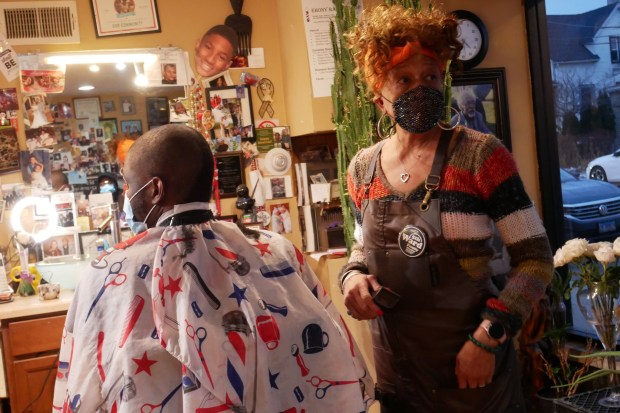
Giles, who owns the four-chair Ebony Barber Shop on the southern edge of the 5th Ward, just north of Evanston Township High School, said she, herself, could qualify for a grant. She is a “descendant,” she explained, defined in the Restorative Housing Program guide as a blood relative “in direct line of descent” of an ancestor. Her late father, from whom she inherited the barber shop, would be an ancestor.
Evanston made national headlines when the Restorative Housing Program became the first of its kind in the nation to compensate African American residents for codified discrimination.
Some of the money for the grants is coming from marijuana sales tax revenue. The City Council approved using $10 million from the Municipal Cannabis Retailers’ Occupation Tax, which collects 3% on gross sales of cannabis, to help fund the housing reparations program.

Now-former 9th Ward Alderman Cicely Fleming, one of three African Americans on the City Council in March 2021 when plans for the housing reparations program came before the council for approval, was the only council member to vote against it.
By the time committee members chose the first reparation grant recipients Jan. 13, the allocations had been delayed repeatedly, and three eligible residents had died. Additionally, the specifics of how and when people would receive grants seemed to have changed even as recently as the week before the lottery.
As the program goes, recipients don’t receive money directly. The funds are instead being managed and spent by the nonprofit Community Partners for Affordable Housing, following a deal approved at the Jan. 6 Reparations Committee meeting.
The use of a third party to manage the funds instead of providing direct payments was the latest controversy to dog the reparations program.
Alderman Peter Braithwaite, 2nd Ward, who chairs the Reparations Committee, told Pioneer Press that CPAH would assist qualifying elderly residents with using the funds or opting out and said that further discussion on the nonprofit would have delayed distribution of reparation funds even more.
Giles, for her part, was unconcerned about this change, so long as she would be able to use the money to renovate her father’s condo, which she moved into after returning to Evanston to take over the barbershop.
“I would love to be able to fix up his home with that money,” she said. “When he started cutting here, there were only two Black barbershops in Evanston. So, I feel like he’s well-deserved for this.”
Giles also said she’d like to see reparations money be used to support Black businesses or to establish an elementary school in the Fifth Ward. Foster School had been there, but it was converted into a magnet school in 1964 and then closed in 1979.
Montez Cannida stopped by Ebony Barber Shop on a Friday afternoon for a haircut. He said he’s lived in Evanston his whole life and talked about how someone should write a screenplay about the 5th Ward.
Cannida said he, too, would qualify for the housing reparations program as a descendant.
He also favors more flexibility in the use of the grant funds, saying he would like to see the money go toward setting up opportunities for residents in film and television – to highlight issues like redlining. Funding could go to that or mental health issues, which he said he felt were overlooked in the Black community.
Cannida said regardless of the restorative housing grants, he wants to see much more done to address racial discrimination.
“You’re not going to put a Band-Aid on it,” Cannida said. “‘Cause it’s an atrocity and it still goes on today.”
Simmons told Pioneer Press there were limits to what Evanston could do with the reparations fund, though she supports growing the program beyond housing to include such offerings as financial support for Black-owned businesses. She acknowledged that $25,000 alone was not enough.
“A cash benefit alone is insufficient redress,” Simmons said. “This housing benefit alone is insufficient redress. The good news is, we are 4% into allocating our budget. We have years ahead of us, and we have community partners who are committed to the work.”
Joshua Irvine is a freelancer.