

The fierce patriotism Ukrainians have shown in resisting Russian tanks was previewed on the Lake Michigan shoreline in 1933. The Ukrainian Pavilion stood there during the Century of Progress Exposition, a world’s fair marking Chicago’s centennial.
The Ukrainians exhibited their traditional handicrafts and the sculptures of Alexander Archipenko, a famed pioneer of modern art. “‘Miss Ukraine’ will be selected this afternoon,” the Tribune reported on Oct. 7, 1934, the fair having been held over for a second year.
Ukraine was then part of the Soviet Union, and its national pavilion at the fair was the only one not sponsored by a government, much to the displeasure of Soviet officials.
“Despite vehement protests from Soviet Ukrainian authorities, the Ukrainian Pavilion was approved by world’s fair organizers,” Myron Kuropas noted in “Ukrainians of Chicagoland.”

Among other things, the Soviets were not pleased to learn that varenky, the Ukrainian variety of a stuffed dumpling known as pelmeni in Russia, would be among the featured delicacies at the Ukrainian Pavilion’s outdoor cafe.
In many ways, Ukrainian nationalism has been a product of exile, forged in overseas communities like Chicago’s Ukrainian Village. Designated a Historic Preservation District by the city in 2002, it was born of the vision of Dr. Volodymyr Simenovych, who in 1911 urged Ukrainians to settle near Western and Chicago avenues, as the Tribune subsequently recalled:
“We can build a glorious new church, we can all purchase lots near the church, we can eventually build our homes on these lots, and with God’s help, we can have our own, new Rus (Ukraine’s ancient name) right here in Chicago.”
During the 1917 Russian Revolution, Ukrainians declared their independence but were defeated by Soviet troops a few years later.
Rusyn was one of the terms by which Ukrainians identified themselves, leading U.S. immigration officers and census takers to mistake them for Russians. Others were registered as Ruthenians, Lemkos, Uhro-Rusyns and Carpatho-Russians.

That varied nomenclature reflected their countries of origin: Austria-Hungary, Poland, Russia and Czechoslovakia. The Ukrainian odyssey is described in “Epic Journey,” Wasyl Kushnir’s account of coming to Chicago.
His father fought for the Ukrainian National Republic, which forced him into hiding when it was crushed by the Soviets. In the 1930s, millions died during the Holodomor, when the Soviets stripped Ukraine of its food supply during a famine.
“I remember that in early spring, when the snow had just melted, I went to the garden to find something, a potato that may have been left in the ground the previous autumn,” Kushnir wrote. “I found not a whole potato, but a piece of potato, so white it looked like shortening. From that, my grandmother cooked a sort of soup-water.”
The Nazis deported him to a forced-labor camp in Germany. Freed by the U.S. Army, the American authorities sent him to Mississippi before he pushed on to Chicago in 1950.
“I had heard about a Ukrainian community in Chicago. They were very supportive and suggested I move to Chicago,” Kushnir wrote.
In Ukrainian Village, he and his refugee wife, Maria, speedily rebuilt their lives. He worked in nearby factories. They initially rented an apartment, then bought a two-flat and an apartment building before retiring to Florida.

“In the free American society, every person’s life is unbounded,” he concluded, adding a thank-you note: “This country has welcomed the people of Ukrainian ancestry who could no longer live in their homeland.”
Ukrainian Village wasn’t homogenous when Kushnir arrived. To this day, its divisions are memorialized in brick and stone by the churches that line Oakley Boulevard: St Nicholas Ukrainian Catholic Cathedral, Sts. Vladimir and Olha Catholic Church, and St. Volodymyr Ukrainian Orthodox Cathedral.
Ukrainian immigrants came from a region where the Roman Catholic Church, whose priests are celibate, abuts the Orthodox Church, which allows priests to marry. Those differences were noted in the Tribune’s 1984 obituary of Josyf Cardinal Slipyj, the head of the Ukrainian branch of the Catholic Church, who “returned to an ancient rite tradition and ordained four married men from Chicago to the priesthood, despite opposition by Vatican officials.”
Such rites pleased the Ukrainian Village traditionalists, who were angered when St. Nicholas cathedral began observing Easter on the same day as other Roman Catholic churches. In 1967, a Ukrainian-language radio station mistakenly announced a pre-Easter celebration would be held at the cathedral on a date set by the Byzantine-Rite calendar listeners grew up with. Five hundred worshippers arrived to find there was no celebration.

“The demonstrators sang and chanted for about four hours before they left at the request of police,” the Tribune reported on April 29, 1967. “Yesterday many of them returned and began what they termed ‘a pray in’ in the cathedral.”
The Ukrainian community’s secular organizations ranged from conservative to radical. But most probably agreed with the Svoboda newspaper, which advocated in favor of an independent Ukraine, writing: “And once we have built a free Ruthenian state we won’t have to wander about the world like homeless orphans.”
When Lenin’s communists ousted the czar in 1917, a mass meeting of Ukrainian socialists in Chicago expressed their congratulations.
But Chicago’s Ukrainians were quickly weaned off Marxism by the reality of Soviet rule in their homeland. In the 1930s, some Ukrainians prepared to liberate the homeland by enrolling in the Illinois National Guard. With the Guard’s membership declining, it allowed ethnic contingents like the Ukrainians’ Company B to form under American officers.
With time, Ukrainians assimilated into the American mainstream. As a Ukrainian activist observed on the eve of World War II: “To understand the true situation among us Ukrainian Americans, especially the fact that we were no longer Ukrainian emigrants, but Americans of Ukrainian extraction,” is critical.
We’re “far more interested in what happens in America than what happens over in Ukraine,” he argued.
But take a look at Ukrainian Village today. Blue and yellow flags line Chicago Avenue. Signs proclaiming solidarity with Ukraine are posted in windows throughout the neighborhood.

Instead of hibernating, Ukrainians’ love for their ancestral homeland has become a worldwide passion. Volunteers from many countries have joined the Ukrainian resistance. Some are retracing the steps of immigrant forebears. Others lack a previous connection with a country for which they are willing to die.
Harrison Jozefowicz told Martha Raddatz, an ABC war correspondent, that he resigned from the Chicago Police Department in order to bring his U.S. Army training to the defense of Ukraine. She asked him why. He pointed to a nearby apartment building where civilians had been killed by Russian bombs and shells.
“This shouldn’t happen to anyone,” he said.
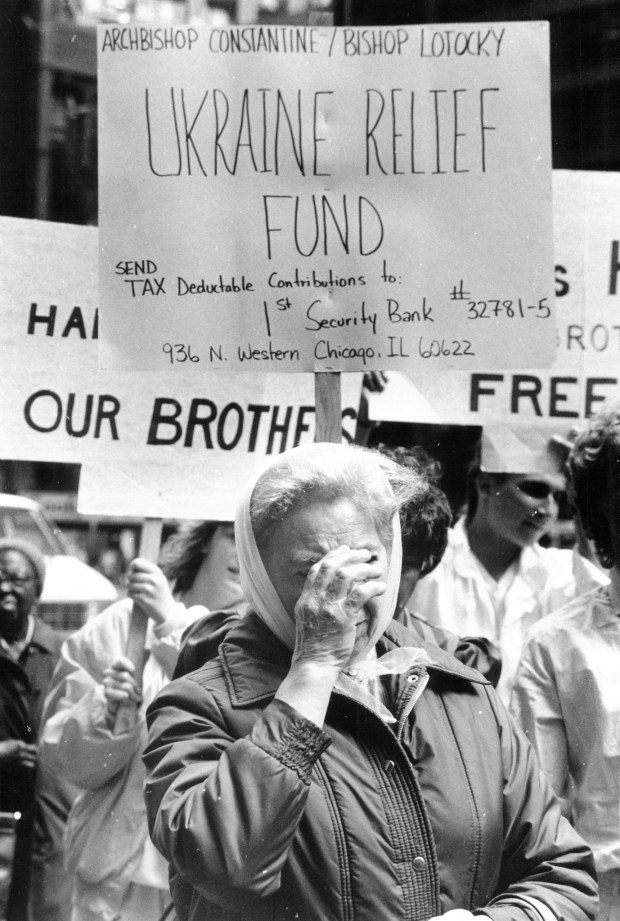
His words were silently echoed in Sts. Vladimir and Olha church on a recent Sunday. Dozens of parishioners were packing food, clothing and medical supplies dropped off by donors horrified by Ukraine’s devastation. Diapers were being shipped to mothers who gave birth in a bomb shelter and had nothing with which to clothe their babies.
A service of remembrance was being held in the adjacent sanctuary. As an elderly woman afterward descended the church steps, a single tear slowly rolled down her cheek.
rgrossman@chicagotribune.com
Join our Chicagoland history Facebook group for more from Chicago’s past.