

Markham Mayor Roger Agpawa has a funny understanding of how democracy works.
When several residents and an alderman raised concerns about a lack of citizen input for remapping wards in the small south suburban city, Agpawa told them their views wouldn’t have mattered, anyway.
“We’d be here for eons trying to get everyone to agree on something,” Agpawa said Wednesday during a Markham City Council public meeting. “This is democracy at its best.”
The council voted 3-1 to adopt a new ward map based on the 2020 census count. Markham should have updated its ward map every 10 years, but its existing map was based on the 1990 census.
“The problem is Markham hasn’t redistricted since 1998, based on 1990 numbers,” celebrated municipal attorney Burt Odelson said. “We’re basically 30 years behind in redistricting.”
One might think that a representative unit of government redrawing district boundaries for elected officials for the first time in a generation would take a careful, deliberate approach that gave citizens ample notice, invited their participation and incorporated their feedback.
Not Markham. The council majority adopted a new map two weeks after it was first publicly presented and without making a single change from the initial proposal.
That upset numerous residents. A half dozen citizens gathered outside Markham City Hall at 6 p.m. Wednesday, an hour before the council meeting. They waited outside the locked front doors until a police officer allowed them to enter at 6:53 p.m.
They arrived early, they said, because some of them were prohibited from attending the Aug. 7 council meeting. The council is still operating under emergency procedures adopted during the pandemic, and capacity in council chambers was restricted, they said.
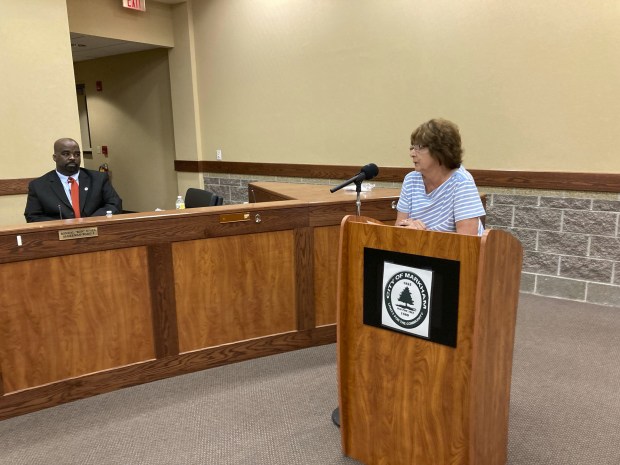
“This governing body limited participation to only 26 attendees at the last meeting,” resident Patricia McKinney said during public comment at the very end of the meeting, after the council had already voted to adopt the new map.
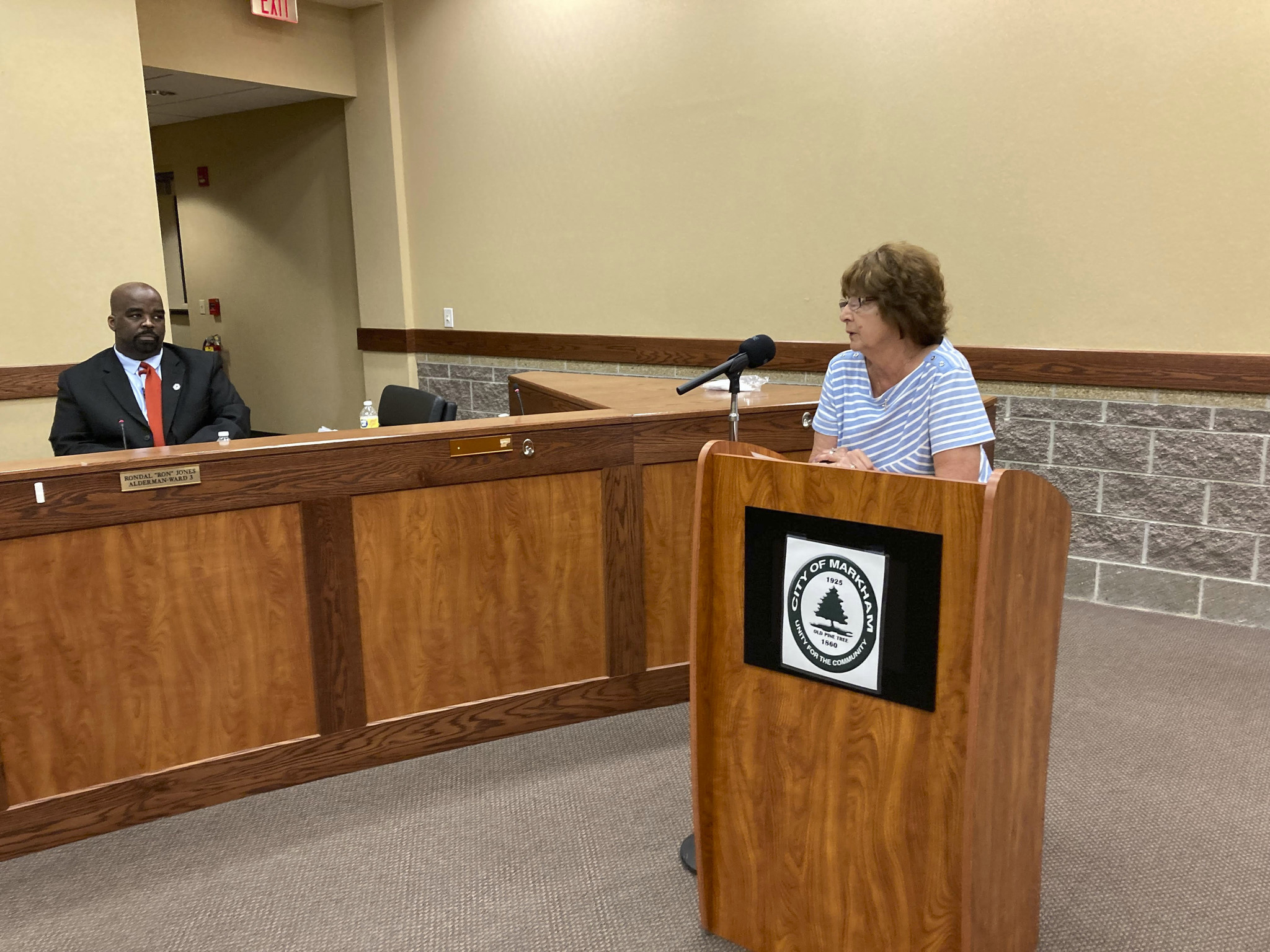
McKinney had researched the remap process and cited guidance that indicated Markham could have done more to invite public feedback.
“To the extent possible, governing bodies should seek to provide more than one platform to submit input,” McKinney said. “Adequate notice should be given to invite participants.”
No one doubts that Markham needed to redraw its four wards. In the village form of government, there are no districts and every elected board member serves the community at-large. But cities have defined wards represented by aldermen. Ward boundaries are supposed to change every decade if population distribution has shifted.
Markham’s ward boundaries had not changed for so long, 44% of the town’s population now lives in the 4th Ward when each ward should have about 25% of the city’s residents.
“That’s why the wards are so far off, with the 4th Ward being so heavily overpopulated and the 1st Ward being so heavily underpopulated,” Odelson said.
The population shift should come as no surprise. In 2016, Markham helped a developer acquire an entire 1st Ward neighborhood. Homes were demolished, trees were cleared and streets and utilities were removed from a 140-acre site now occupied by an Amazon fulfillment center, south of 159th Street between the Tri-State Tollway and Dixie Highway.
Federal law requires that population variations shall not exceed 10% in representative districts.
“The deviation in 1998 was 91%,” Odelson said. “Now it’s 9.7%.”
Ald. Rondal Jones, who has represented Markham’s 1st Ward for 16 years, cast the dissenting vote. Jones and Agpawa argued and spoke over one another during the council meeting.
“This is not transparent,” Jones said.
“Nothing is going to be good enough for you,” Agpawa replied. “We listened to you two weeks ago.”
That reminds me of someone who said, “But I fed the baby yesterday.” In Agpawa’s innovative interpretation of democracy, apparently dissenting voices need only be heard once. There’s no time for repetition when you’ve got to fix 30 years’ worth of noncompliance with federal law, I suppose.

Earlier, Jones sought to table adoption of the new map but his motion to postpone died due to lack of a second.
“There’s not enough information,” Jones said. “We need more time to digest this.”
The new map will change aldermanic representation for thousands of Markham residents. Markham’s population declined by 866 people to 11,661 in 2020 from 12,527 in 2010, according to the city’s redistricting presentation.
“This will confuse residents eight months before an election,” Jones said.
Markham’s redistricting presentation cited a section of the Illinois Municipal Code that states, “This redistricting shall be completed not less than 30 days before the first day set by the general election law for the filing of candidate petitions for the next succeeding election for city officers.”
Candidates for the April 4, 2023 consolidated election may begin collecting signatures from registered voters on nominating petitions Sept. 20. A council member said he was concerned about meeting a deadline set by the election calendar.
“I was not willing to put this off until after the April election,” 4th Ward Ald. William Barron said.
Still, results of the 2020 census have been available for more than a year. It’s a shame Markham didn’t begin its ward remapping process sooner and allow residents more opportunities to share their input.
Resident Laurence Patterson II, a Markham Park Board member, asked why the city didn’t mail postcards to every household about the redistricting issue, since the city routinely sends postcards about other, less important topics.
“I think this room should be filled wall to wall,” Patterson said. “I think this is the most important issue in 10 years. Why wasn’t this delivered to everybody? It’s not fair.”
About 35 people filled all the available chairs in council chambers, and a few stood along the back wall.
“This is going to affect us for generations to come,” Patterson said. “We need representation.”
Agpawa seemed annoyed by the criticism.
“We’re going to continue to move the city forward whether some people like it or not,” the mayor said.
Agpawa seems he may have three council members who will vote in lockstep whenever he wants: Ald. Barron, Wanda Jean McDowell and Brenna Hampton-Houser. Jones, however, remains a strong voice of dissent.
“This council is not a dictatorship, it’s a democracy,” Jones said.
Ted Slowik is a columnist for the Daily Southtown.