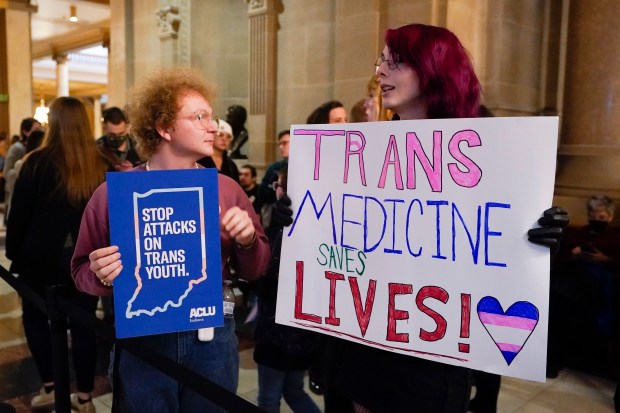

Nikki Lynch said she’s disappointed that Gov. Eric Holcomb signed a ban on gender-affirming care for minors but isn’t surprised, since the Republican-heavy legislature likely would have overturned a veto anyway.
Lynch, 65, of Schererville, is a transgender woman who grew up in western Pennsylvania without the support groups and resources available online and through social media.
She grew up feeling alone with only an aunt who understood her and not starting to come out until she was in college.
“If you’re on that path with your parents and your doctor, I have a hard time with the government telling you this isn’t the path you should go if you have that support with you,” she said. “This is a really touchy decision between kids and their parents and their doctors.”

This week, Indiana and Idaho joined 11 states that have so far enacted similar gender-affirming care bans for minors, according to data compiled by the Human Rights Campaign, an LGBTQ+ advocacy organization. Another 19 states are currently considering banning gender-affirming healthcare for minors; the one in Indiana takes effect July 1.
The bill, signed into law by Holcomb on Wednesday, bans treatments like surgery that are extremely rare and not even performed by Gender Health Clinic at Indianapolis’ Riley Hospital for Children, the state’s lone gender-affirming care health clinic.
Representatives from the clinic testified in February that they do not perform gender-affirming surgery on anyone under the age of 18. Transgender children can be prescribed puberty blockers and hormone therapy, in consultation with their families, mental health care providers and other physicians, but those treatments will be banned if a minor is diagnosed with gender dysphoria. But the treatments would remain available for other medical diagnoses, such as for intersex individuals.
Other hospitals in Indiana and Illinois are coming to terms with what the new bill means for how they treat transgender youth.
“The gender health program will continue providing care and support to patients under age 18 experiencing gender identity disorder or gender dysphoria, with their family’s consent,” Indiana University Health said in a provided statement.
“While the law does not allow the use of medicine supported therapies for gender affirming care needs for minors, the program has a multidisciplinary team who can provide mental health and social support.”
Northwestern Medicine in Chicago is committed to continue treating transgender youth, since a similar bill is not in place in Illinois.
“Every patient deserves access to safe, high-quality health care, and Northwestern Medicine provides world-class, evidence-based, compassionate care in an inclusive environment. We provide comprehensive and affirming medical treatment that honors every individual, including those who are transgender and gender-diverse,” a spokesman for Northwestern Medicine in Chicago said in an email.
“We stand with our patients and families, with members of the transgender and gender-diverse community and with our physicians and employees who provide gender-affirming care.”
The hospital declined to comment further on the new legislation “until we see how potential legislation in Indiana could impact our patient volume.”
When the bill was under consideration by the Senate Committee on Public Health in March, Jillian Schranz of Dyer watched the testimony from her office.

Schranz has been outspoken locally about the measure and its companion legislation in the house, contacting and sending information to State Sen. Dan Dernulc, R-Highland, and State Rep. Hal Slager, R-Schererville, and appearing before the Lake Central School Board.
“I’m angry, as usual. It’s hard to watch something happening in real time knowing I’ve sent so many emails and so much evidence,” Schranz said then.
A handful of doctors wearing white coats testified in support of the bill including an infectious disease specialist and a geriatric physician.
“It was so striking how being a doctor and being transphobic aren’t mutually exclusive,” Schranz said, adding she saw a lot of personal belief and bias presented as fact.
“I can say with near certainty that the legislators don’t have a trans kid in their life that they love. If they did, they’d feel very differently,” Schranz said.
“They are not listening to stories of gender-affirming care benefitting kids,” Schranz said.
“Our legislators are putting in place laws that state sanction bullying … just because they don’t like it,” she said.
The Rev. Michael Cooper, pastor at Illiana Metropolitan Community Church in Portage, which holds a Transgender Day of Remembrance memorial service every November to honor people in the transgender community who have been killed around the globe, said his church will continue to offer support services for its transgender members, “no matter what the law says.”

He thinks Indiana can do better than the transgender treatment ban for minors.
“I think it’s detrimental to the lives of many teenagers and going to cause some significant challenges, greater than they’ve faced in the past,” Cooper said, adding the ban limits access to care and treatment. “They’re just looking for reasons to exclude (the LGBTQ+ community) to live the safe and vibrant life of their choice.”
The conversation is familiar after Indiana’s ban on transgender girls playing on girls’ sports teams, a bill vetoed by Holcomb a year ago that the legislature overrode, “because that was a hard thing for the community,” said Simon Anderson Schelling, chair of LGBTQ Outreach of Porter County, which focuses on support for young people.
“We’re talking about safety and having a safe environment, yet we’re taking away their ability to have lifesaving healthcare,” Anderson Schelling said.
The ban here, he added, follows a trend of “hateful legislative bills” across the country. “It’s unfortunate but there were signs it was coming to Indiana.”
Transgender youth already face bullying in their daily lives, he said, and now the legislature is bullying them as well.
“I see that these kids are not putting up with it. They’re angry, they’re upset,” he said, adding the people who should be protecting them, including the legislature, aren’t doing so. “It’s not happening so they’re stepping up and speaking out.”
He is proud kids are advocating for themselves, “and they shouldn’t have to.”
Staff reporters Carrie Napoleon and Alex Dalton contributed.
alavalley@chicagotribune.com