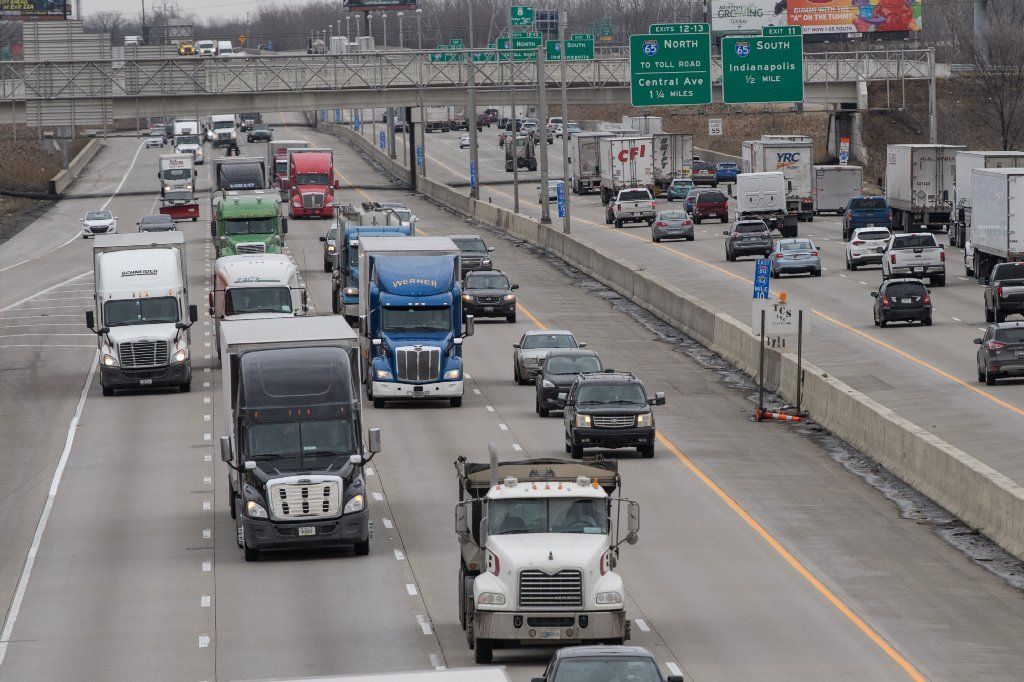

Borman motorists may never entirely stop slowing down or stopping at seemingly nothing, but the state’s FlexRoad project for I-80/94 to I-65 hopes to improve the flow of traffic through its FlexRoad project.
At a cost of $290 million, FlexRoad aims to improve the eastbound stretch of I-80/94 from Illinois 394 to I-65, officials with the Indiana Department of Transportation said during an August 14 public session at the Hammond SportsPlex. That portion of road draws more up to 200,000 vehicles per day, said Mindy Peterson, who works for Parsons, the Indianapolis firm helming the project.
“The FlexRoad project is looking at solutions that make sense for this particular corridor,” Peterson said. “Since there are limitations in place, we have to get a little more creative. That’s why the team is looking at strategies to determine what can make a difference.”
The major construction will start in 2026, but fiber optic work is expected to start next year.
Among the improvements the project aims to make are turning an existing auxiliary lane between Grant Street and Broadway into a fifth lane; adding a third lane from the Borman to I-65; removing the existing northbound ramp on Broadway; adding an “option lane” for drivers to continue east or head toward I-65 south; adding a dynamic shoulder lane through the I-65 interchange; and expanding the I-65 south exit ramp to three lanes from two, with four lanes heading east on I-80/94, according to literature passed out at the meeting. The improvements are supposed to reduce travel time and safety, the document said.
There are two other ideas Parsons is considering for the Broadway interchange, said Toby Randolph, who’s with the firm. One is a modified signalized intersection that would have stoplights controlling traffic coming on and off 80/94 east, he said; the other would be a multilane roundabout at the interchange.
Improved fiber optics will also be key, which is why that’ll be the first thing INDOT starts.
“There is a lot of digital signage that is part of FlexRoad, plus new fiber optic cables provide redundancy to make sure the system is running in the event of an issue with a single cable,” he said.
Other features could include ramp metering to control the frequency of vehicles entering the roadway; variable speed limits based on real-time traffic incidents; improved signage and queue warnings to inform drivers of incidents ahead; and digital gantries spaced about every half mile to provide drivers with key information, according to the literature.
The project is currently in the design stage, with environmental impact hearings slated for later this year or early next year, officials said. The project is expected to be completed in late 2028, and during construction, four lanes of the Borman will be open in both directions most of the time, the literature said, with a minimum of three lanes open in both directions during overnight work.
The eastbound Borman to southbound I-65, meanwhile, should maintain two traffic lanes at all times, but local roads adjacent to the expressway will close at various intervals.
INDOT is encouraging comments on the project through September 16 at IndianaFlexRoad.com.
Michelle L. Quinn is a freelance reporter for the Post-Tribune.