When David Schumacher, owner of a hardware store at 3634 N. Central Ave., Chicago, hung a Chicago flag atop his business, he said no one recognized what it was. Still, he told the Tribune in August 1958 that he would continue flying it. (Chicago Tribune)
1905: Former Chicago Cubs first baseman A.C. “Cap” Anson was elected city clerk on the Democratic ticket. He served in the position for two years.
Wallace Rice, poet and author who designed the official Chicago flag, explains to Jimmy Malles, 10, left, and Frank Pfieffer, 12, the meaning of the emblem, circa 1938. The flag was made by Mrs Emil Rieger and will be presented to the Sheffield branch of the Chicago Boys Clubs. (Chicago Tribune historical photo)
1917: Chicago’s now iconic flag, designed by Wallace Rice, was adopted by the City Council.
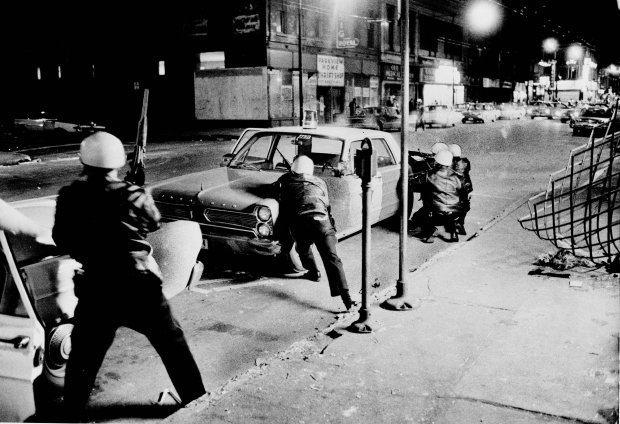
Chicago police, shown here with rifles, crouch behind a patrol car to take cover from gunfire during the riots that followed the assassination of Martin Luther King Jr. in 1968. (Don Casper/Chicago Tribune)
A woman crosses the street near Century Furniture and Clothing, at the northwest corner of Western Avenue and Madison Street, which was set on fire in an outbreak of violence on April 5, 1968. (Chicago Tribune historical photo)
An aerial view of fires on the West Side of Chicago on April 5, 1968. (Cy Wolf/Chicago Tribune)
A young person points at members of the Illinois National Guard on duty in the area of Albany Avenue, south of Madison Street, on April 6, 1968. (William Kelly/Chicago Tribune)
An aerial view of the West Side shows smoke rising from several fires ignited by rioters along Madison and Leavitt streets, west to Spaulding Avenue, on April 5, 1968. (Cy Wolf / Chicago Tribune)
Firemen fight one of the blazes at the corner of Western Avenue and Madison Street on April 5, 1968. More than 1,000 firemen were called to battle fires in the city during the rioting. (Michael Budrys / Chicago Tribune)
Four firemen use a firetruck for protection as policemen aim rifles at suspected snipers at Clybourn Avenue and Division Street on April 6, 1968. (William Yates / Chicago Tribune)
William Bender / Chicago Tribune
Chicago police Officer Erwin Karol answers telephone complaints by candlelight in the Fillmore Street police station during rioting April 5, 1968.
John Austad / Chicago Tribune
The crumbling shell of a building destroyed in the West Side rioting is silhouetted against the sky as some semblance of order returns for a short period to the area toward the southeast corner of Spaulding Avenue and Madison Street on April 6, 1968.
Don Casper / Chicago Tribune
Men are arrested with guns in the back of a building at 815 W. 69th St. by policemen on April 7, 1968, during the rioting.
James O'Leary / Chicago Tribune
An aerial view of fires in the 400 block of West 63rd Street on April 6, 1968.
William Yates / Chicago Tribune
A bloodied CTA bus driver, right, walks with a policeman after his bus was halted by a mob that broke windows and beat the driver at 2739 W. Madison St. on April 5, 1968.
William Kelly / Chicago Tribune
Members of the Illinois National Guard are on duty while firefighters try to put out a blaze in the 3200 block of West Madison Street on April 6, 1968.
Luigi Mendicino / Chicago Tribune
On the 3000 block of West Madison Street, the aftermath of rioting over the assassination of Martin Luther King Jr. is seen on April 6, 1968.
Walter Neal / Chicago Tribune
Police search suspects along 63rd Street during rioting April 6, 1968.
Don Casper / Chicago Tribune
Chicago's skyline is a background for U.S. Army troops stationed in the Loop at Monroe Street and Columbus Drive on April 9, 1968. The troops were in town to keep the peace during rioting caused by the assassination of Martin Luther King Jr.
Chicago Tribune historical photo
An aerial view on April 6, 1968, of the 3300 block of Madison Street in the heart of Chicago's riot-torn West Side after the looting and burning rampage that occurred in response to the assassination of Martin Luther King Jr.
Kenneth Lovett / Chicago Tribune
Police hold a woman suspect on the street in the riot-torn West Side on April 6, 1968.
Luigi Mendicino / Chicago Tribune
A city bulldozer in the 3300 block of West Madison Street clears rubble of riot-torn buildings on April 7, 1968. It was in this block that the worst damage occurred during the nearly 48 hours of virtually uncontrolled rioting and looting that raged in the glare of burning buildings.
William Yates / Chicago Tribune
Troops deployed along 63rd Street, from about Cottage Grove to Stony Island avenues, walk in groups as they patrol the area near businesses on April 8, 1968.
John Austad / Chicago Tribune
People look over riot damage on April 6, 1968, including protective window coverings that were ripped by looters from a store in the 3000 block of West Madison Street.
Ray Foster / Chicago Tribune
Two girls carry a carton of soft drinks and other merchandise from Del Farm Store at Hobbie and Larrabee streets on the Near North Side on April 6, 1968, in Chicago.
Michael Budrys / Chicago Tribune
U.S. Army troops, in battle gear with bayonets, line the sidewalk along 63rd Street near Ellis Avenue on April 7, 1968.
William Kelly / Chicago Tribune
Looters carry merchandise out of a liquor store at 3825 W. Roosevelt Road on April 6, 1968.
William Kelly / Chicago Tribune
Looters search the debris and rubble of a burned-out liquor store for anything left in the 3200 block of West Madison Street on April 6, 1968.
James OLeary / Chicago Tribune
An employee of a jewelry store at 27 W. Madison St. sweeps up glass broken by rioters who smashed a window and looted the display during a rampage through downtown Chicago and the surrounding area on April 5, 1968.
1 of 26
Chicago police, shown here with rifles, crouch behind a patrol car to take cover from gunfire during the riots that followed the assassination of Martin Luther King Jr. in 1968. (Don Casper/Chicago Tribune)
1968: Riots exploded on Chicago’s West Side after the Rev. Martin Luther King Jr. was assassinated in Memphis.
Mayor-elect Richard M. Daley is surrounded by confetti after his victory speech at the Hyatt Regency Chicago on April 4, 1989. Daley was elected mayor of Chicago by a wide margin, capturing the office held by his father for 21 years, but still facing the task of building a multiracial coalition of support before the next election only two years away. Daley built his victory by winning overwhelming support from white voters and chipping loose enough elements of Harold Washington's old coalition to easily defeat Ald. Timothy Evans (4th), whose claim to be the rightful heir to the late mayor failed to stir all of Chicago's black community. The election marked only the second time in history that a son has followed his father into the mayor's office. Carter Harrison and Carter Harrison II served a total of 22 years between 1879 and 1915. (Chris Walker/Chicago Tribune)
1989: Richard M. Daley, son of Richard J., was elected mayor.
He served until 2011, holding office even longer than his father.
Travelers walk through a grandly decorated terminal at Chicago O’Hare International Airport on Dec. 3, 2024, in Chicago. (Stacey Wescott/ Chicago Tribune)
1990:“Home Alone” filmed a memorable scene at O’Hare International Airport. The 14-odd members of the McCallister family raced through Terminal 3 before miraculously hopping aboard their American Airlines flight at gate K-12. (Though the Tribune incorrectly reported at the time that a flight bound for Honolulu would figure into the plot.)
4/4/98 FIRE A WPOPE 86686 Chicago Fire’s Frank Klopas celebrates after scoring his team’s first home goal during the first half Saturday against the Tampa Bay Mutiny. TRIBUNE PHOTO BY WES POPE 86686 ORG XMIT: 86686
1998: The Chicago Fire, an MLS expansion team, won their home opener at Soldier Field against the Tampa Bay Mutiny, 2-0. Chicago native Frank Klopas scored one of the goals. He dedicated it to his father-in-law who died in a plane crash the previous year.