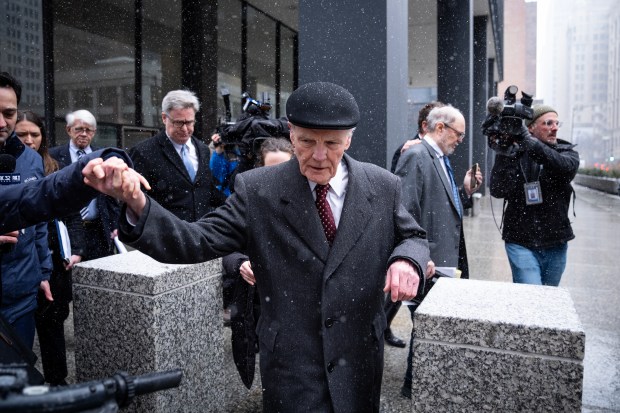





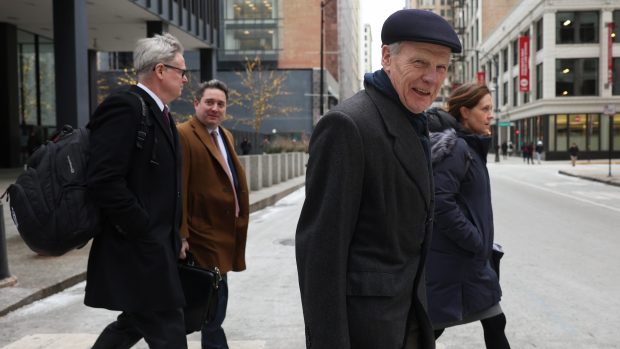








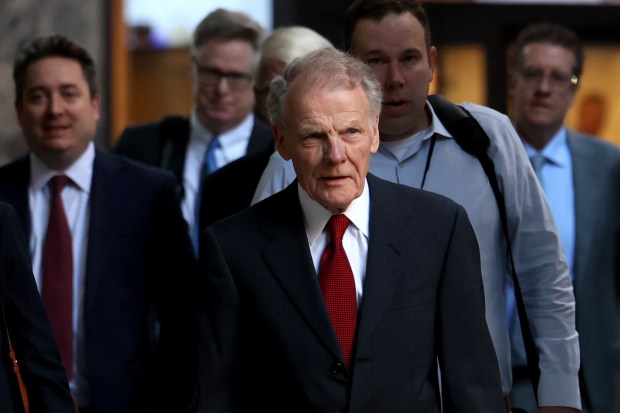
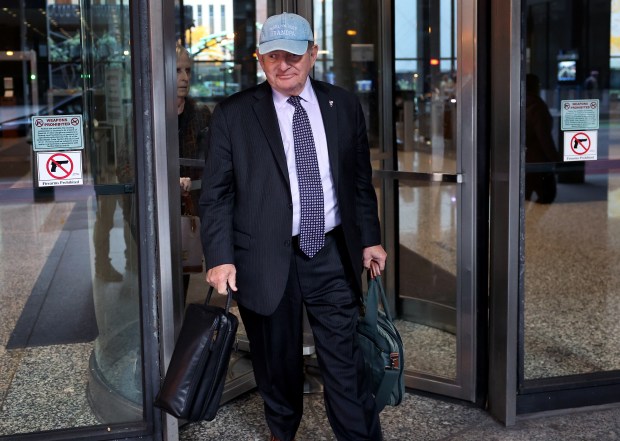






A federal appeals court Friday denied bond for ex-House Speaker Michael Madigan pending his appeal on corruption charges, a decision that means Madigan will have to report to prison in less than two weeks to begin serving his 7 ½-year sentence.
Madigan’s attorneys had argued he should remain free for a number of reasons, including that he’s not a flight risk and that there are complex legal issues that, if resolved in his favor, will require a new trial.
That motion was denied in a one-page order from the 7th U.S. Circuit Court of Appeals.
Lawyers for Madigan were not immediately available for comment.
After a trial that stretched nearly four months, Madigan, 83, was convicted by a jury Feb. 12 on bribery conspiracy and other corruption charges. The jury found him guilty on 10 of 23 counts, including a multipronged scheme to accept and solicit payments from Commonwealth Edison to Madigan associates for do-nothing subcontracts.
Madigan also was convicted on six out of seven counts — including wire fraud and Travel Act violations — regarding a plan to get then-Chicago Ald. Daniel Solis, who testified at length in the trial, appointed to a state board.
The jury acquitted Madigan of several other schemes alleged in the indictment and deadlocked on other counts, including the overarching racketeering charge.
The same jury deadlocked on all counts involving his co-defendant, longtime confidant Michael McClain, and prosecutors later opted not to retry McClain and dropped the charges. McClain was convicted, however, in the parallel “ComEd Four” bribery case for much of the same conduct and has been sentenced to two years behind bars.
U.S. District Judge John Robert Blakey sentenced Madigan in June to 7 ½ years in prison, saying Madigan’s crimes represented “abuse of power at the highest level” and were aggravated by the fact that Madigan had every advantage in life, including a privileged education and thriving law practice.
The judge also found that Madigan lied repeatedly and willfully when testifying in his own defense during the trial. Blakey called it “a nauseating display of perjury and evasion” that was “hard to watch.”
Blakey ordered Madigan to report to prison by Oct. 13.
Madigan had first asked Blakey for an appeal bond, which was also denied. In his ruling on that issue, Blakey said his evidentiary rulings and jury instructions were legally sound, and that Madigan’s attorneys had failed to reach the “nearly insurmountable” legal hurdles required to win an appeal bond.
“Frankly, Madigan does not come close to meeting this high burden,” the judge said.
Meanwhile, Madigan’s opening appellate brief is not due until Nov. 3, and the court will likely not hold oral arguments on the case for several months after that.
Much of Madigan’s appeal will center on the rapidly evolving interpretations of federal bribery laws, and the former speaker has hired high-powered Washington attorneys to handle the briefing, including Lisa Blatt, who successfully argued the case involving former Portage, Indiana, Mayor James Snyder, which substantially reined in prosecutions under a federal bribery law known as 666, its number in the federal code.
In its decision in the Snyder case, the high court ruled that “gratuities” — or gifts given as a thank-you for actions a public official has already taken — are not criminalized under the federal statute, and that prosecutors must prove there was an agreement ahead of time, often referred to by the Latin quid pro quo.
Madigan’s motion for an appeal bond argued that Blakey’s instructions to the jury erred in part by focusing “on the intent of the bribe-giver, not the recipient,” flipping what prosecutors are actually required by statute to prove.
The judge also incorrectly modified the language in the instructions to say payments to Madigan’s associates be “in connection with … official duties,” the motion stated.
The instructions also were flawed when it came to the “heavily litigated definition of ‘corruptly,’” Madigan’s team argued, “and the crucial instruction on “stream of benefits,” the motion stated.
The motion also challenged Blakey’s decision to admit the now-infamous wiretapped recording of Madigan telling his co-defendant, McClain, that some of their associates had “made out like bandits.” McClain responded, “For very little work too.”
The judge initially barred the jury from hearing the conversation, which began with a discussion about a labor consultant who was on ComEd’s payroll, not one of the subcontractors that were part of the indictment. But Blakey let that in after Madigan testified he didn’t know ComEd was paying his associates for no work.
“The substantial questions, if resolved in Madigan’s favor, are likely to result in reversal of all convictions or a new trial,” Madigan’s attorneys said in that filing.
jmeisner@chicagotribune.com