Then, as now, America loves true crime stories. That’s why the last edition of our Illinois 250 series looks back at how our state has been home to some of the most notorious ones.
Here’s a look back at the most infamous, shocking, blood-curdling or mysterious crimes and disasters that captured the attention of the nation — and the world.
- Illinois 250: Celebrating the state’s fabulous firsts
- Illinois 250: Art, culture, food and music made here — and then shared with the world
- Illinois 250: The political land of Lincoln, but also Addams, Daley, Washington, Jackson, Obama and more
- Illinois 250: Sports teams and individuals that have achieved greatness — or infamy
- Illinois 250: From ‘The Jungle’ to Shel Silverstein, how the state has helped shape the printed word
- Illinois 250: What we’ve invented, innovated, created and manufactured
- Illinois 250: Meet the state’s most influential people, from architects to a pope and future presidents
The city burns (1871)

The Great Chicago Fire began in a hay-filled cow barn behind the frame house that Mrs. Catherine O’Leary shared with her husband, Patrick, and their five kids on DeKoven Street on the Near West Side.
The fire ran — and it grew, swept by a strong wind from the southwest, eating its ravenous way north and toward downtown and beyond. People ran to the lake for shelter as the city became a vast ocean of flame.
After that horrible night and the equally terrifying and destructive day and night that followed, the fire finally burned itself out. Chicago awoke two days later to find almost 18,000 buildings destroyed, much of the city leveled, 90,000 people homeless and 300-some people dead.
The Tribune offered a stirring prophecy that “CHICAGO SHALL RISE AGAIN.”
The Great Chicago Fire destroyed 17,450 buildings. Here are six that survived and still stand today.
Abraham Lincoln’s grave robbers (1876)
Four men with shady backgrounds, under the cover of darkness on Nov. 7, 1876, tried to remove the body of President Abraham Lincoln from its marble sarcophagus in Springfield’s Oak Ridge Cemetery. The next day, the Tribune ran a long article about the aborted scheme. The following day, the newspaper carried a longer account about the “Desecrators of Lincoln’s Remains.” On Nov. 18, the whole front page was devoted to in-depth coverage of the plot, the break-in, the escape of two would-be body snatchers and their capture at a Chicago saloon called The Hub, allegedly frequented by lowlifes.
What made such instant journalism possible? Chicago police Chief Elmer Washburn had a confidential secretary, Percy English, who also wrote for the Tribune. When Washburn was alerted that the skulduggery was going to happen, he allowed the young reporter to accompany authorities determined to foil the plot. English became a witness and got one of the scoops of the century.
‘Murder Castle’ of H.H. Holmes (1893)
Differing accounts claim that the man who became infamous during the World’s Columbian Exposition as H.H. Holmes may have had hundreds of victims who were tortured and killed within a network of secret rooms in his so-called Murder Castle at 610 W. 63rd St. There was a “mostly” soundproof walk-in vault, but it likely was used to conceal stolen furniture, not murder, experts said.
“He did kill nine or 10 people, but it wasn’t hundreds and hundreds. It wasn’t in a hotel, and it wasn’t World’s Fair patrons,” said author and Chicago tour guide Adam Selzer, whose 2017 book “H.H. Holmes: The True History of the White City Devil” sought to demystify the killer behind the legend, using official records and documents.
“He was a swindler, first and foremost, who partly through his own confessions, became a new American tall tale,” Selzer said.
Iroquois Theatre fire (1903)

The matinee performance of “Mr. Bluebeard” at Chicago’s newly opened Iroquois Theatre on Randolph Street between State and Dearborn Streets was packed on Dec. 30, 1903, with an estimated 2,000 schoolchildren and families. Though the “finest, handsomest, and best equipped” theater bragged about its 35 exits, it did not have a sprinkler system, telephone, fire alarm or exit signs.
The second act had just begun when an arc light near the stage ignited a curtain. As flames licked at the fabric and smoke curled toward the ceiling, an overcapacity crowd of more than 1,800 panicked, rushing for the exits and jamming against doors that opened inward. Some exits were locked; others were nearly impossible to open.
Firefighters put out the fire in 30 minutes, but not before it became the worst of its kind in American history with 602 dead, more than twice the toll of the Great Chicago Fire of 1871. Theatergoers from 13 states were killed in the disaster, which made headlines worldwide.
The Iroquois Theatre fire resulted in reforms such as fireproof scenery and stage curtains, illuminated exits and doors that open outward. It also inspired the invention of the exit-door “panic bar,” which is still in use today, and the UL Label Service.
SS Eastland disaster (1915)

The SS Eastland — packed on July 24, 1915, with Western Electric Co. employees and their families for a day trip to Michigan City, Indiana — rolled to its side in the Chicago River between LaSalle Drive and Clark Street.
Vintage Chicago Tribune: Eastland disaster and its aftermath
More than 840 of the 2,500 aboard died, many of them trapped inside the vessel as water poured in when the ship tipped over just a few feet from the riverbank.
‘Black Sox’ banned from baseball (1921)
Eight White Sox players were charged with throwing the 1919 World Series. Despite earning the “Black Sox” nickname, the men were acquitted by a jury that deliberated for just 2 hours and 47 minutes on Aug. 2, 1921.
A day after their acquittal, however, baseball Commissioner Kenesaw Mountain Landis ruled the players allegedly involved — Joe Jackson, Eddie Cicotte, Oscar Emil “Happy” Felsch, Chick Gandil, Frederick William McMullin, Swede Risberg, Buck Weaver and Lefty Williams — would be banned for life from organized baseball.
Good girl gone bad (1924)

Chicago’s youngest and first female assistant U.S. district attorney was a brilliant Polish immigrant named Wanda Stopa. She had been one of only two women to graduate from John Marshall Law School in 1921. But just three years after graduation, Stopa left her career, married a Russian count and then fell in love with a rich, married advertising executive, Y. Kenley Smith, who paid for her to live in New York.

When Smith refused to leave his wife, Genevieve, nicknamed Doodles, Stopa showed up at their Palos Park home on April 24, 1924, intending to kill Smith’s wife. She took a shot, but it hit the couple’s elderly caretaker, Henry Manning, killing him. Stopa went on the run, later killing herself by swallowing poison in a Detroit hotel room.
Approximately 10,000 Chicagoans turned out for her wake and funeral.
‘The perfect murder’ (1924)

Friends Nathan “Babe” Leopold Jr. and Richard “Dickie” Loeb — the pampered sons of prominent Kenwood families — killed Robert “Bobby” Franks after they offered him a ride home from school on May 21, 1924.
To the public, Franks’ death appeared to have been orchestrated for money and thrills. But the two brilliant masterminds behind the crime simply referred to it as a “perfect murder” for which they believed they could outsmart the authorities and would never stand trial.
After they dumped the boy’s body near Wolf Lake, however, they confessed to the murder and were brought to trial for what became the “crime of the century.”
Clarence Darrow was hired by the confessed killers’ families for their defense, and he made a surprise tactical move as the trial began.
“We withdraw our plea of not guilty and enter a plea of guilty,” Darrow told Judge John Caverly.
Darrow’s eloquent plea had the desired effect, and Leopold and Loeb were sentenced to life in prison.
‘Prettiest woman ever accused of murder in Chicago’ (1924)

A young, liquored-up woman (this was during Prohibition) named Beulah Annan shot her equally inebriated lover to death on April 3, 1924, inside the apartment she shared with her husband. Another young woman named Maurine Dallas Watkins reported Annan’s expedited travails through Cook County’s legal system for the Tribune.
Watkins used the trial’s twists to write a three-act play, “A Brave Little Woman,” while attending the new Yale School of Drama in 1926. When it debuted on Broadway later that year, it was called “Chicago.”
The musical version of “Chicago” is the second-longest-running show on Broadway after “The Phantom of the Opera” (13,981 performances) and the longest active show.
First person to kill a federal agent (1925)

On Oct. 11, 1925, Martin Durkin shot FBI Agent Edwin Shanahan at Porter’s Garage, 6231 Princeton Ave. in Englewood. Shanahan was attempting to arrest Durkin for violating the Dyer Act by transporting a stolen automobile, a charge Durkin denied. Durkin was eventually caught, subsequently convicted and sentenced to 19 years in an Illinois prison for the murder of Shanahan, followed by 15 more years in Leavenworth for his federal crime.
Most infamous of all gangland slayings in America (1929)

Seven men, suspected to be members of George “Bugs” Moran’s gang, were lined up against the wall of a garage on Clark Street, the gang’s headquarters, and killed by rivals’ machine guns in what became known as the St. Valentine’s Day Massacre.
It savagely achieved its purpose: eliminating the last challenge to Al Capone for the mantle of crime boss in Chicago.
John Dillinger given up by ‘woman in red’ (1934)

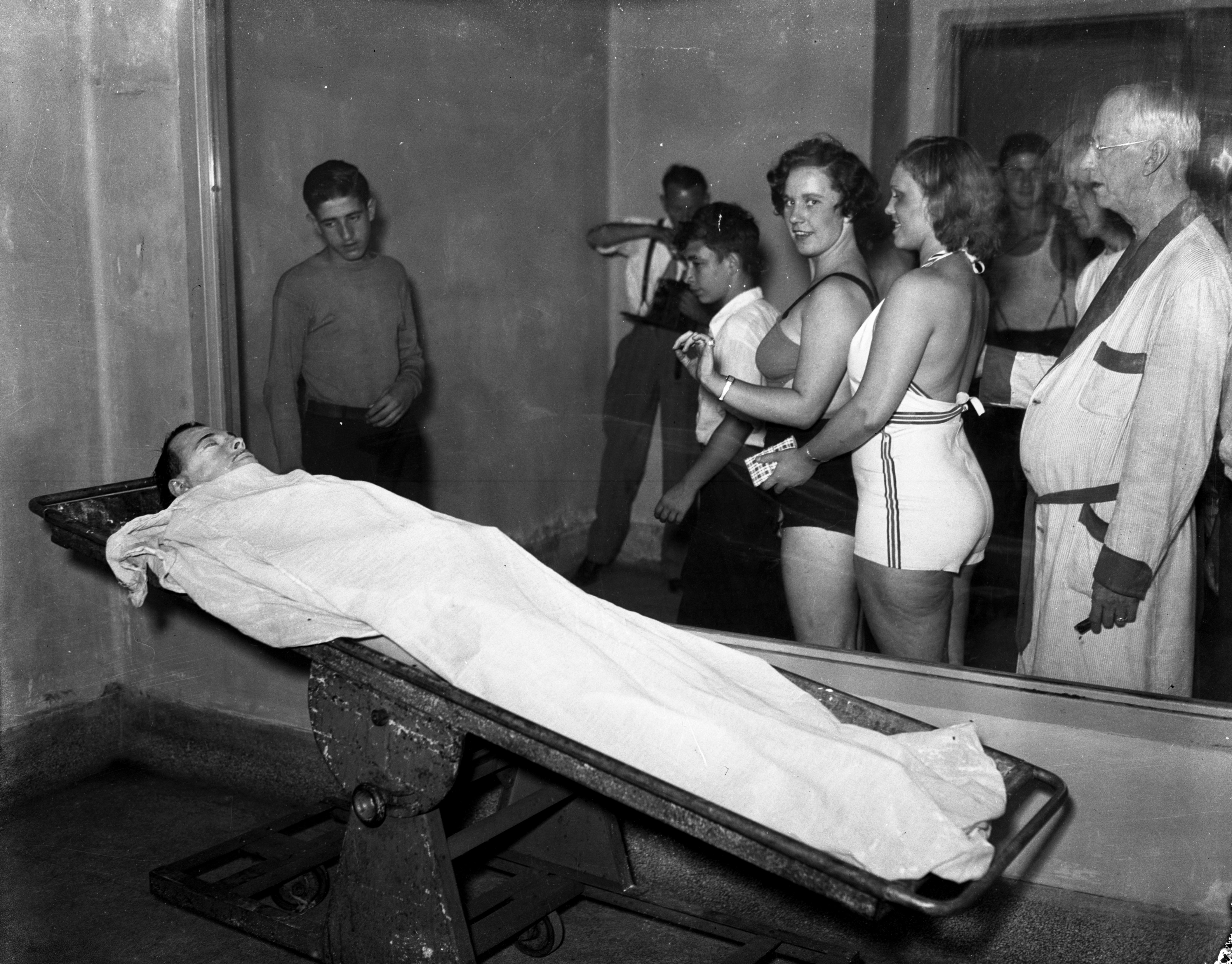
Chicago was in the grip of a weeklong heat wave, and the mercury on July 22, 1934, reached 101 degrees. Twenty-three people died of the heat, but the death that drew the most attention was that of John Dillinger — a 31-year-old Indiana man who, on his birthday a month earlier, had been declared Public Enemy No. 1 by the FBI.
Vintage Chicago Tribune: John Dillinger’s final days — and the ‘Lady in red’ who helped trap him
Dillinger was ambushed by federal agents outside Chicago’s Biograph Theater (now known as Victory Gardens Theater), 2433 N. Lincoln Ave. His corpse was put on display at the Cook County morgue.
‘Battle of Barrington’ (1934)
Bank robber and “Public Enemy No. 1” Lester Joseph Gillis — better known as George “Baby Face” Nelson — was killed on Nov. 27, 1934, in a gun battle with FBI agents in Barrington. FBI Inspector Samuel P. Cowley and FBI Special Agent Herman E. Hollis were also killed.
Chicago’s notorious ‘Lipstick Killer’ (1945-46)

Six-year-old Suzanne Degnan was strangled by an intruder on Jan. 7, 1946, who used a ladder to climb into a window of her Edgewater home. The killer left a note demanding $20,000, but her body was found dismembered and disposed of in city sewers.
William Heirens, then a 17-year-old University of Chicago student, was caught and confessed to killing Degnan and two women later that year. He became known as the “Lipstick Killer” after scrawling a message in lipstick at a crime scene: “For heaven’s sake, catch me before I kill more.”
Heirens was in prison for 65 years, becoming one of the longest-serving inmates in Illinois history, before he died in 2012.
The shooting of Eddie Waitkus (1949)
Onetime Chicago Cub Eddie Waitkus, by then with the Philadelphia Phillies, became the inspiration for “The Natural” when he was shot in the Edgewater Beach Hotel by Ruth Ann Steinhagen, a 19-year-old fan.
Grimes sisters’ nude bodies found (1957)

The nude bodies of sisters Barbara and Patricia Grimes were found on Jan. 22, 1957, along a rural road near Burr Ridge. The girls had slipped away from their home in Chicago’s McKinley Park neighborhood a month earlier to see an Elvis Presley movie at a nearby theater, but never returned.
Investigators didn’t find enough evidence to explain their deaths. The official cause of death was exposure to winter cold, and despite an exhaustive investigation and widespread media attention, the case remains one of the Chicago area’s most notorious unsolved mysteries.
Killing of eight student nurses (1966)

Armed with a gun and a knife, Richard Speck broke into a townhouse on July 14, 1966, in the 2300 block of East 100th Street on Chicago’s South Side and killed eight student nurses who lived there and worked at South Chicago Community Hospital. They were Nina Jo Schmale, Patricia Ann Matusek, Pamela Lee Wilkening, Mary Ann Jordan, Suzanne Bridget Farris, Valentina Pasion, Merlita Gargullo and Gloria Jean Davy. Corazon Amurao Atienza managed to crawl under a bed and hide while Speck methodically stabbed and strangled her roommates after telling them he would not hurt them, that he just needed money to get to New Orleans.
Speck was captured two days later when an emergency room doctor at Cook County Hospital thought a patient he was treating for self-inflicted gashes looked familiar. The doctor had just had a dinner break and saw the front page of a newspaper featuring the killer’s face. As he was sponging blood off the patient’s arm, he saw the man had a tattoo that said “Born to Raise Hell” that matched the paper’s description.
Though originally convicted and then sentenced to die in the electric chair for the murders, Speck was resentenced to eight consecutive terms of 50 to 150 years each after the U.S. Supreme Court ruled in 1972 that the death penalty of Illinois and other states was unconstitutional.
Speck died of a heart attack at a Joliet hospital on Dec. 5, 1991 — the day before his 50th birthday.
Black Panthers leaders killed in a hail of police bullets (1969)

Police raided a two-flat on Dec. 4, 1969, at 2337 W. Monroe St. — the Illinois’ Black Panther Party stronghold — killing party leaders Fred Hampton and Mark Clark.
Officially, the Cook County state’s attorney’s 4:30 a.m. raid by 14 Chicago police officers began as the execution of a search warrant to turn up weapons and explosives that the feared Black power group was supposedly hoarding inside.
Vintage Chicago Tribune: Black Panther heritage sites in the Chicago area
But survivors described a far more frightening scene: Officers armed with shotguns and rifles opened fire on sleeping Black Panther members inside, among them Hampton’s pregnant fiancee. A special federal grand jury determined that police sprayed 82 to 99 gunshots through doors, walls and windows, while just one shot appeared to have been fired by someone inside.
Hoodlum shot in his basement kitchen (1975)

Just hours after returning from Houston, where he had undergone gallbladder surgery, former Chicago Outfit head Salvatore “Sam” Giancana entertained friends and family on June 19, 1975, at his Oak Park home at 1147 Wenonah Ave. Police conducted surveillance as revelers entered and exited the home.
Someone shot Giancana five times as he prepared a meal in his basement kitchen. His body was discovered by his live-in caretaker and the caretaker’s wife.
Vintage Chicago Tribune: Inside the final months of Sam Giancana, former Chicago Outfit head
“A frying pan containing sausage and spinach was on the stove,” Tribune reporter Weldon Whisler wrote. “The gas was turned off by police when they arrived shortly after midnight, but the food had not burned, indicating that Giancana was shot not long before.”
The killing was never solved.
Disappearance of a candy heiress (1977)
Helen Vorhees Brach was last seen alive on Feb. 17, 1977. Brach left an appointment at the Mayo Clinic in Rochester, Minnesota, where she was given a clean bill of health after a routine checkup.
Not many seemed to notice, at first, that she had disappeared. Brach’s husband, Frank, president of E.J. Brach & Sons candy company, died in 1970. They had no children, and she was close only with few relatives. Her handyman, Jack Matlick — who claimed he picked Brach up from O’Hare Airport on Feb. 17, 1977, drove her to her palatial house in Glenview, then took her back to O’Hare on Feb. 21, 1977 — didn’t submit a missing-person report to police until March 1977. Five checks were cashed — forged with her signature — after she vanished.
Brach was declared legally dead in 1984, though her body was never found.
John Wayne Gacy arrested (1978)

Investigators uncovered 29 bodies buried at the serial killer’s one-story, ranch-style house in unincorporated Norwood Park Township — 26 in the crawl space under his home and three more outside the house. Gacy confessed to four more murders, of victims whose bodies were found in waterways south of Chicago.
After five weeks of testimony from psychiatrists, police, neighbors, acquaintances and family members of the victims, a jury of seven men and five women took less than two hours to convict Gacy on March 12, 1980, of killing 33 young men.
Gacy was sentenced to death the next day. He was executed on May 10, 1994, by lethal injection at Stateville Penitentiary near Joliet.
The Tylenol murders (1982)
Twelve-year-old Mary Kellerman of Elk Grove Village died on Sept. 29, 1982, after taking an Extra-Strength Tylenol capsule.
The Tylenol murders: Timeline of key events before and after the 1982 poisonings
Seven people died as a result of poisoning from drug tampering in the Chicago area and panicked the nation. Widely regarded as an act of domestic terrorism — a term not in the country’s vernacular at the time — the killings led to tamper-evident packaging, copycat killings and myths about tainted Halloween candy.
Spilotro brothers buried alive (1986)
Anthony Spilotro, 48, and his brother Michael, 41, were beaten with baseball bats and then buried alive on June 14, 1986, in a northwest Indiana cornfield. Contrary to what was depicted in the 1995 film “Casino,” the brothers were driven to a Bensenville home where Michael thought he was going to become a “made member” of the Outfit. Instead, the brothers were beaten with fists, knees and feet in the home’s basement before being driven to the cornfield and buried.
Dental records were used by their brother, Patrick Spilotro, a dentist, to identify the bodies. The details came out during the 2007 “Family Secrets” trial, which Tribune editor Jeff Coen wrote about in his 2009 book, “Family Secrets: The Case That Crippled the Chicago Mob.”
The gang leader and Libya (1987)
Jeff Fort, founder of the ruthless El Rukn gang, was convicted on Nov. 24, 1987, of plotting acts of domestic terrorism from his Texas jail cell in exchange for $2.5 million from Libya. It was the first time that U.S. citizens were brought to trial and found guilty on terrorism charges, the Tribune reported at the time.
Fort is serving an 80-year sentence in the supermax federal prison in Florence, Colorado.
Hubbard Woods Elementary School shooting (1988)

Laurie Dann shot six children at the Winnetka school, killing 8-year-old Nicholas Corwin, during a rampage that ended in her own death in the North Shore suburb.
Killed while walking to school (1992)
Shortly after the 9 a.m. school bell, 7-year-old Dantrell Davis was shot in the head by a sniper while walking with his mother from his Cabrini-Green high-rise to the Jenner Academy of the Arts. Half an hour later, he was pronounced dead at Children’s Memorial Hospital.
Later that day, police arrested reputed street gang leader Anthony Garrett in connection with Dantrell’s murder.
Brown’s Chicken murders (1993)

Seven people — five employees and the couple that owned the restaurant — were killed on Jan. 8, 1993, inside Brown’s Chicken & Pasta at 168 W. Northwest Highway in Palatine.
Juan Luna and Jim Degorski escaped justice for nearly a decade until investigators caught a break. Degorski had told an ex-girlfriend of his role in the killings, and a friend who overheard her talking about it in 2002 went to the police.
Another piece of evidence was crucial to the case. Investigators had saved a discarded meal from the scene, and as DNA analysis improved, they were able to match DNA left on a chicken bone with Luna’s saliva. The two were arrested in May 2002. Luna was convicted of murder in 2007, and Degorski followed two years later. Jurors spared them the death penalty, but both are serving life sentences with no possibility of parole.
11-year-old gang member killed execution style (1994)
Black Disciples-affiliated Robert “Yummy” Sandifer was a 4-foot, 6-inch 11-year-old on the run after he allegedly fired the shot on Aug. 28, 1994, that wounded 16-year-old Kianta Britten. Two hours later, Sandifer shot and killed his 14-year-old neighbor Shavon Dean.
After an intense police manhunt, Sandifer was found killed, his body lying in the mouth of a pedestrian walkway at 108th Street and Dauphin Avenue. Less than 24 hours later, neighbors Derrick Hardaway, 14, and his 16-year-old brother, Cragg, were charged with Sandifer’s murder. Both were convicted of murder in 1997. Derrick was sentenced to 45 years in prison, but was released in December 2016. Cragg was sentenced to 60 years.
Sandifer’s photo was used on the cover of Time magazine in September 1994.
Chicago heat wave (1995)

The prolonged extreme heat of July 1995 — the deadliest weather event in Illinois history — led to the deaths of 739 people, mostly elderly residents, people of color and those who lived alone. The heat wave also redefined the city’s emergency response and disaster preparedness.
Chicago doesn’t remember one of its worst disasters, and there are few memorials to this day
Its exact duration — which, by most accounts, lasted July 13 to July 20 — is still somewhat difficult to settle on, partly because of dead Chicagoans found in homes and hotels after the heat declined to the low 90s. Even the final number of dead was only settled on months later.
Husband of cosmetics guru Marilyn Miglin murdered (1997)
Real estate magnate Lee Miglin was discovered slain on May 4, 1997, in the garage of his Gold Coast home.
Though there was no known link, police suspect Andrew Cunanan committed the crime. Cunanan killed himself on July 23, 1997.
‘Unabomber’ pleads guilty (1998)
Chicago-area native Ted Kaczynski, dubbed the “Unabomber,” pleaded guilty on Jan. 22, 1998 — almost 20 years after his first pipe bomb exploded — choosing to spend life in prison rather than be portrayed at trial as mentally ill.
5 things you might not know about Chicago native Ted Kaczynski — the ‘Unabomber’
Kaczynski was arrested in 1996 at his remote Montana cabin. He was held in the federal supermax prison in Florence, Colorado, since May 1998, when he was sentenced to four life sentences plus 30 years for a campaign of terror that set universities nationwide on edge. He admitted to committing 16 bombings from 1978 to 1995, permanently maiming several of his victims. Kaczynski died in 2023.
Judge’s husband and mother killed in her home (2005)

U.S. District Judge Joan Lefkow found her husband — Michael F. Lefkow, 64, an attorney — and mother — Donna Grace Humphrey, 90 — shot dead in the basement of her home, less than a year after white supremacist Matthew Hale was convicted of trying to have her murdered for holding him in contempt of court.
Security at the Lefkow home — including a camera mounted outside the home and guards posted on the block in unmarked cars — had been beefed up after the allegations against Hale emerged in January 2003. But neighbors said the extra measures tailed off about the time Hale was convicted in April 2004.
On March 7, 2005, investigators told Tribune reporters that DNA was pulled from a cigarette butt found in the kitchen sink of the Lefkow home. Out-of-work electrician Bart Ross, who had a long history of ranting against judges and lawyers, shot himself two days later during a traffic stop outside Milwaukee. The DNA from the cigarette butt matched samples taken from Ross’ body.
Judge Lefkow was determined to return to the bench. She is now a U.S. District judge for the Northern District of Illinois.
Back-to-back governors imprisoned (early 2000s)
George Ryan was governor of Illinois from 1999 to 2003. He chose not to run for a second term amid a brewing scandal and ongoing federal investigation related to his time as Illinois secretary of state. Ryan was convicted in 2006 on 18 felony counts, including racketeering conspiracy, tax and mail fraud and lying to the FBI.
Prosecutors accused him of receiving illegal cash payments and gifts during his time as secretary of state and governor. Ryan was given a 6½-year prison sentence. He spent more than five years in a federal prison in Terre Haute, Indiana, and was released from home confinement in 2013.
Rod Blagojevich was elected governor in 2002 and served until 2009, when he became the first Illinois governor in history to be impeached and removed from office.
The impeachment occurred after Blagojevich was arrested in late 2008 by federal law enforcement on a series of corruption charges, including attempting to sell the U.S. Senate seat once held by President Barack Obama. At Blagojevich’s first trial, he was convicted of lying to the FBI, but the jury was hung on other charges.
At his second trial in 2011, Blagojevich was found guilty on the more widespread allegations, including the Senate seat charges, trying to shake down a children’s hospital leader in exchange for sending money approved for pediatric services, and seeking a $100,000 contribution from a horse track owner in exchange for signing favorable legislation.
In 2020, President Donald Trump, a Republican later convicted of felonies himself, commuted Blagojevich’s 14-year sentence to about eight years served.
Jon Burge’s ‘Midnight Crew’ (2010)
Decades after torture allegations were first leveled against former Chicago police Cmdr. Jon Burge’s “Midnight Crew,” a secret Chicago police internal report surfaced cataloging more than 50 instances of “methodical” and “systematic” torture by Burge and his subordinates. Burge himself was never charged directly in any of the torture allegations, though he was fired from the Chicago Police Department in 1993.
Although most of Burge’s alleged misconduct took place in the 1970s and ’80s, his accusers played a fundamental role in former Gov. Ryan’s decision to vacate Illinois’ death row in 2000 and declare a moratorium on capital punishment in the state.
A federal jury convicted Burge on June 28, 2010, on all three counts of obstruction of justice and perjury for lying in a lawsuit about the torture of suspects in attempts to obtain confessions. He was sentenced to prison and released in 2014. Burge died in 2018.
Lawsuits from Burge’s victims have cost taxpayers many millions in settlements and judgments, much of it paid out of city coffers.