The Prairie State’s political arena has always been the place for civil debate — and violent confrontation — for rights.
For the third installment of “Illinois 250,” we look at what the Chicago area and the state of Illinois have offered up to the rest of the country in governance.
Illinois is where presidents have been born, gained experience to lead the nation — and even forced to resign, thanks in part to efforts by the Tribune. It’s where some of the nation’s best leaders have rallied on behalf of immigrants, laborers, women and people of color. Yes, it’s the land of Lincoln, but also (Jane) Addams, (Frances) Willard, (Richard J. and Richard M.) Daley, (Harold) Washington, (Eugene) Debs, (Jesse) Jackson and (Barack) Obama.
What follows are dozens of examples of how those whose names are familiar (or aren’t) and legendary (or infamous) for their actions while representing the state have been embraced (or renounced) by the rest of the country and beyond.
- Illinois 250: Art, culture, food and music made here — and then shared with the world
- Illinois 250: Celebrating the state’s fabulous firsts
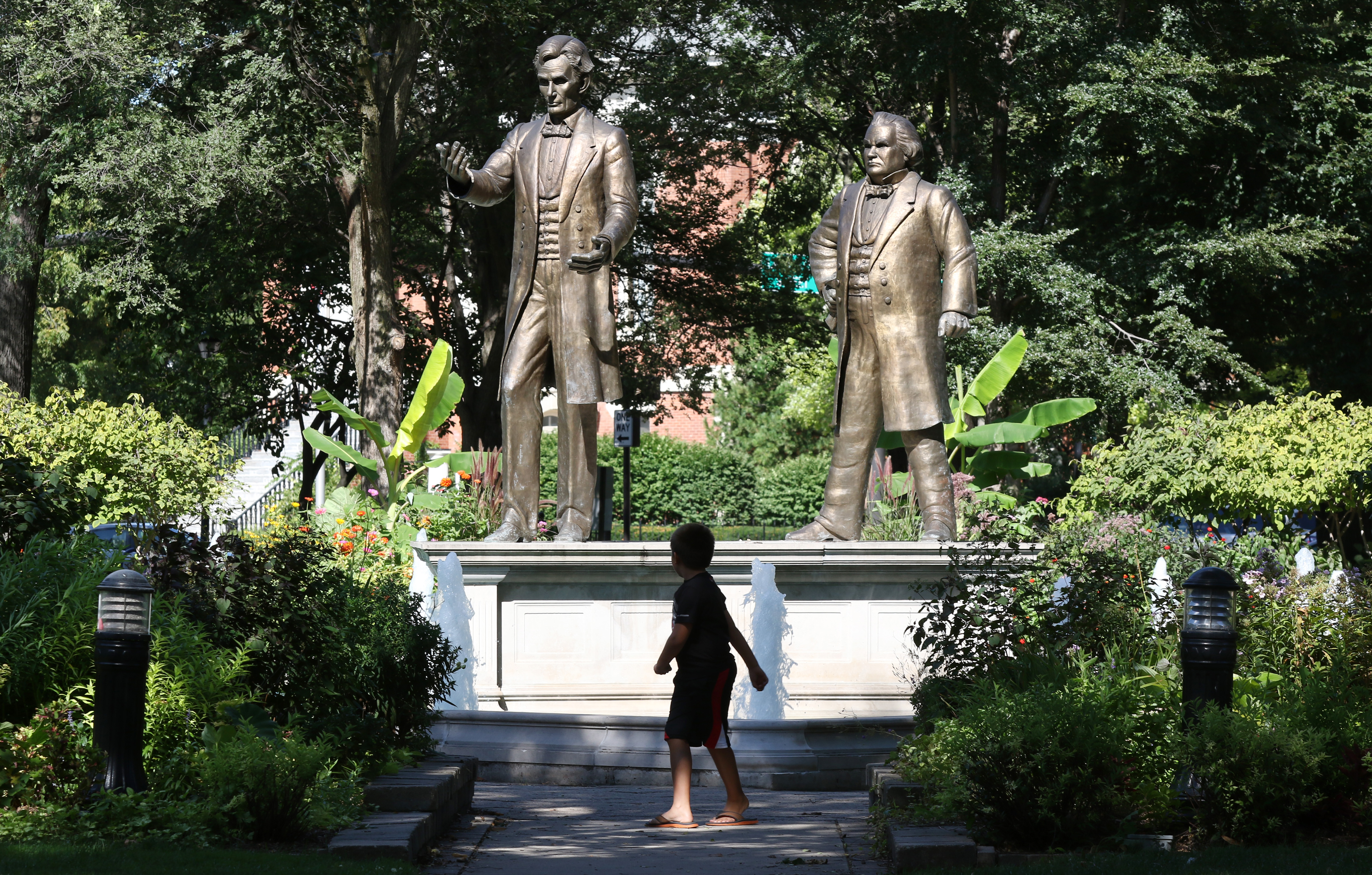
Lincoln-Douglas debates (1858)
The first of seven debates between Abraham Lincoln and Stephen Douglas took place at Washington Square in Ottawa.
Papers outside of Illinois first published only Douglas’ speeches. As Lincoln’s fame spread, his side began to appear in print too. Although Lincoln won the popular vote, he lost in the Illinois legislature at a time when state legislators, not voters, chose senators. But the debates established Lincoln as a national figure.
Lincoln nominated for president (1860)
With a critical push from the Tribune, Lincoln was nominated for president at the Republican Convention at the Wigwam building (what is now Wacker Drive and Lake Street) in Chicago.
He was elected the country’s 16th president on Nov. 6, 1860.
Great Railroad Strike (1877)
A rail strike that started in West Virginia grew into a national struggle between industrialists and workers, with Chicago a hotbed of the dispute. Workers demanding an eight-hour day clashed violently with police, militia and even U.S. infantry. President Rutherford Hayes deployed the Army in city after city throughout the East and Midwest, joining with local militias to restore order.
The National Guard has been activated to Chicago 18 times from 1877-2021. Here’s a breakdown.
Strikers viewed militiamen and soldiers as strikebreakers, and with the arrival of troops in Chicago, the violence escalated dramatically, as did civilian deaths. The Chicago Times noted that the largely immigrant mob included women — “Bohemian Amazons” wielding clubs in their “brawny arms.” The more heavily armed authorities killed 30 protesters in the fighting, which included an incident known as “The Battle of the Viaduct” because it occurred at a viaduct at 16th and Halsted Streets.
The birth of May Day (1886)
Tens of thousands of people marched on Michigan Avenue on May 1,1886, in a campaign to reduce the customary 10- to 12-hour workday to eight hours.
Three days later, an unknown bomb-thrower at a labor rally sparked the Haymarket Affair on the Near West Side. Eight policemen and at least four civilians died. The Tribune called it “a hellish deed.”
Flashback: Chicago’s place at the forefront of labor history
Illinois quickly passed an eight-hour workday law, which went into effect one year later. Workers thought the vague language of the law could be enforced, but employers thought otherwise. Thousands of workers marched through Chicago in support, but a failed general strike proved the employers right.
Though the U.S. honors workers in September with Labor Day, which also has Chicago roots, the 1886 events inspired the establishment of International Workers’ Day or May Day. A memorial on Desplaines Street, north of Randolph Street — a bronze statue of a wagon that served as a speakers’ platform during the labor meeting — commemorates the fight for workers’ rights in Chicago.
First settlement house in the nation (1889)
Jane Addams and Ellen Gates Starr opened Hull House on Sept. 18, 1889. The building at 800 S. Halsted St. in Chicago’s 19th Ward offered cultural and educational programs and social-reform efforts for the poor. And with the help of private donors, it prospered. By 1907, Hull House — which was named after its original owner, Charles Jerald Hull — consisted of 13 buildings covering a city block.

‘Most dangerous woman in America’
In addition to Hull House, Addams led a highly unpopular international crusade for peace during World War I, spoke our against municipal corruption in Chicago and fought for factory inspections, child labor laws and public health services. She also participated in the founding of the NAACP (National Association for the Advancement of Colored People), the ACLU (American Civil Liberties Union) and the Women’s International League for Peace and Freedom. In the 1920s, FBI Director J. Edgar Hoover characterized Addams as “the most dangerous woman in America” because of her pacifism and challenging the status quo.
By 1931, Addams became the first American woman to win the Nobel Peace Prize. Hull House remained open until 2012. It now houses the Jane Addams Hull-House Museum.
Pullman Strike (1894)
Chicago was the center of the nationwide Pullman strike, and the use of troops led to another round of death and destruction in the city. Illinois Gov. John Altgeld, aware that intervention of the militia or Army would only lead to a repetition of 1877 violence, would not send the militia to Chicago and urged President Grover Cleveland to refrain from committing troops. Instead, Cleveland ordered the Army into Chicago, and the tragic events of 1877 were repeated.
‘Cross of Gold’ speech (1896)
It’s been called one of the best political speeches ever delivered. William Jennings Bryan stepped onto the podium on July 8, 1896, at the Democratic National Convention inside Chicago Coliseum at 63rd Street and Stony Island Avenue, and demonstrated that reformers could profit from working within the system instead of fighting it. Stretching his arms wide, he mimed Jesus’ crucifixion.
“You shall not press down upon the brow of labor this crown of thorns!” he thundered. “You shall not crucify mankind upon a cross of gold!”
Bryan played third-party politics to his advantage, winning the nomination before losing to William McKinley.
First state to establish labor regulations for children (1903)
An improved law for the regulation of child labor was passed by the General Assembly. Under provisions of the act, Illinois was the first state to establish an eight-hour workday and 48-hour workweek for children. It went into effect on July 1, 1903.
First state to submit a statue honoring a woman for the National Statuary Hall Collection (1905)
Frances Willard, the founder and national president of the Evanston-based Women’s Christian Temperance Union (WCTU), encouraged young men to spend their leisure time pedaling a bike rather than imbibing liquor in a saloon. Known for her excellent speaking and lobbying skills, she was also a leader of the national Prohibition Party. She died in February 1898 in New York City. The 18th Amendment, which prohibited the sale of “intoxicating liquors,” was ratified 21 years later. A marble statue in her honor was added to the U.S. Capitol in 1905.
Industrial Workers of the World founded (1905)
The labor organization was established in Chicago, and featured some leading socialists, including Mary “Mother” Jones, “Big Bill” Haywood and Eugene Debs.
Promoting the idea of “one big union,” the IWW made inroads, but fell into decline because of a government crackdown on “reds” and internal dissension. A version of the IWW survives.
First party whip (1913)
James Hamilton Lewis, the son of a Confederate soldier, moved to Illinois in 1903. Two years later, he was the city’s attorney and assistant corporation counsel. Lewis was elected U.S. Senator in 1912 and became Democratic whip in 1913.
“As the whip, it was his duty to hold the party’s voting strength readily available during floor ballot tests,” the Tribune reported after Lewis’ death in 1939. “He held this honor until a Republican landslide carried him out of office in 1918.”
Direct election of U.S. senators (1913)
William Lorimer was chosen by Illinois lawmakers — not voters — to serve in the U.S. Senate. The Senate expelled Lorimer in 1912 and ruled his election was invalid because he attained the post through corrupt methods, including bribing state legislators.
After Lorimer’s dismissal, the 17th Amendment, providing for direct election of U.S. Senators, became part of the U.S. Constitution.
First vice president to win a Nobel Prize (1925-26)
Evanston resident Charles Gates Dawes, the U.S. comptroller of currency, impressed many as a brigadier general in charge of supplying the Army in France during World War I. After the war, he made headlines again as the nation’s first budget director, saving as much as $300 million in his first year. But back in Europe, Germany was struggling to repay enormous reparations. Dawes became the natural go-to guy in 1924 as vice president under Calvin Coolidge to help broker a deal to stabilize Germany’s finances and figure out how the allies would get their money. The result was called the Dawes Plan, and for it, he was awarded the Nobel Peace Prize. His former home is now the Evanston History Center.
Most convicted governors of any state
Illinois has had 43 men elected as the state’s chief executive. Six of them have been accused of wrongdoing. Four have been convicted or pleaded guilty: Otto Kerner, Daniel Walker, George Ryan and Rod Blagojevich. Two were acquitted at trial.
Vintage Chicago Tribune: Illinois governors — mostly the corrupt ones
Lennington Small, one of the men acquitted at trial (William Stratton was the other), was arguably the dirtiest of them all. Small, a Kankakee farmer, was elected governor in 1920. Just seven months after taking office, the former state senator was indicted on charges of embezzling millions of dollars while he was state treasurer. He was acquitted, but four jurors later got state jobs, raising suspicions of jury tampering.
Small was re-elected in 1924 despite a Tribune editorial declaring him the “worst governor the state ever had.”
First Black person from a Northern state to sit in Congress (1928)

Oscar Stanton De Priest was elected Chicago’s first Black alderman in 1915 and was also the first African American elected Cook County commissioner. When the Republican was elected to Congress in November 1928, he became its first Black member in nearly a quarter century. De Priest served three terms in the U.S. House of Representatives.
First presidential nominee to deliver his acceptance speech in person at his party’s convention (1932)
Eight candidates arrived at the Democratic convention inside Chicago Stadium to challenge the front-runner, New York Gov. Franklin Delano Roosevelt, who called for massive government intervention to end the Great Depression. Through three tedious roll calls, Roosevelt forces bartered with delegations and finally put their man over the top on the fourth try when House Speaker John Nance Garner folded his candidacy in exchange for the vice presidential nomination.
Vintage Chicago Tribune: Tradition of acceptance speeches at political conventions began in Chicago
Roosevelt broke major party tradition by flying nine hours from Albany to personally deliver his acceptance speech from the Congress Plaza Hotel, which was carried live at Chicago Stadium on WGN-AM. Roosevelt, certain of victory against the Republicans, promised “a New Deal for the American people.”
“These are unprecedented and unusual times,” Roosevelt said. “May this (appearance) be the symbol of my intention to be honest and to avoid all hypocrisy or sham.”
‘Dewey Defeats Truman’ (1948)

The Tribune was on deadline. And in the absence of election results, the newspaper assumed New York Gov. Thomas E. Dewey (Republican) would sink incumbent Harry S. Truman (Democrat). He didn’t. And the blunder — “Dewey Defeats Truman” — appeared atop a single edition of the Tribune.
Several news organizations made the same miscalculation, but none was displayed gleefully by Truman for what has become an iconic photograph.
First-ever political convention broadcast nationwide on television (1952)
A primitive broadcast from the Republican National Convention at the International Amphitheatre had cameras focused mostly on the podium or provided long shots of the delegations. Television reporters were heard but rarely seen.
In his acceptance speech at the Hilton Chicago, Dwight D. Eisenhower called for party unity.
“The noble service to which we Republicans summon all Americans is not only for one campaign or for one election. Our summons is to a lifetime enrollment. And our party shall always remain committed to a more secure, a brighter and an even better future for our people,” he said.
‘Most powerful local politician America has ever produced’ (1955)

Richard J. Daley was elected Chicago mayor on April 5, 1955, for the first of six terms.
During the long reign of “The Boss,” the face of Chicago changed profoundly. Daley’s friendship with Presidents John F. Kennedy and Lyndon B. Johnson brought the city millions of federal dollars to pay for ambitious capital-works projects and fund jobs that Daley used to hold his political apparatus together. He presided over the construction of the city’s expressway system, sprawling public-housing complexes, a greatly expanded O’Hare International Airport, the vast lakefront filtration plant for the city’s water system and the West Side campus of the University of Illinois at Chicago.
Daley’s national reputation was cemented in the presidential election of 1960, when legend has it that late-counted Democratic votes were responsible for Kennedy’s paper-thin victory over Richard Nixon.
“Daley, who served as mayor of Chicago from 1955 until his death in 1976, was the most powerful local politician America has ever produced,” wrote Adam Cohen and Elizabeth Taylor in “American Pharaoh.” “He possessed a raw political might that today, in an age when politics is dominated by big money and television, is hard to imagine.”
First televised presidential debate (1960)
Vice President Richard Nixon and Sen. John F. Kennedy squared off in the first presidential debate shown on TV on Sept. 26, 1960. Yes, Nixon appeared sweaty while Kennedy appeared poised and relaxed at WBBM-TV studios at 630 N. McClurg Court. (The studios were demolished in 2009 and the Rehabilitation Institute of Chicago opened at the site in 2017.)
It wasn’t until 1976 that other presidential candidates were willing to roll the dice and debate in that format, an eloquent testimony to Kennedy’s unexpected and devastating victory.
‘First significant northern freedom movement ever attempted’ (1966)
The Rev. Martin Luther King Jr. told reporters in Chicago in early January 1966 that he was working on a three-phase plan to mobilize the city’s roughly one million Black people. King selected a “typical ghetto apartment on the West Side” at 1550 S. Hamlin Ave. to serve as his base for a year.
King led marches — including one through Marquette Park in which he was struck in the head by a rock and announced, “I have never seen anything so hostile and so hateful as I’ve seen here today” — and met with city leaders to discuss how to provide better schools and housing for Chicago’s Black community. King visited Chicago less frequently in 1967, blaming city officials for not living up to their promises.
‘The whole world is watching’ (1968)
Vice President Hubert H. Humphrey was nominated at a stormy Democratic National Convention that was marked by riots on the streets with clashes of police and peace activists as well as raucous political demonstrations on the floor of the Chicago Amphitheatre.
“This moment is one of personal pride and gratification. Yet we cannot help but reflect the sadness we feel at the violence … in the streets of this great city and for the personal injuries which have occurred,” Humphrey said.
Gov. Samuel Shapiro ordered the National Guard to assist the almost 12,000 Chicago police officers, 1,000 federal agents and 7,500 U.S. soldiers already on duty to maintain law and order during the convention. Almost 10,000 members of the Illinois National Guard also responded.
“In the heat of emotion and riot, some policemen may have overreacted,” Daley said. “But to judge the entire police department by the alleged action of a few would be just as unfair as to judge our entire younger generation by the actions of this mob.”
Republican Richard Nixon was elected on Nov. 5, 1968, defeating not only Humphrey but also George Wallace, an American Independent Party candidate and former Alabama governor.
Operation PUSH founded (1971)

Rev. Jesse Jackson resigned from the Southern Christian Leadership Conference to start Operation PUSH (People United to Save Humanity, later changed to “Serve” Humanity) at 47th Street and King Drive in Chicago. PUSH was about economic empowerment and expanding educational, business and employment opportunities for the disadvantaged and people of color.
Under Jackson, the first Black Expo was held at the International Amphitheater that same year. The five-day trade fair drew Black businesspersons from dozens of states, fortifying Jackson’s assertion that economic development is the way to Black power.
Operation PUSH merged with Rainbow Coalition in 1996 and became known as Rainbow/PUSH Coalition.
Watergate tapes printed (1974)
The Tribune on May 1, 1974, became the first news organization to publish the entire 246,000-word transcript of the Watergate tapes, scooping even the government printing office by several hours.
The Tribune’s second punch to Nixon’s presidency was delivered on May 9, 1974. The Tribune’s Editorial Board, a longtime Republican stalwart, called for his resignation. With articles of impeachment looming, Nixon became the first — and only — U.S. president to resign.
‘Welfare queen’ (1974)
Linda Taylor, a South Side con woman whose long list of crimes included public aid fraud, was dubbed a “welfare queen” by the Tribune. Two years later, presidential candidate Ronald Reagan seized on her story to attack waste in social welfare programs.
Jackson runs for president (1984 and 1988)
The Operation PUSH founder became the first Black person to lead a serious campaign for the White House.
A comment to Washington Post reporter Milton Coleman, however, strained Jackson’s relationship with the Jewish community. Coleman reported he heard Jackson refer to Jews as “Hymie” and New York as “Hymietown.” Jackson said he had “no recollection” of using those terms, but the remarks caused dissent within the Democratic Party.
Vintage Chicago Tribune: Five phases of Rev. Jesse Jackson’s legendary life
Walter Mondale received the Democratic nomination at the party’s convention in San Francisco on July 18, 1984, with 2,191 votes. Jackson had just 465 ½ votes. Mondale lost to incumbent Ronald Reagan.
Jackson received an endorsement from Chicago Mayor Harold Washington — the city’s first Black mayor — during the 1988 race. Michael Dukakis, who would lose the election to George H.W. Bush, earned the party’s nomination on July 20, 1988, at the convention in Atlanta with more than 2,700 delegate votes. Jackson had about 1,100 — more than any other Black candidate before him.
Chicago becomes a ‘sanctuary city’ (1985)
Washington signed an executive order to end the city’s practice of asking job and license applicants about their U.S. citizenship and halt cooperation by city agencies with federal immigration authorities.
Every Chicago mayor since Washington has reaffirmed “fair and equal access” to employment, benefits and licenses to all regardless of nationality or citizenship.
Operation Greylord (1987)
Six Cook County judges tied to a federal investigation of public corruption in Chicago, known as Operation Greylord, were relieved of their judicial duties on May 4, 1987. Greylord was a watershed moment in its use of eavesdropping devices and a mole to obtain evidence instead of relying on wrongdoers to become government informants.
Nearly 100 people were indicted and all but a handful were convicted. The convictions included 50 lawyers, as well as court clerks, police officers and sheriff’s deputies. Of the 17 judges indicted, 15 were convicted.
First Black person named president of Harvard Law Review (1990)
A then-28-year-old Barack Obama spent the years before he enrolled in law school as executive director of the Developing Communities Project in Chicago.
First Black woman elected U.S. Senator (1992)

Carol Moseley Braun upset Sen. Alan Dixon in the Democratic primary election, then was elected as the first female Senator from Illinois. The Democrat served until 1999.
One of the largest pro-immigrant rallies in U.S. history (2006)
A controversial federal bill that would crack down on those who employ or help illegal immigrants led to a largely word-of-mouth campaign that brought up to 100,000 people to the Loop for a march that stretched two miles from Union Park on the Near West Side to Federal Plaza.
First Black president (2008)

A $10,000-a-year job brought the Hawaii-born Obama to Chicago for the first time. It’s the city where he began his work as a community organizer, met his wife and had children. It’s also where he launched his political career, which began in the state Senate and peaked in an election night rally in Grant Park on Nov. 4, 2008, after he was elected the nation’s chief executive.
Host to most political conventions in the United States (1860-2024)
Chicago has hosted 26 Republican and Democratic conventions since 1860. No other city has hosted nearly as many. The city has also bid to host the 2028 DNC.Operation Midway Blitz (2025)
“What happened here for more than two months is unlike anything in recent American history: the federal government sending agents dressed for war into neighborhoods of the country’s third-largest city to arrest mostly people who look Latino and to ask questions later,” the Tribune reported in its Pulitzer Prize-winning “64 days in Chicago: The story of Operation Midway Blitz.”
On social media and in off-the-cuff moments over the past decade, President Donald Trump has displayed disdain for the city, railing against its challenges with crime and gun violence and using “sanctuary city” as a slur. It wasn’t long after Trump’s inauguration that ICE activity increased in the city.
In fall 2025, “Operation Midway Blitz” arrested more than 4,500 people. The Department of Homeland Security said it targeted “the worst of the worst.” Yet the government’s own data showed agents failed to meet their stated goal: In what data the government has so far released, covering the first half of the blitz, a Tribune analysis found only about 1.5% of those detained for immigration-related reasons had been convicted of a violent felony or sex crime.