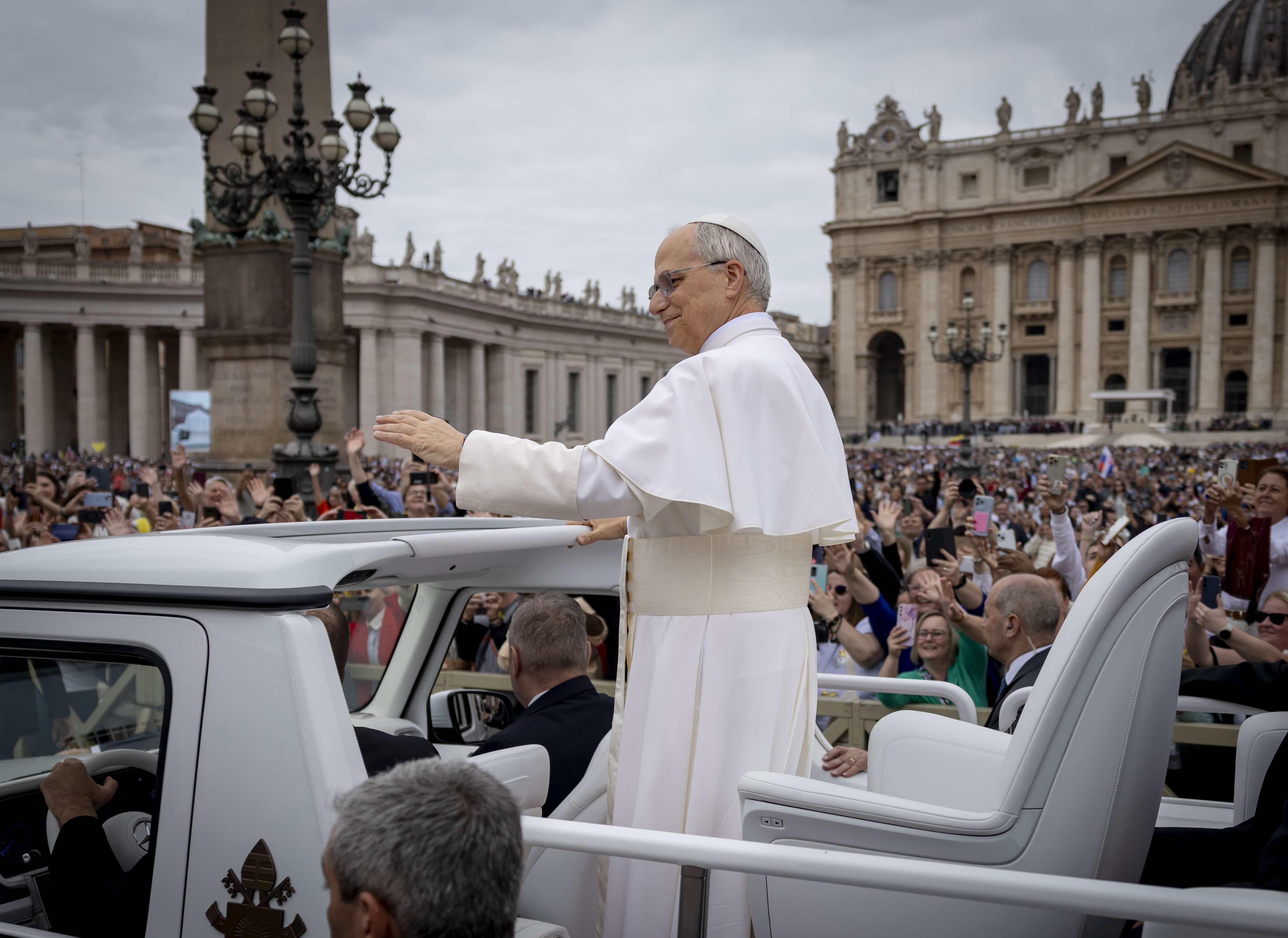
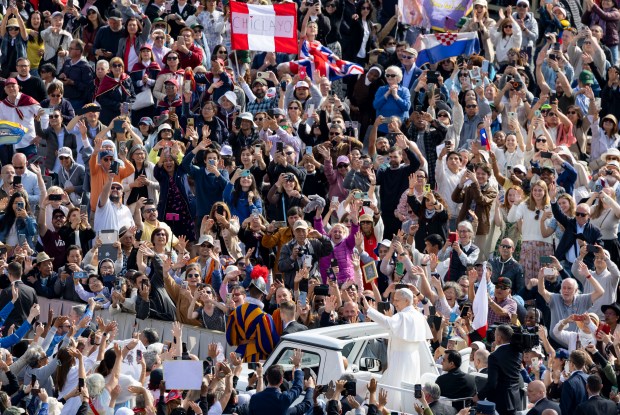
Pope Leo XIV waves to the crowd while holding his first general audience on May 21, 2025, in St. Peter’s Square at the Vatican. Leo is the first pontiff from the U.S. in the 2,000-year history of the Roman Catholic Church. (Brian Cassella/Chicago Tribune)
This Fourth of July the United States marks its 250th anniversary (or semiquincentennial) of existence. Some might be conflicted when it comes to celebrating our divided country this year. And, it turns out, some Chicagoans in 1876 felt the same way.
“Since the (Civil) War, the average Chicagoan has taken comparatively little interest in ‘the day we celebrate,'” the Tribune observed on July 5, 1876. “Nothing of (the Fourth of July) remains to-day, so far as Chicago is concerned, save a large number of headaches, the smoldering ruins of a few small-sized conflagrations, an occasional thumbless hand, and a general feeling of used-upness.
“A hundred years hence, (people) may search the files of the Tribune of the century previous to ascertain how the then half-million population of Chicago celebrated the first Centennial of the nation’s existence for the purpose of instituting a kind of Plutarchian comparison between the days that were and the days that are. … and they will do just as Chicago did yesterday.”
Yes, fireworks, cookouts and parades will still mark the occasion. And there likely will be much reflection on the country’s ingenuity and tenacity — including that shown by the Prairie State over the past 250 years.
That’s why the Tribune is taking a look back at what the Chicago area and the state of Illinois have uniquely contributed to the nation — and the world — from scientific inventions and pioneering businesses to food, culture, sports and transportation modernizations.
The seven-part series starts today and will run each Sunday leading up to the July 4 weekend. Expect about 35 items each week in our attempt to compile a list of 250.
This week’s focus is fabulous firsts — ideas that took root here in Illinois before they captured the world’s attention. You’ll learn that our state is home to giants of industry and innovation. Entrepreneurs have launched first-of-their-kind ventures here. We have welcomed diversity, better representation, empowerment and demonstration on behalf of people of color, the LGBTQ+ community, those with disabilities and women.
Our residents have perfected techniques to help save lives of people, animals and the environment. Some Chicagoans have been honored for their work with awards — including the Nobel Prize — or lifetime achievement honors. Others have been declared saintly for their devotion to the sick and poor. Then there are people or events we might prefer to forget for they have brought death or destruction. But combined with the good, these are the things that make up the fabric of the place we live.
Here, in chronological order, is a handpicked list — by no means a comprehensive one — of homegrown accomplishments to celebrate this year.
Oldest Black-founded town in the United States (1836) and first majority-Black town in America (1873)
Brooklyn residents Amir Watson, right, and Promise Houston ride bikes on Madison Street on Nov. 24, 2024. Brooklyn, Illinois, is considered to be one of the country's first Black settlements, the first majority-Black town in America to incorporate and the oldest such town still in existence today. (E. Jason Wambsgans/Chicago Tribune)
An aerial view of Brooklyn, Illinois, on Nov. 25, 2024, shows the railroad tracks, vacant lots, single-family homes and churches that make up much of the tiny village's footprint. It's considered to be one of the country's first Black settlements, the first majority-Black town in America to incorporate and the oldest such-town still in existence today. (E. Jason Wambsgans/Chicago Tribune)
Historic photographs of Brooklyn from the collection of Magnolia Johnson, considered one of Brooklyn's resident historians, Nov. 12, 2024. (E. Jason Wambsgans/Chicago Tribune)
Brooklyn Mayor Trenton Atkins, photographed Nov. 12, 2024, said he is not waiting around for the federal government. “We’re trying to put ourselves in a position where when things get better,” he said, “we’ll be ready.” (E. Jason Wambsgans/Chicago Tribune)
Brooklyn hopes to redevelop the former grocery store, and later roller rink, at Madison and South 5th streets into a community center, Nov. 24, 2024. (E. Jason Wambsgans/Chicago Tribune)
Brooklyn native and Chicago resident Tracy Crawford Kincaide sings at the Historical Society of Brooklyn Illinois Gathering in the Wilderness History and Heritage Day event on Sept. 13, 2025. (E. Jason Wambsgans/Chicago Tribune)
Illinois State Archaeological Survey archeologist Erin Benson digs at a site on the north side of Brooklyn, Illinois, on Sept. 13, 2025. (E. Jason Wambsgans/Chicago Tribune)
Hakeem Abdul-Rasheed examines artifacts found in a Illinois State Archaeological Survey dig at a site on the north side of Brooklyn on Sept. 13, 2025. (E. Jason Wambsgans/Chicago Tribune)
Illinois State Archaeological Survey archeologist Erin Benson digs at a site on the north side of Brooklyn, Illinois, on Sept. 13, 2025. (E. Jason Wambsgans/Chicago Tribune)
The newly installed Freedom Village and Priscilla ”Mother” Baltimore monument on the north side of Brooklyn on, Sep. 16, 2025. (E. Jason Wambsgans/Chicago Tribune)
Brooklyn residents at the Historical Society of the Brooklyn Illinois Gathering in the Wilderness History and Heritage Day on Sept. 13, 2025. (E. Jason Wambsgans/Chicago Tribune)
Kids play in Brooklyn Community Park, a park built with money from money laundering fines paid by brothel owners, Nov. 11, 2024. The fines currently funds scholarships for local students.(E. Jason Wambsgans/Chicago Tribune)
Glen Chatman and Irene Henry chat after Sunday service at Brooklyn's Quinn Chapel AME church Nov. 24, 2024. (E. Jason Wambsgans/Chicago Tribune)
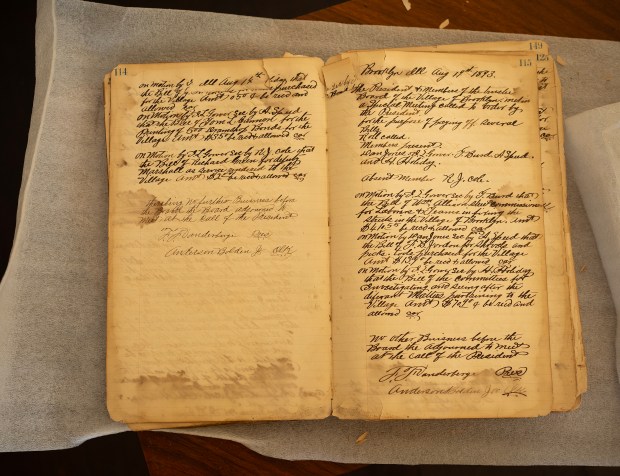
Ledger from 1893 from Brooklyn Village Council meetings in the collection of former Brooklyn Mayor Nathaniel O'Bannon III. (E. Jason Wambsgans/Chicago Tribune)
Brooklyn's post office waits to be repaired months after a motorist drove into the building. (E. Jason Wambsgans/Chicago Tribune)
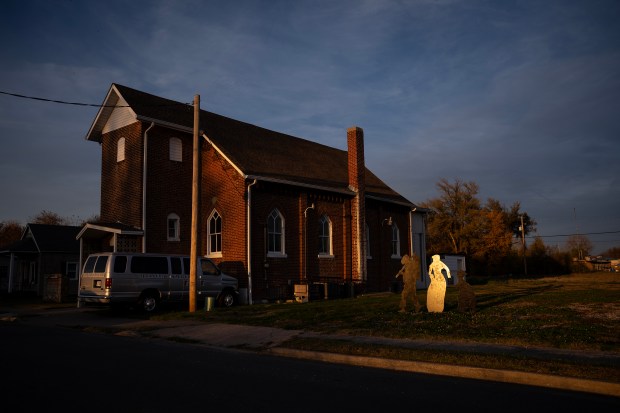
Quinn Chapel AME church, though likely founded earlier, was established at this location on North Fifth Street in 1839. It was rebuilt after a fire in 1878 on the same location, and is the same building where the congregation meets. (E. Jason Wambsgans/Chicago Tribune)
Fragment of a metal bowl or ladle, likely from around the 1890s, unearthed in Brooklyn, Illinois, in an Illinois State Archaeological Survey excavation. (E. Jason Wambsgans/Chicago Tribune)
Silhouettes evoking Brooklyn’s role as a stop on the Underground Railroad outside Quinn Chapel AME church. The figures were put there with the help of students and staff at Southern Illinois University-Edwardsville and are the first pieces of what the Rev. Aurelia Jackson envisions will be a replica of Brooklyn's early days. (E. Jason Wambsgans/Chicago Tribune)
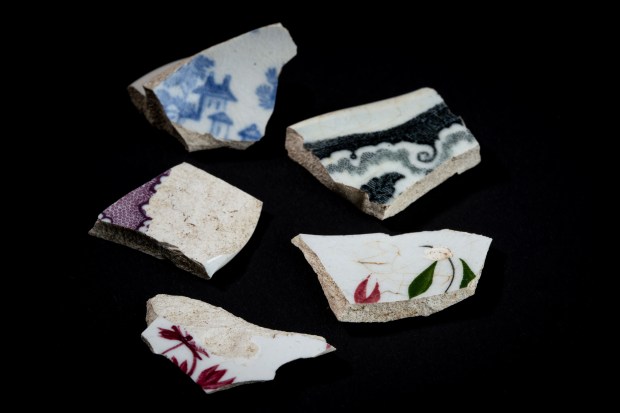
Pottery fragments, dated to the 1830s, unearthed in Brooklyn, Illinois, during an Illinois State Archaeological Survey excavation. (E. Jason Wambsgans/Chicago Tribune)
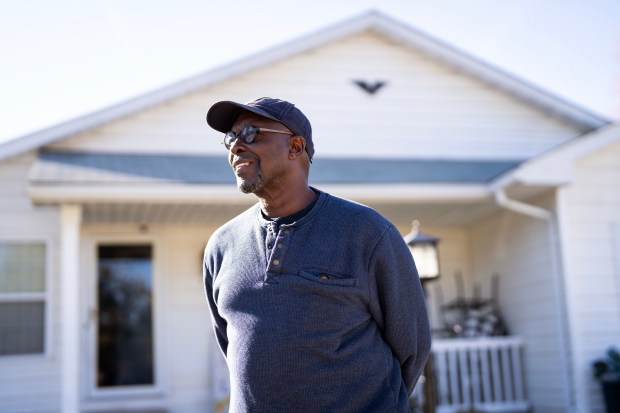
Former Brooklyn Mayor Nathaniel O'Bannon III, 66, on Nov. 12, 2024, in his home that's been in his family since 1929. (E. Jason Wambsgans/Chicago Tribune)
A portrait shows the great-grandparents of former Brooklyn Mayor Nathaniel O'Bannon III, 66. "We're right at the pinnacle of it all," he said of Brooklyn, standing outside his home on the east side of town that has been in his family since 1929. "And that's a beautiful thing. We're one of the ones that is still existing — a government established by Black people." (E. Jason Wambsgans/Chicago Tribune)
Fragment of a Cairns Timmerman Block & Co. soda bottle from the 1850s to 1860s, unearthed in Brooklyn, Illinois, in an Illinois State Archaeological Survey. (E. Jason Wambsgans/Chicago Tribune)
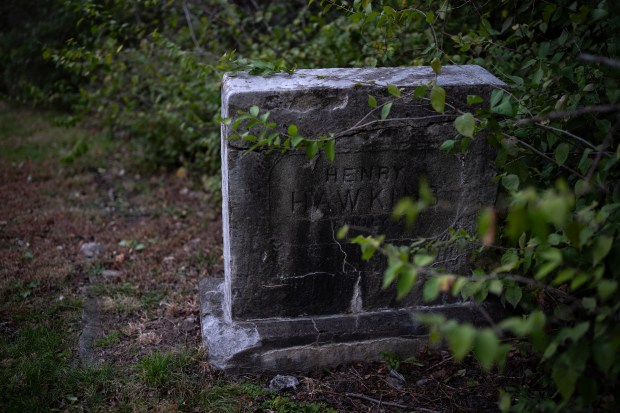
Grave marker for the Henry Hawkins family in the Brooklyn cemetery on Eagle Park Road in Brooklyn, Illinois, on Nov. 25, 2024. Henry Hawkins Sr. was born into slavery in Kentucky. (E. Jason Wambsgans/Chicago Tribune)
Strip clubs located off of Illinois Route 3 in Brooklyn, Illinois, are seen on Nov. 23, 2024. (E. Jason Wambsgans/Chicago Tribune)
Prince Wells III, 71, a trumpet player and retired Southern Illinois University-Edwardsville professor whose family lineage in Brooklyn dates back to before incorporation, on Nov. 24, 2024. (E. Jason Wambsgans/Chicago Tribune)
1 of 25
Brooklyn residents Amir Watson, right, and Promise Houston ride bikes on Madison Street on Nov. 24, 2024. Brooklyn, Illinois, is considered to be one of the country's first Black settlements, the first majority-Black town in America to incorporate and the oldest such town still in existence today. (E. Jason Wambsgans/Chicago Tribune)
Free Frank McWorter was an enterprising enslaved Kentucky man who purchased freedom for his pregnant wife, Lucy, then his own, by manufacturing and selling a component of gunpowder and fertilizer. He moved his family to Illinois, a free state, in 1831. McWorter bought 80 acres for $100 and in 1836 founded New Philadelphia, a promising city of brotherly love, in Pike County, 20 miles from the slave state of Missouri. The town was dissolved around 1880, about a decade after the railroad notably bypassed it. But two groups work tirelessly to tell Free Frank’s story — his descendants, spread widely across the country, and a small group of local residents who form the New Philadelphia Association.
Established in the early 1830s as a refuge for free and enslaved Black people and incorporated in 1873, Brooklyn is nestled on the eastern bank of the Mississippi River across from St. Louis. It was once a key outpost on the Underground Railroad and, later, a welcoming beacon for those fleeing the Jim Crow South. It was a thriving, close-knit community where, at its peak, more than 2,500 lived under the town motto: “Founded by Chance, Sustained by Courage.” In the last 70 years, though, Brooklyn has spiraled toward extinction. A group of tireless advocates and historians are trying to save it.
First state to ratify the 13th Amendment (1865)
Head conservator Christina Marusich, of Graphic Conservation Co., points to the signature of President Abraham Lincoln on Nov. 17, 2011, on a copy of the 13th Amendment, which banned slavery in the U.S. (Antonio Perez/Chicago Tribune)
A prominent anti-slavery battleground state, Illinois was prime Underground Railroad territory. The 13th Amendment, which banned slavery and involuntary servitude in the United States, was passed by the U.S. House 119-56 on Jan. 31, 1865, several months after the Senate had approved it. The Tribune called the action, “the day of doom to man selling.”
First statewide organization advocating for women’s voting rights (1869)
On June 26, 1913, Gov. Edward F. Dunne of Illinois, seated, signed the Suffrage Bill that gave Illinois women the right to vote. Dunne signed the bill in the presence of his wife and suffragette leaders Grace Wilbur Trout, Elizabeth Booth, Antoinette Funk and Margaret Haley. (Acme)
Gov. Edward Dunne signed the Illinois Suffrage Act into law in 1913, giving women the right to vote for president, as well as municipal officers. This made Illinois the first state east of the Mississippi River to empower women to vote for president. And on June 10, 1919, Illinois became one of the first states to ratify the 19th Amendment to the Constitution, which would give women the right to vote. The 19th Amendment was ratified on Aug. 18, 1920.
First upright farm silo (1873)
A silo is used for storage on a farm off North Dwight Road in Morris on Sept. 20, 2024. (Tess Crowley/Chicago Tribune)
Grain was stored in pits during the 1800s, which made it susceptible to spoilage. University of Illinois graduate Fred Hatch convinced his father, Lewis Hatch, to build up instead of down on the family’s farm near Spring Grove in McHenry County. The Hatches lined a 6-foot pit with rocks and mortar and kept building higher — extending the walls 16 feet high inside their family barn. They constructed the floor of the new structure out of double-ply floorboard lined with tar paper.
The design made it faster to fill, pack and empty, and set the stage for another agricultural invention — putting a separate roof on the silo, and building it outside.
The original silo no longer stands, but a plaque acknowledging its existence was added to the site by the American Society of Agricultural Engineers in 1984. Today it’s part of Lyle C. Thomas Park, 7816 Blivin St., in Spring Grove.
World’s first skyscraper (1884)
The Home Insurance Building in Chicago is considered the world's first modern skyscraper, built in 1884. It was designed by William Le Baron Jenney and had an interior metal frame to support its weight. The building was demolished in 1931. (Chicago History Museum)
A permit was issued on March 1, 1884, for the construction of a nine-story structure at the northeast corner of LaSalle and Adams streets in downtown Chicago. This office building, for the Home Insurance Co., was designed by architect William Le Baron Jenney and completed the following year. For the first time, a skeleton of metal, rather than walls of masonry, formed the main supporting material for a large commercial tower. The Home Insurance Building was demolished in 1931 to make way for the 42-story Field Building, which became the city’s next largest office building.
First Ferris wheel (1893)
The first Ferris wheel was built by George W. Ferris for the World's Columbian Exposition in 1893 in Chicago. (Chicago Herald-American)
Visitors boarded the the giant wheel during its debut on June 15, 1893, at the World’s Columbian Exposition in Chicago. Imagined and built by George Washington Gale Ferris Jr., the ride stood a staggering 264 feet tall, its cars were 24 feet long, 13 feet wide and 10 feet high, and the whole construction weighed 26,000 pounds.
“It seemed as if 100,000 gazed in trembling and anticipation of something awful from the earth below,” a Tribune reporter aboard one of the cars recounted. “The stream of humanity along the Midway ceased its movement and gazed at the monster wheel.”
The wheel was moved to St. Louis for the 1904 World’s Fair, then destroyed in 1906.
First serial killer in the United States (1893)
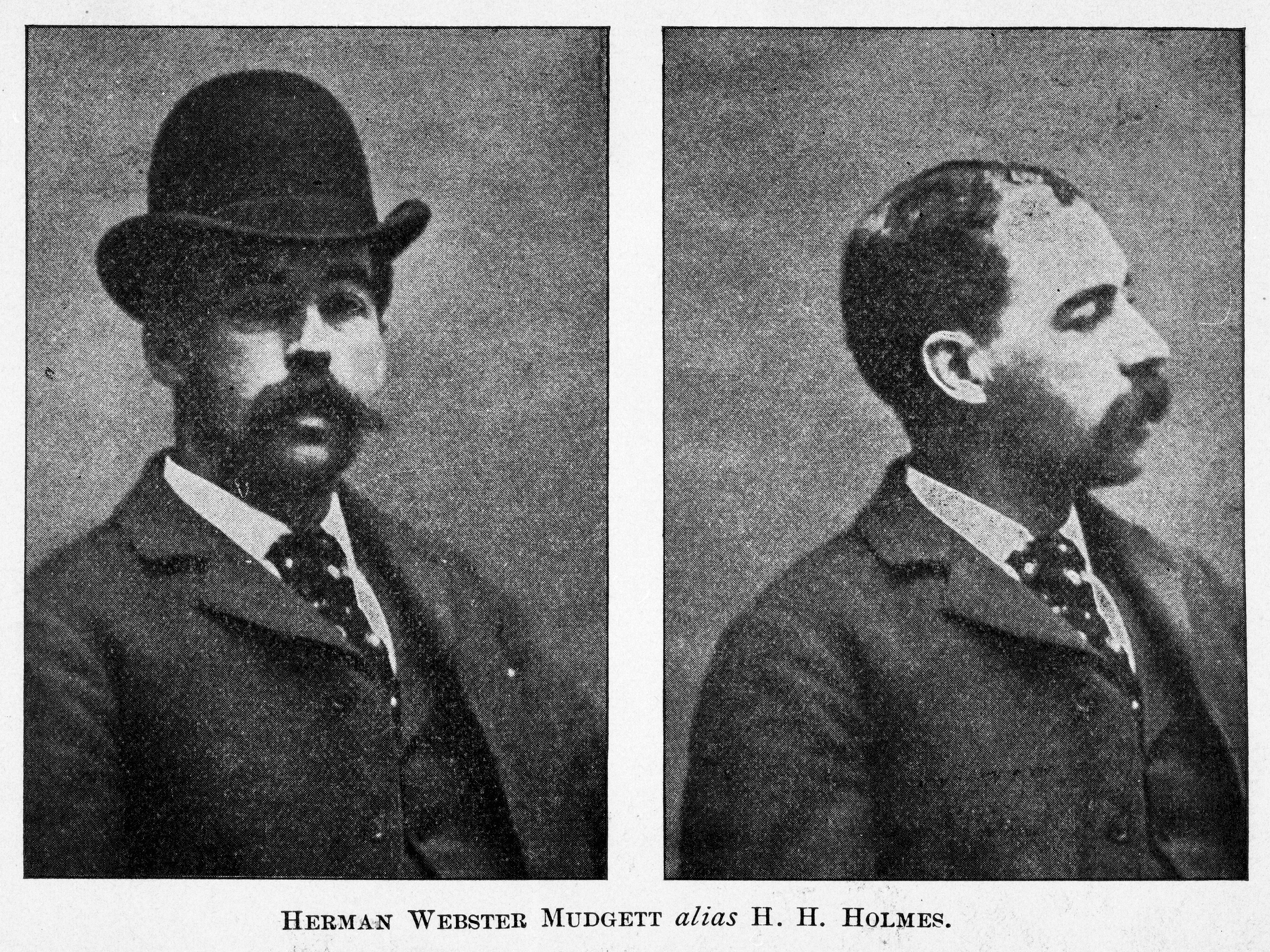
Convicted serial killer Herman Webster Mudgett, better known by his alias H.H. Holmes, is considered America's first serial killer. The photos of Holmes originally appeared in the book "The Holmes-Pitezel Case: A History of the Greatest Crime of the Century" by Frank P. Geyer. (Chicago History Museum)
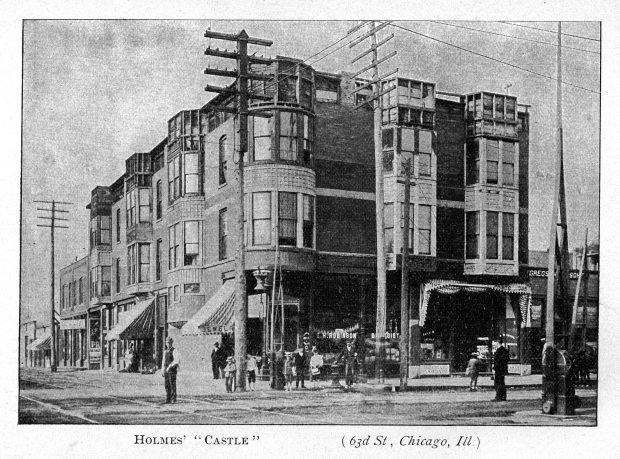
The exterior of H.H. Holmes' World's Fair Hotel on West 63rd Street in Chicago. It would become known as the "Murder Castle." The photo originally appeared in the book "The Holmes-Pitezel Case: A History of the Greatest Crime of the Century" by Frank P. Geyer. (Chicago History Museum)
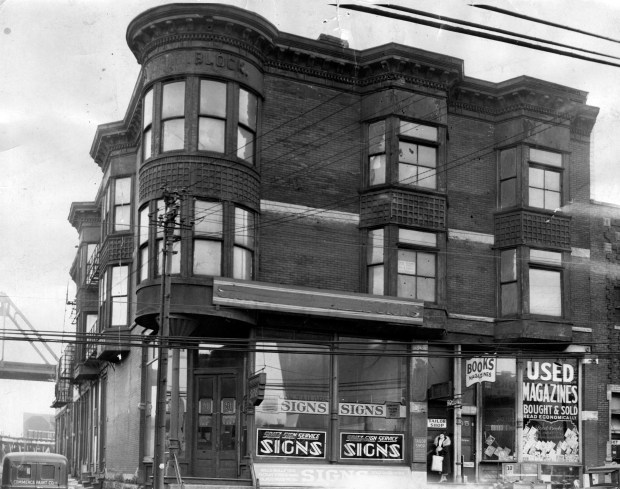
The H.H. Holmes "Murder Castle" in Chicago in March 1937. The building at 601-603 West 63rd Street was sold in 1938 and razed to make way for the Englewood post office. (Chicago Tribune historical photo)
1 of 3
Convicted serial killer Herman Webster Mudgett, better known by his alias H.H. Holmes, is considered America's first serial killer. The photos of Holmes originally appeared in the book "The Holmes-Pitezel Case: A History of the Greatest Crime of the Century" by Frank P. Geyer. (Chicago History Museum)
Herman Mudgett — the man who became infamous as H.H. Holmes — preyed mainly on naive and gullible women who wouldn’t be missed amid the thousands of tourists streaming into Chicago’s fashionable Englewood neighborhood to attend the “White City” of the World’s Columbian Exposition of 1893. Many of Holmes’ dealings in his so-called “Murder Castle” at 610 W. 63rd St., however, were fabrications. He left the city in summer 1894 before he was linked to any murders. It was only after his subsequent arrest in Boston and confessions that his Chicago activities were scrutinized.
First open-heart surgery (1893)
In 1893, Dr. Daniel Hale Williams, a pioneering Black surgeon, performed the first successful suture of a human heart and pericardium at Provident Hospital in Chicago. (Chicago Tribune archive)
The procedure was performed at Provident Hospital — the city’s first interracial hospital — on Chicago’s South Side. The patient was James Cornish, a young man with a knife wound to the chest from a barroom brawl. The surgeon, who had gone into medicine because he disliked earlier work as a shoemaker’s apprentice, was Daniel Hale Williams. Both patient and surgeon were Black.
Despite lacking X-rays, antibiotics, adequate anesthesia or other tools of modern surgery, Williams stepped in. Cornish lived, and Williams went on to acclaim. Williams was appointed in 1894 as chief surgeon at the Freedmen’s Hospital in Washington, D.C., which gave care to formerly enslaved Blacks.
First organized automobile race in the nation (1895)
Chicago's first auto race is about to start in Jackson Park on Thanksgiving Day, Nov. 28, 1895. (Chicago Times-Herald)
The 55-mile route started in Chicago’s Jackson Park — amid snow and slush — and ended in Evanston. Of the seven competitors, only two crossed the finish line. A Duryea “motocycle” won the race. The other five, according to the Tribune, “were lost — wandering aimlessly about the streets of Chicago or lying wrecked in some gutter along the way.”
First juvenile court (1899)
Cook County Juvenile Court building in Chicago, circa 1939. (Chicago Tribune historical photo)
Judge Richard S. Tuthill, a Civil War veteran, presided over the first case on July 3, 1899.
Lena Campbell of 84 Hudson St. accused her 11-year-old son, Henry Campbell, of larceny. Instead of sending the boy to a penal institution, Tuthill sent the boy to New York to live with his grandmother. For thousands of children, the “child-saver” experiment was a huge success, and it expanded to all 50 states.
‘Greatest ship canal ever constructed’ (1900)
The earth section of the Sanitary and Ship Canal was constructed by horse-drawn graders, which scraped up the earth and dumped it into accompanying wagons. The first water trickled into the finished Sanitary and Ship Canal from Lake Michigan at Needle Dam on Jan. 2, 1900. (Chicago Tribune archive)
The Chicago Sanitary and Ship Canal (a project long championed by the Tribune) was completed on Jan. 2, 1900, after eight years of work by 8,500 laborers. “The opening of the greatest ship canal ever constructed in America and the informal completion of one of the engineering feats in the world’s history was accomplished without ceremony,” the Tribune reported.
First American to win a Nobel Prize (1907)
Nobel Prize-winning professor Albert A. Michelson of the University of Chicago in an undated photo. (University of Chicago)
Albert A. Michelson, the first head of the physics department at the University of Chicago, won the first Nobel Prize in science.
The U.S. Naval Academy graduate measured the speed of light with unsurpassed accuracy and built several machines for studying the length of light waves.
First U.S. city to require pasteurization of milk (1908)
Health Commissioner Herman Bundesen examens samples of impure milk in his laboratory, circa 1925. Editors' note: This historic print shows some hand painting. (Chicago Tribune historical photo)
All milk producers in Chicago — as of Jan. 1, 1909 — were required by ordinance to provide “pure milk” that had either been treated to remove pathogens or certify that the milk they sold was produced from healthy cows. The union of milk shippers almost unanimously agreed to the arrangement during a meeting on Dec. 21, 1908, at 10 S. Clark St. The measure was championed by the city’s first health commissioner, William A. Evans, who sought to prevent tuberculosis and other debilitating diseases in children. Evans also contributed a column in the Tribune called “How to Keep Well,” which debuted Sept. 10, 1911. The first of its kind in a daily newspaper, it was syndicated and later widely imitated.
America’s first recorded commercial aviation disaster (1919)
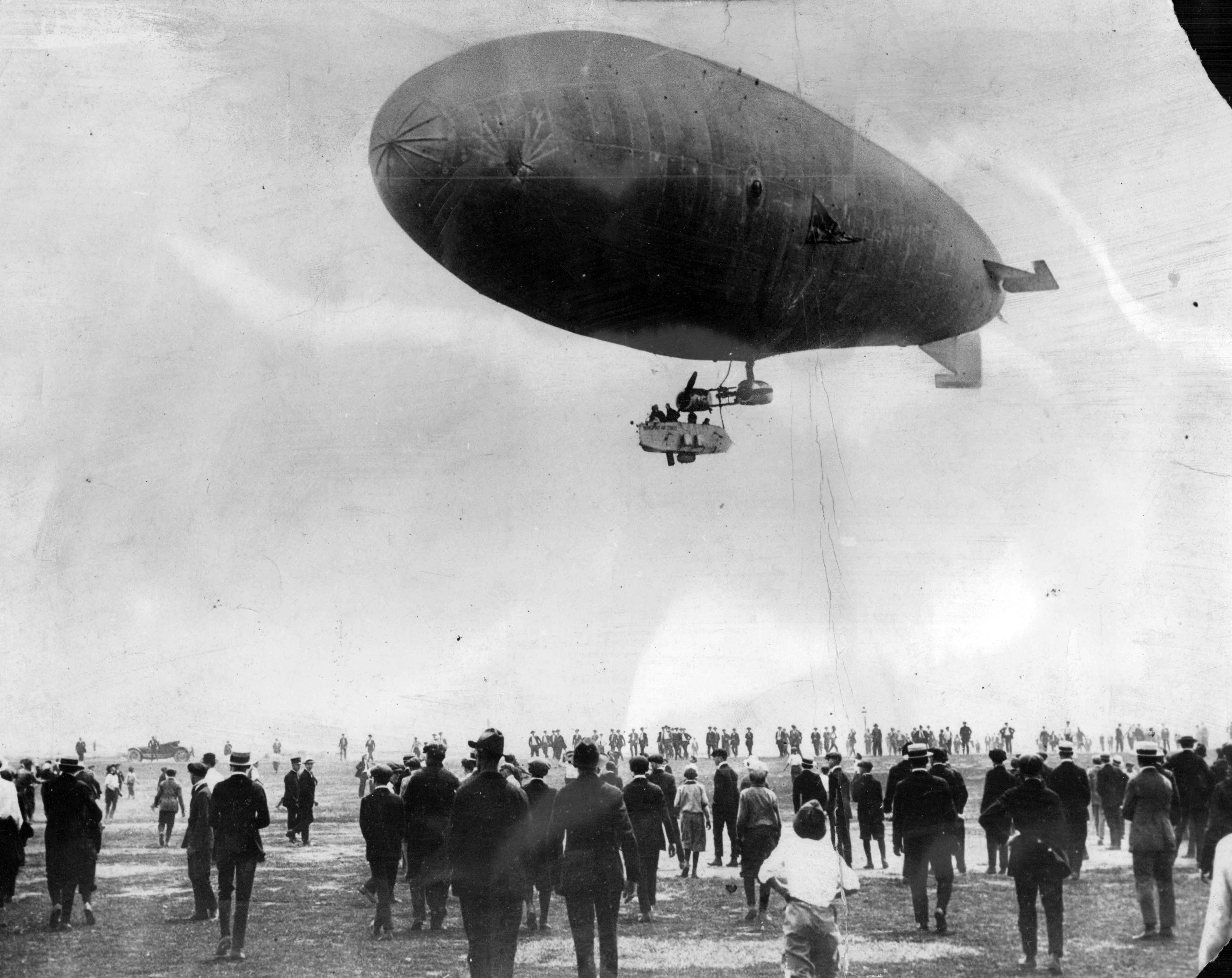
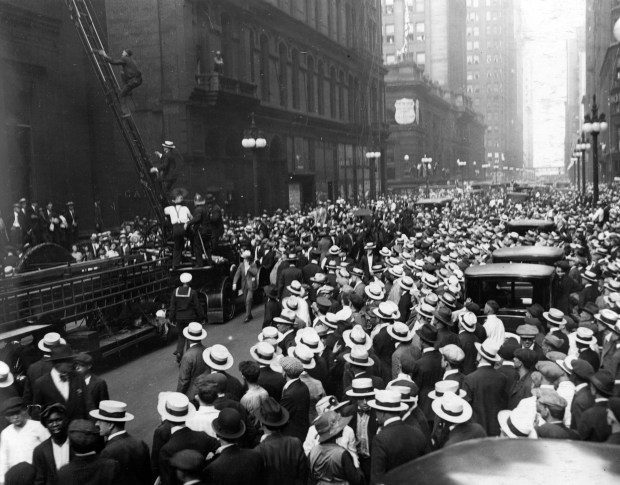
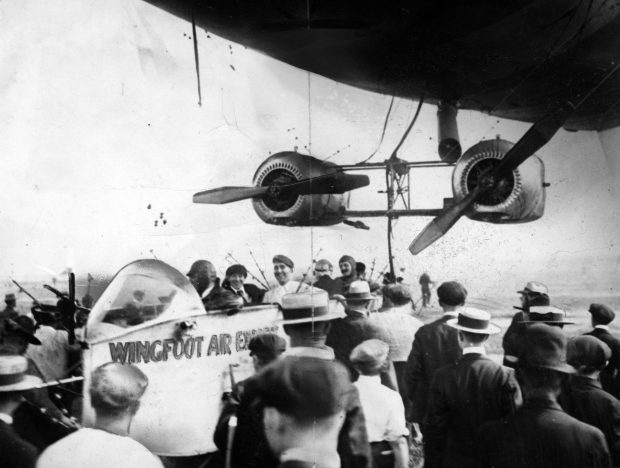
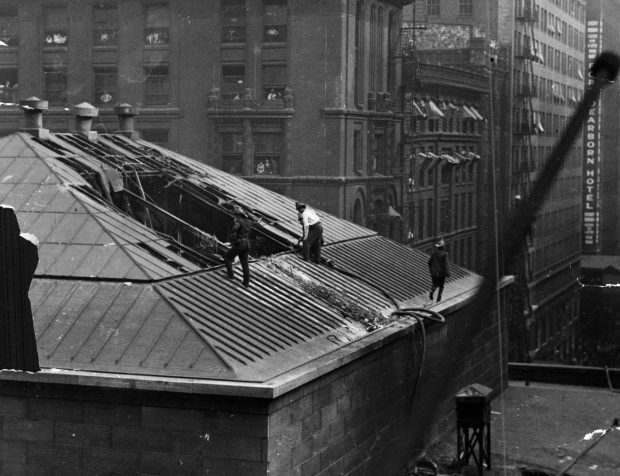
A few minutes after this photo was taken in Grant Park on July 21, 1919, the Wingfoot Air Express blimp crashed through the skylight roof of the Illinois Savings and Trust Bank in Chicago's Loop, killing 14 people. (ACME)
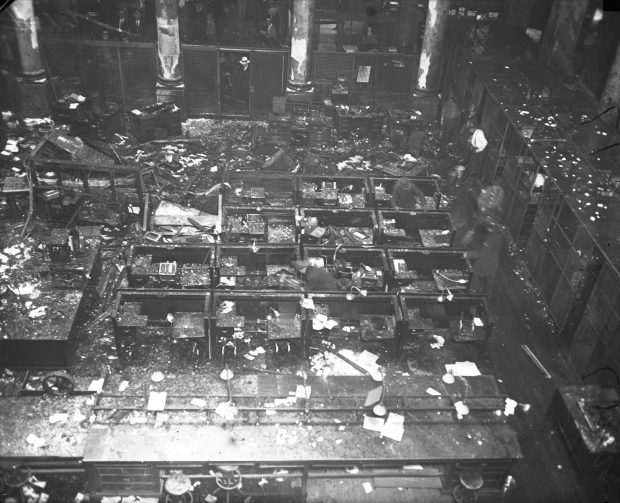
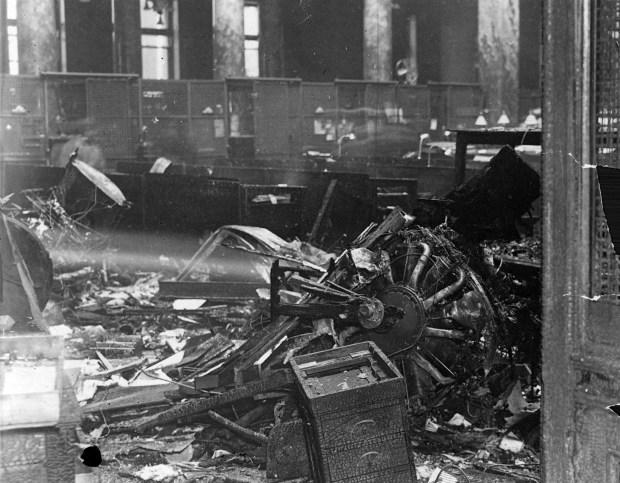
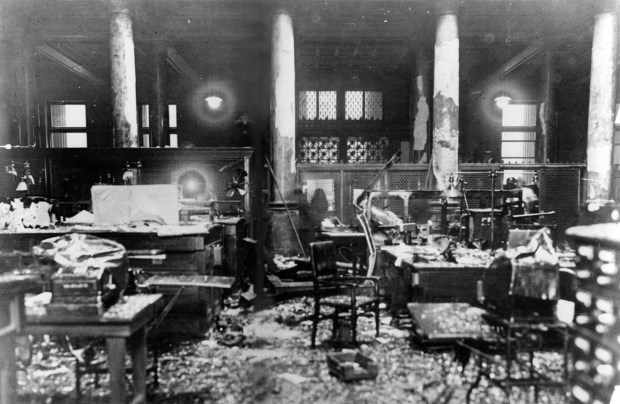
Debris is scattered throughout the Illinois Trust and Savings Building in Chicago after the Wingfoot Air Express plunged through the ceiling of the building on July 21, 1919. (Chicago Tribune archive)
The Wingfoot Air Express blimp crashed into the Illinois Trust and Savings Bank building in Chicago on July 21, 1919. (Chicago Tribune historical photo)
A crowd gathers outside the Illinois Trust and Savings Bank on Jackson Boulevard after the Wingfoot Air Express dirigible crashed through the rooftop skylight, killing 14 people on July 21, 1919, in Chicago. (Chicago Tribune historical photo)
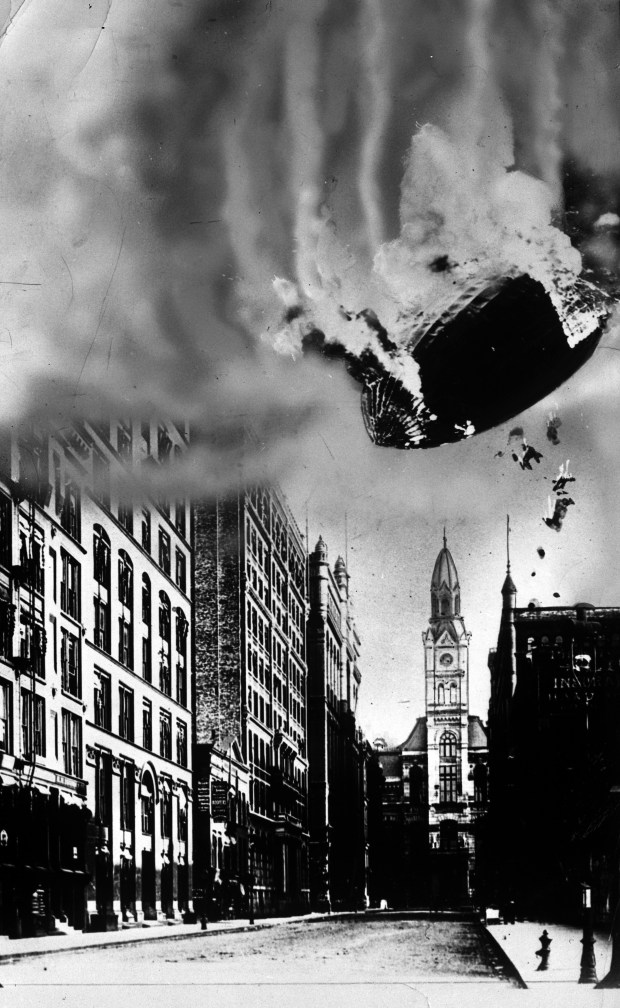
A composite illustration shows the Wingfoot Air Express blimp as it crashed into the Illinois Trust and Savings Building in Chicago on July 21, 1919. (Chicago Tribune historical illustration)
The Wingfoot Air Express dirigible in Grant Park in July 1919. The Wingfoot crashed through the skylight of the Illinois Trust and Savings bank, causing a fire and killing many people. (Chicago Tribune archive)
The wrecked motor of the Wingfoot Air Express sits in the bank's rotunda in July 1919. One person was crushed to death beneath it. (Chicago Tribune historical photo)
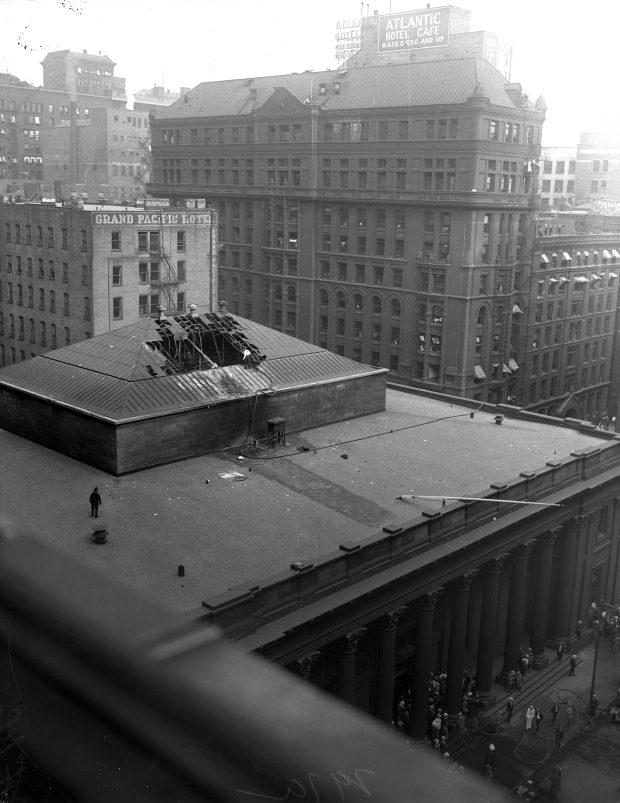
A hole was left in the roof of the Illinois Trust and Savings Bank where the Wingfoot Air Express dirigible fell through the skylight of the building in downtown Chicago on July 21, 1919. (Chicago Tribune historical photo)
The marble-columned rotunda of the Illinois Trust and Savings Bank, which became an inferno after the Wingfoot Air Express crashed into it through the skylight above this area on July 21, 1919. (Chicago Tribune historical photo)
1 of 9
A few minutes after this photo was taken in Grant Park on July 21, 1919, the Wingfoot Air Express blimp crashed through the skylight roof of the Illinois Savings and Trust Bank in Chicago's Loop, killing 14 people. (ACME)
For most of the day on July 21, 1919, the Goodyear Tire and Rubber Co.’s Wingfoot Air Express airship cruised above the city. At about 5 p.m., however, the dirigible hurtled through a lobby skylight of the Illinois Trust & Savings Bank at 231 S. LaSalle St., killing 13 people and injuring 28. Nobody was charged. Nobody was tried. No definitive cause was reported, though the Tribune ran one story attributing the explosion to a static spark lighting the highly flammable hydrogen gas.
First public display of a ‘talking’ movie (1922)
University of Illinois professor Joseph Tykociner gave the first public demonstration of his "sound on film" invention on June 9, 1922. In one of the segments, Tykociner's wife, Helena, shown here in a screengrab, rings a bell while saying, "I will ring … Did you hear the bell ringing?" (University of Illinois Archives)
University of Illinois professor Joseph Tykociner gave the first public demonstration on June 9, 1922, of his “sound on film” invention. The sound recording — which was converted to a light pattern on film — was played in real time with the film. Video of Tykociner’s presentation was captured and later restored by the National Film Preservation Foundation. One of the segments shows Tykociner’s wife, Helena, ringing a bell while saying, “I will ring … Did you hear the bell ringing?”
First LGBTQ rights organization (1924)
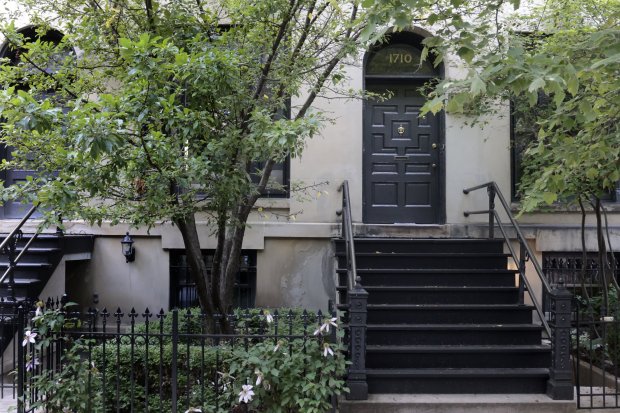
Pioneer gay civil-rights activist Henry Gerber lived from 1924 to 1925 at 1710 N. Crilly Ct., a small 2 1/2 -story Queen Anne row house, in the Old Town Triangle district in Chicago. (Chicago Tribune archive)
In the mid-1920s, Henry Gerber lived at 1710 N. Crilly Court in Chicago, which is on the National Historic Register, June 6, 2024. Gerber founded the Society for Human Rights, the first gay rights organization in the county. (Antonio Perez/Chicago Tribune)
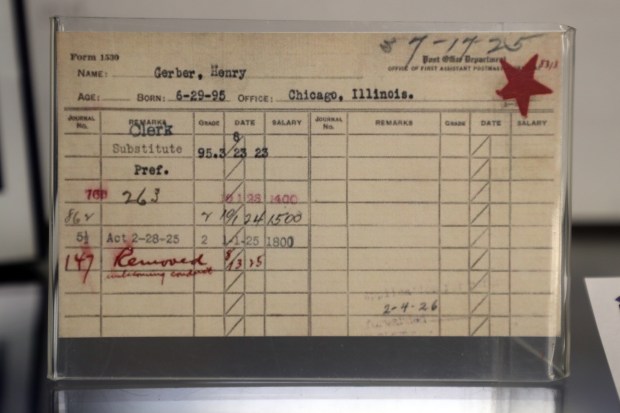
A card noting Henry Gerber's removal from employment with the Post Office is on display at the Gerber/Hart Library and Archives at Howard Brown Health in Chicago on March 25, 2022. (Terrence Antonio James/Chicago Tribune)
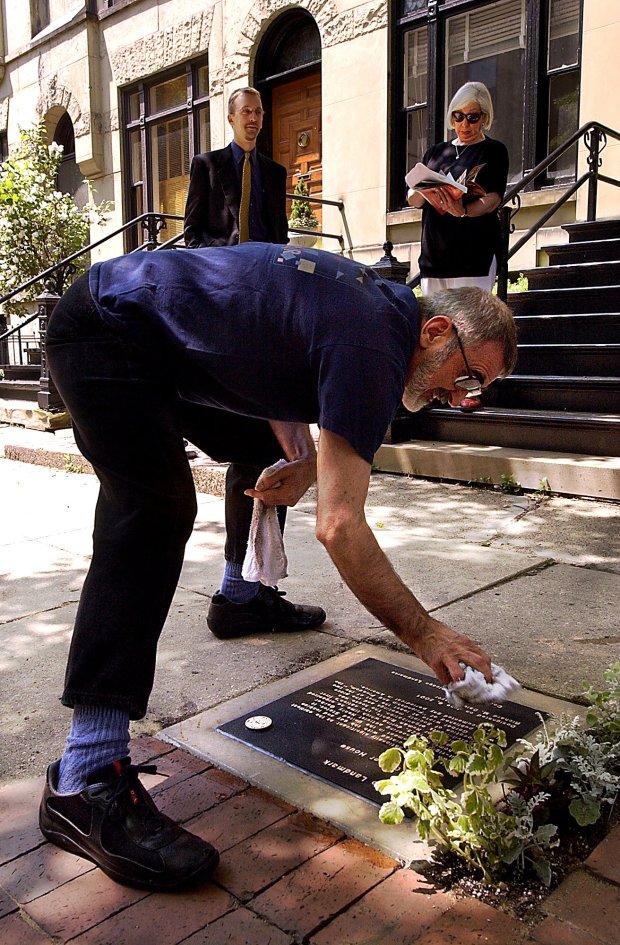
Norman Baugher cleans a plaque on June 18, 2002, that marks the home Henry Gerber at 1710 Crilly Ct., where Gerber founded the Society for Human Rights in 1924. (Chuck Berman/Chicago Tribune)
1 of 4
Pioneer gay civil-rights activist Henry Gerber lived from 1924 to 1925 at 1710 N. Crilly Ct., a small 2 1/2 -story Queen Anne row house, in the Old Town Triangle district in Chicago. (Chicago Tribune archive)
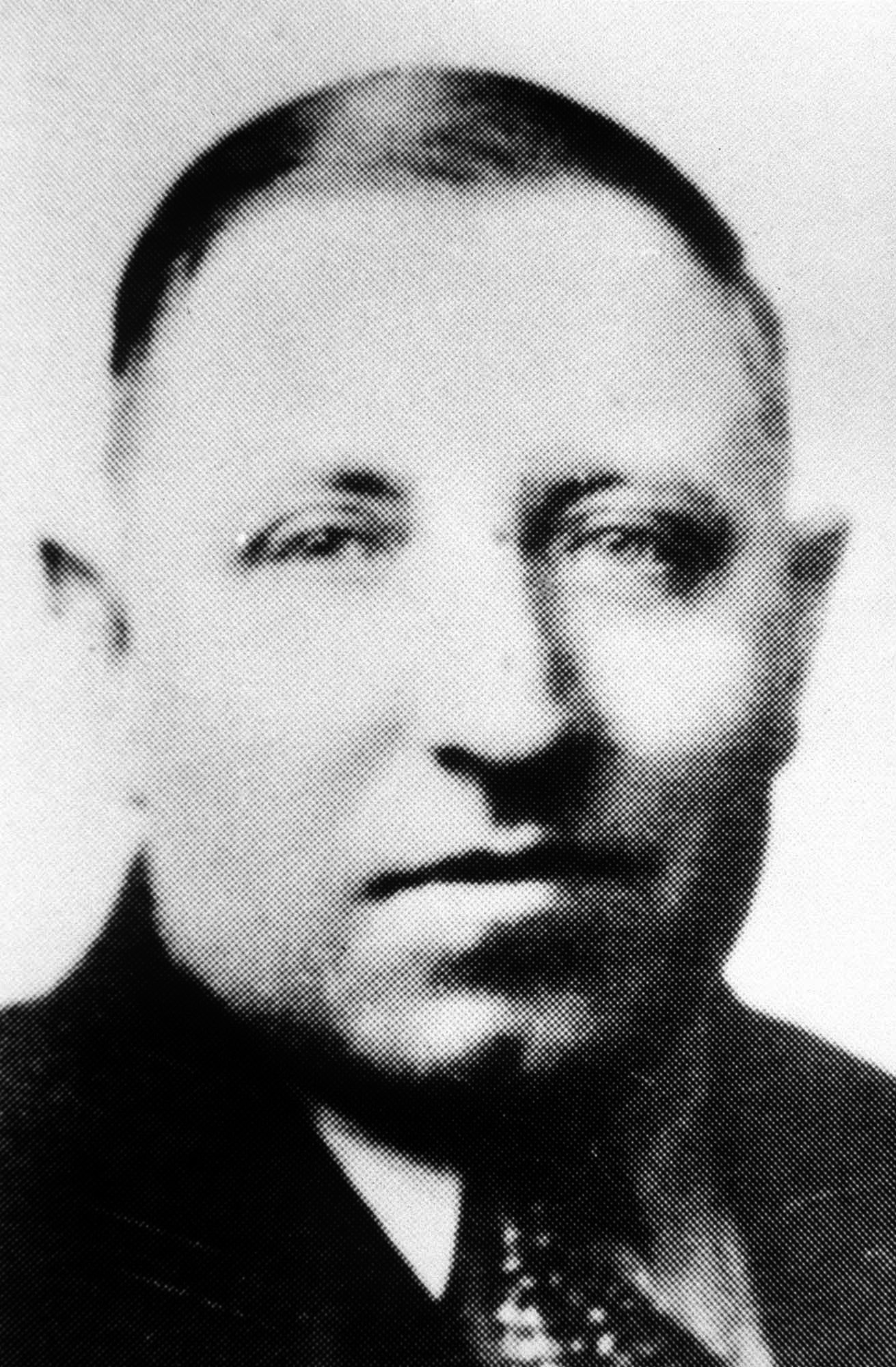
Postal clerk Henry Gerber formed the Society for Human Rights, but was soon arrested for being gay. Gerber was never convicted, but the publicity (including a newspaper headline reading “Strange Sex Cult Exposed”) led to his firing for conduct unbecoming of a postal worker. Before the group disbanded, it published “Friendship and Freedom” — the first American gay publication.
Gerber’s home at 1710 N. Crilly Court in the Old Town Triangle neighborhood was designated a National Historic Landmark in 2015.
First U.S. airport and aviation school built, owned and operated by Black men (1931)
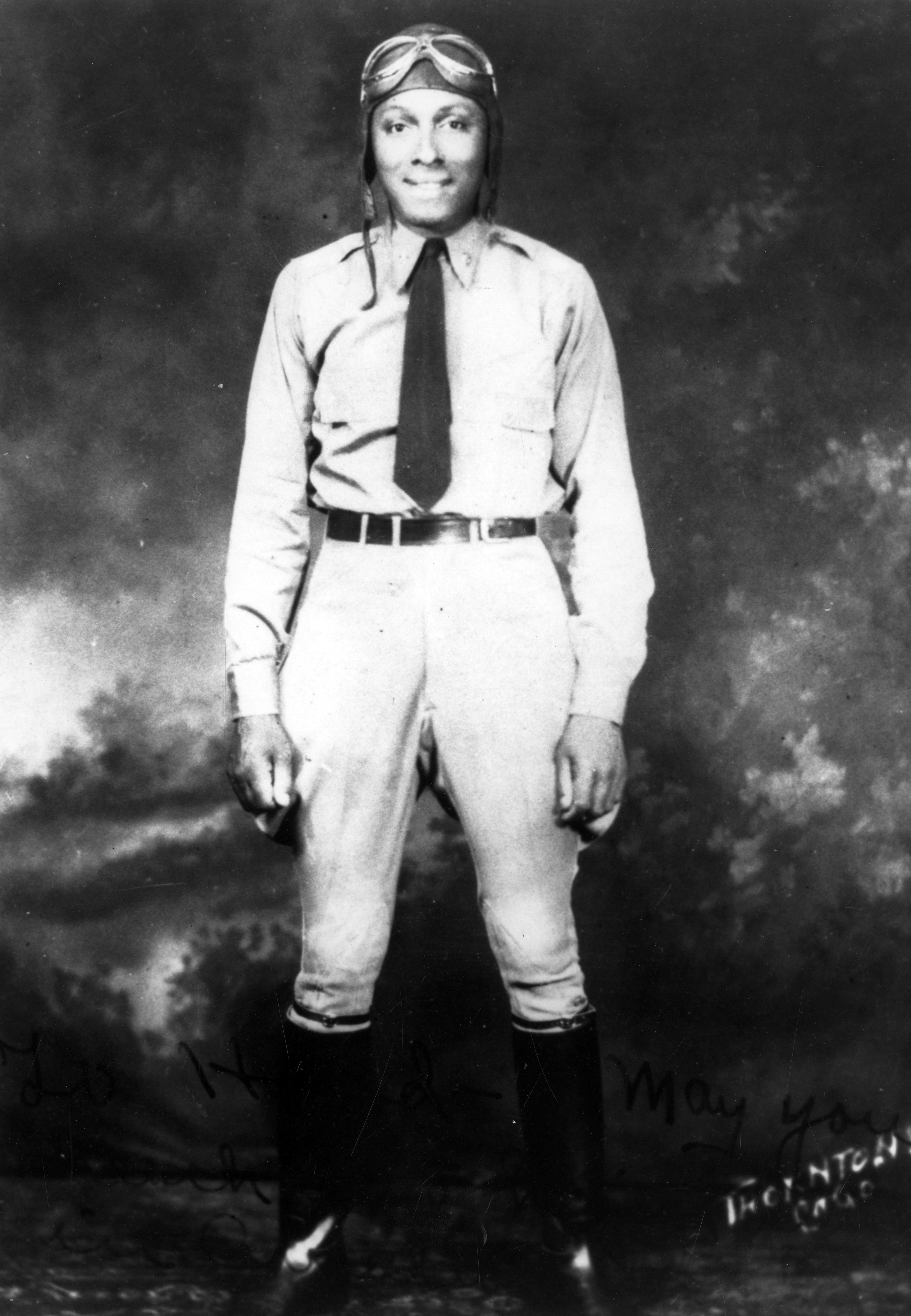
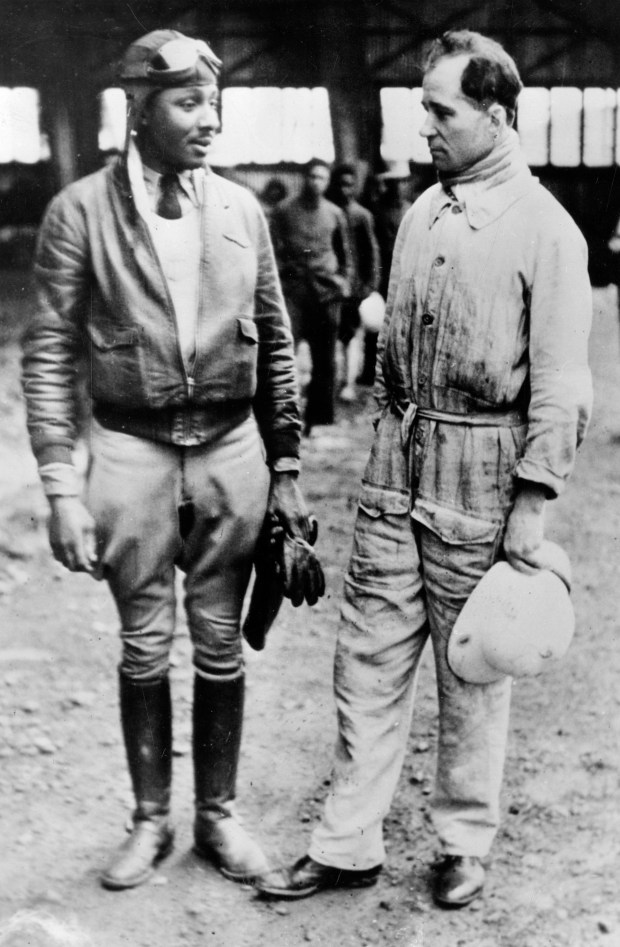
John Charles Robinson was a pioneer aviator from Chicago nicknamed the Brown Condor. Robinson started an airport in Robbins with Bessie Coleman and Cornelius Coffey. (Smithsonian Institution)
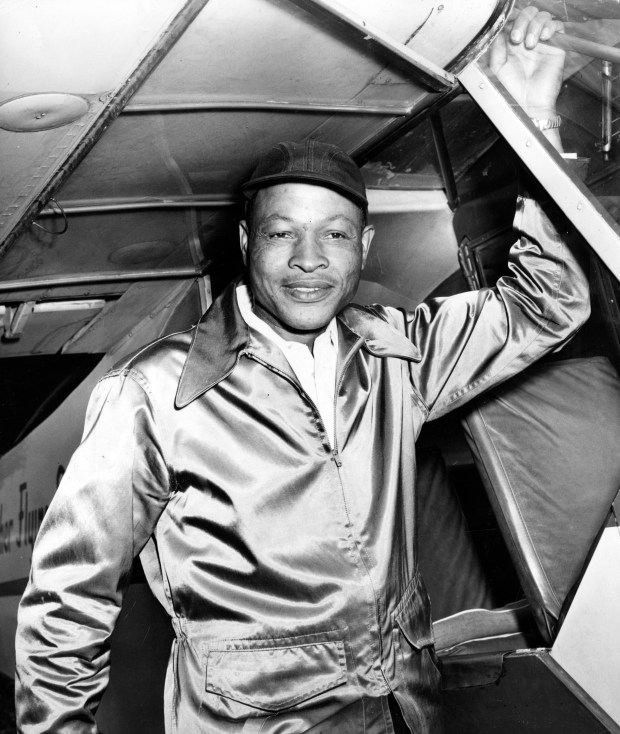
Cornelius Coffey, shown here in 1951, trained more than 1,000 fledgling pilots, 200 of them for military forces. (Chicago Tribune historical photo)
Col. John C. Robinson, known as the Brown Condor, left, just before going up for a test flight recently, circa 1935. (ACME)
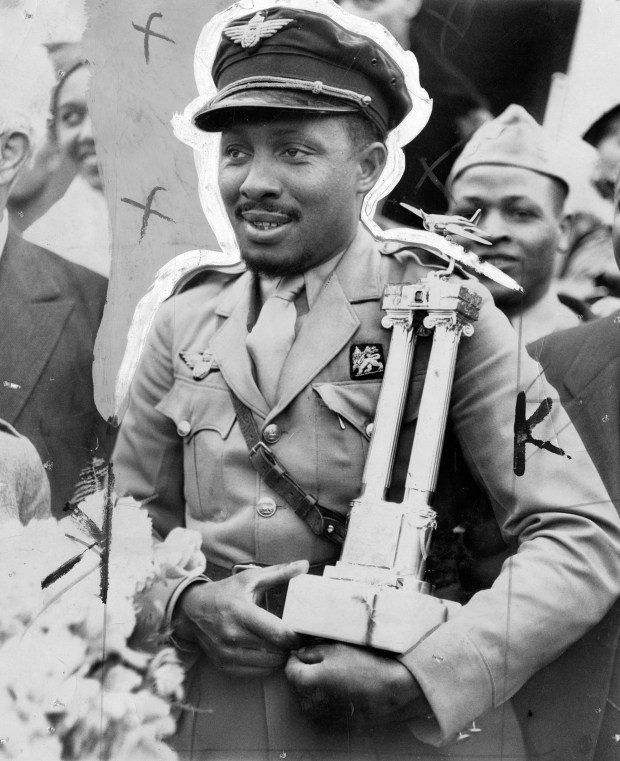
Aviator Col. John C. Robinson, of Chicago, is welcomed home, circa 1936. Editors' note: This historic print has crop marks and has some hand-painting on it. (Chicago Tribune historical photo)
1 of 4
John Charles Robinson was a pioneer aviator from Chicago nicknamed the Brown Condor. Robinson started an airport in Robbins with Bessie Coleman and Cornelius Coffey. (Smithsonian Institution)
Operating under the name the Challenger Air Pilots Association, Cornelius R. Coffey and John Charles Robinson began operations in 1931 along 139th Street in south suburban Robbins. Mayor Samuel Nichols, whose daughter Nichelle Nichols notably was a trailblazing icon aboard another aircraft, Star Trek’s USS Enterprise, helped them find land and labor to clear it for a hangar.
The men were initially denied admission to Curtiss-Wright Aeronautical University in Chicago because they were Black, Tyrone Haymore, executive director of the Robbins Historical Society and Museum, told the Tribune. The Robbins Historical Museum now occupies part of the site. Both men were later allowed to attend Curtiss-Wright and graduated at the top of their class.
A windstorm destroyed their hangar and two airplanes in 1933, but they were welcomed to Harlem Airport in Oak Lawn. There they trained hundreds of pilots — Black and white — together.
First blood bank (1937)
Technician Hale Erickson, from left, Dr. Hjalmar Wallin and nurse Doris Stone check blood for count and storage in an ice box at Cook County Hospital on March 14, 1947. (Hugh Sinclair/Chicago Tribune)
Hungarian doctor Bernard Fantus coined the term and established a “Blood Preservation Laboratory” at Cook County Hospital on March 15, 1937. His work showed that blood and its components (red cells, plasma, platelets, etc.) could be collected and then refrigerated for later use — even a month or longer afterward, in some instances.
First live panda in captivity (1937)
Su-Lin, a baby giant panda, and her captor, Ruth Harkness of New York, who sold the panda to the Brookfield Zoo in Chicago for $20,000. (Chicago Tribune historical photo)
Su-Lin — which loosely translates to mean “a little bit of something very cute,” and her guardian, Ruth Harkness, became instant celebrities when they arrived by boat in San Francisco in November 1936. Harkness, her partner Quentin Young and their crew discovered the baby panda in a hollow tree shortly after arriving in China’s Sichuan Province earlier that month. Brookfield Zoo became Su-Lin’s home while Harkness returned to China to search for a mate for the panda. The animal died of pneumonia in 1938. It is now part of the Field Museum’s taxidermy collection.
First ‘March Madness’ (1939)
The Chicago Bruins started their season in 1939 with, from left, Bill Phillips, forward; Frank Linskey, guard; Mike Novak, center; Wibs Kautz, guard; and Eddie Oram, guard. The team practiced under Coach Sam Lifschultz. Editors' note: This historic print shows a hand-painted background. (Chicago Tribune historical photo)
Henry V. Porter, an Illinois High School Association official who was later inducted into the Naismith Memorial Basketball Hall of Fame, is credited with originally using the phrase in 1939 to describe the state’s high school basketball tournament.
The Tribune adopted it in 1940, but Porter’s motto remained largely a regional phenomenon for four decades until CBS broadcaster Brent Musburger, a former Chicago newspaper reporter, began using it during the NCAA tournament in 1982.
World’s first sustained nuclear reaction (1942)
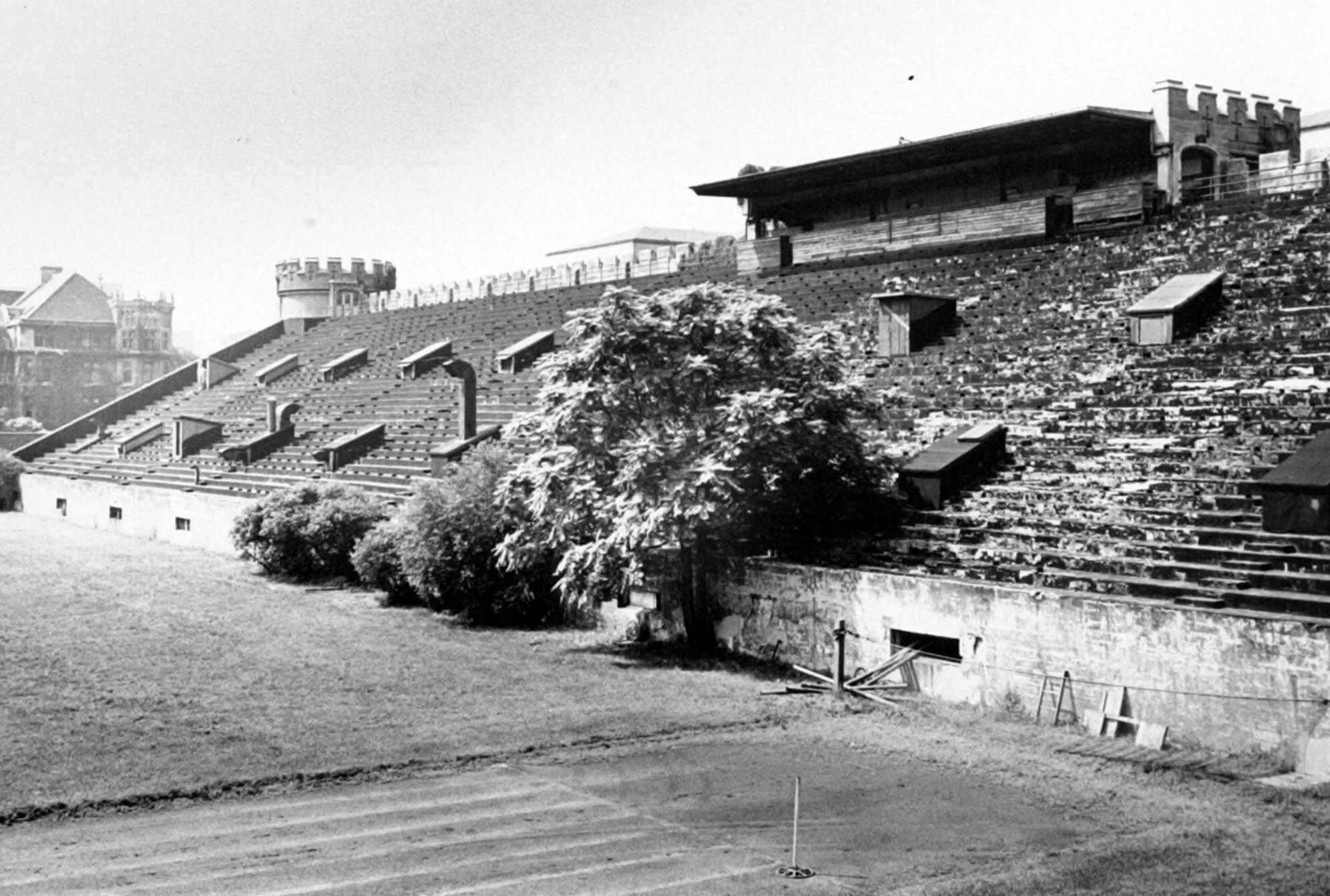
The west stands of Stagg Field at the University of Chicago in the mid-1940s. It was in a secret laboratory under the stands that physicist Enrico Fermi and a team of scientists achieved the first controlled and self-sustained nuclear reaction that led humanity into the Nuclear Age. (Argonne National Laboratory)
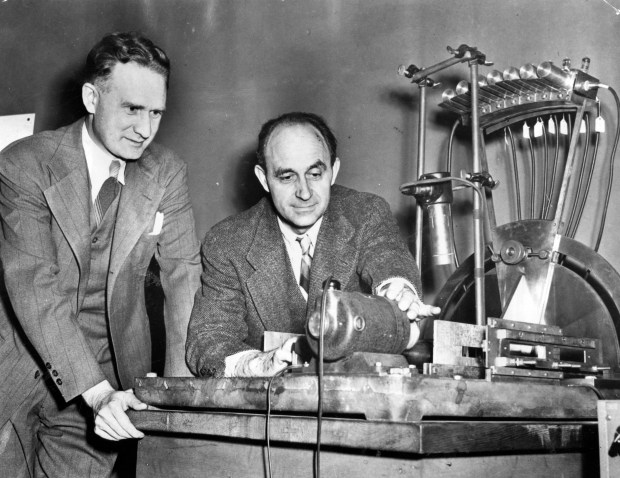
Physicist Enrico Fermi demonstrates his neutron velocity selector to Walter H. Zinn between sessions of a meeting of the Argonne National Laboratory on Dec. 2, 1946, commemorating the initial operation of the first self sustaining nuclear chain reaction. The meeting took place at the Museum of Science. (Ray Gora/Chicago Tribune)
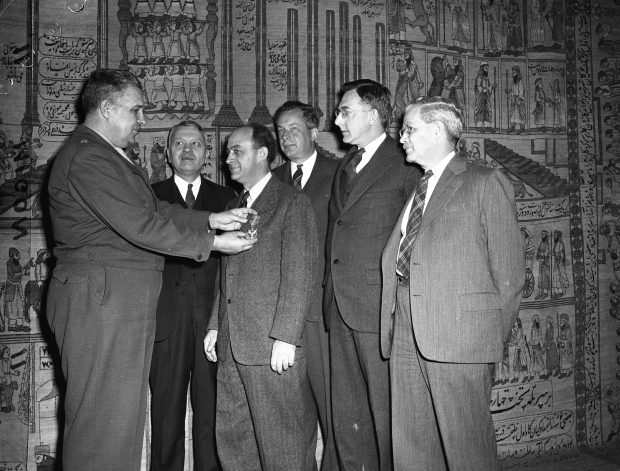
Standing on a rug that made history in the Orient centuries ago, the modern history makers — the Atomic bomb scientists — are decorated by Major Gen. Leslie R. Groves, left, with the medal of merit on March 20, 1946, at the University of Chicago Oriental Institute in Chicago. The scientists are, from left, Harold C. Urey, Enrico Fermi, getting pinned, Samuel K. Allison, Cyril Smith and Robert S. Stone. (Joe Migon/Chicago Tribune)
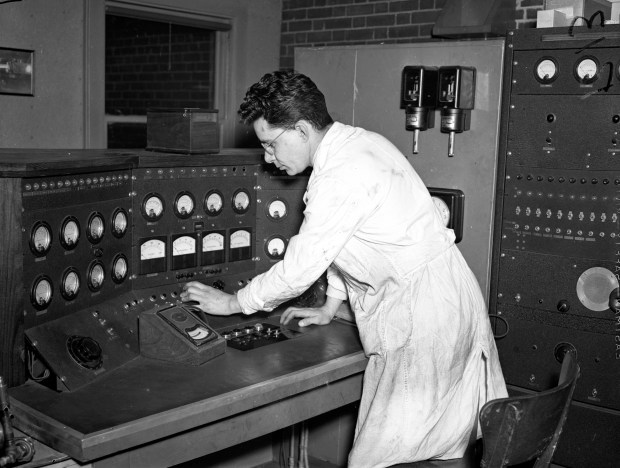
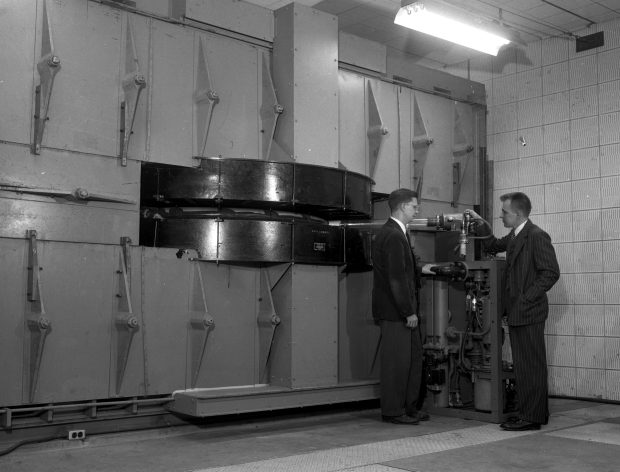
Louis Slotin, research assistant in the physics lab at the University of Chicago, is at the controls of the atom smasher on Jan. 13, 1941. Slotin was testing the 8,000,000-volt cyclotron at the university in preparation for a laboratory demonstration. (P.K. Burgess/Chicago Tribune)
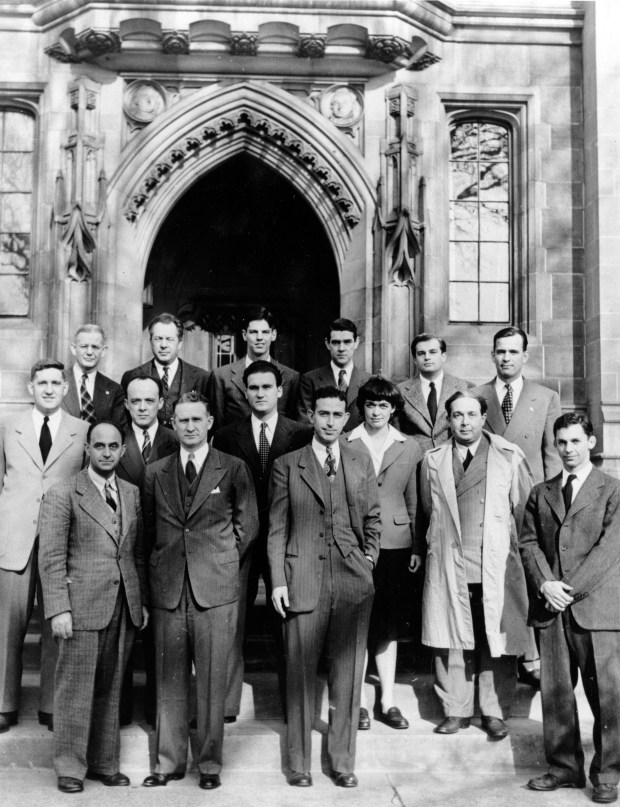
The first pile scientists at the University of Chicago on Dec. 2, 1946, the fourth anniversary of their success. Back row, from left, are Norman Hilberry, Samuel Allison, Thomas Brill, Robert G. Nobles, Warren Nyer and Marvin Wilkening. Middle row, from left, are Harold Agnew, William Sturm, Harold Lichtenberger, Leona W. Marshall and Leo Szilard. Front row, from left, are Enrico Fermi, Walter H. Zinn, Albert Wattenberg and Herbert L. Anderson. (Argonne National Laboratory)
Louis Slotin, research assistant in the physics lab at the University of Chicago, on Jan. 13, 1941. Slotin was testing the 8,000,000-volt cyclotron. (P.K. Burgess/Chicago Tribune)
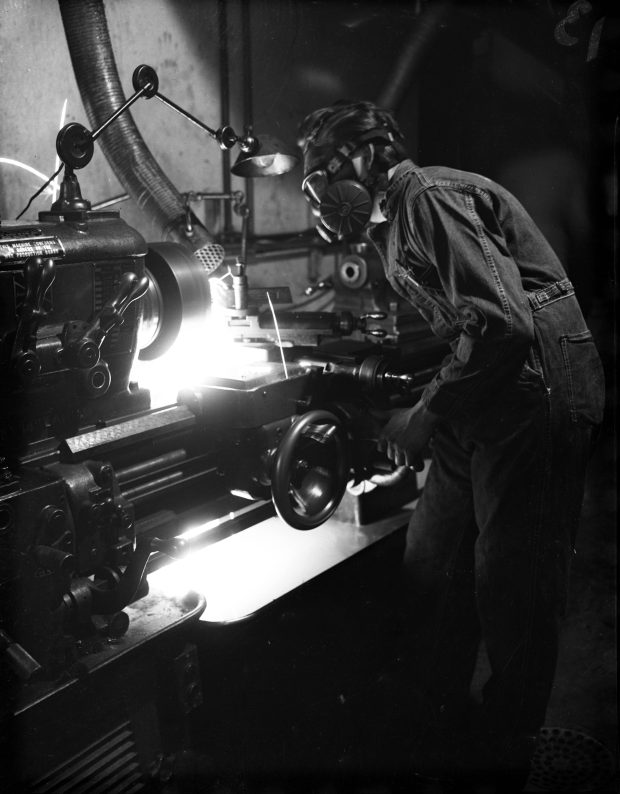
Joe Lillie does a dangerous job of machining uranium on a lathe for the plutonium project on July 3, 1946, at the University of Chicago. (Frank Berger/Chicago Tribune)
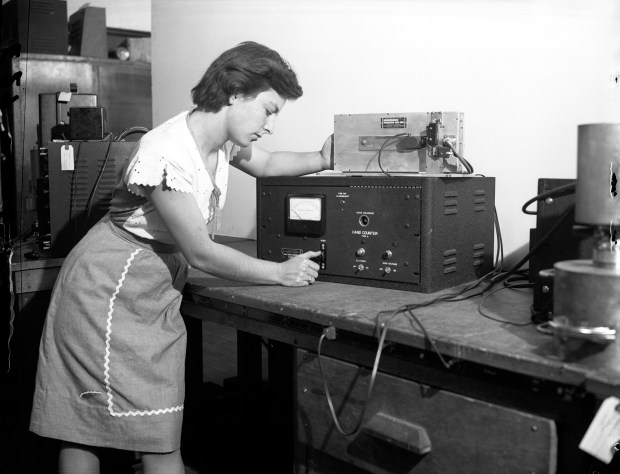
Technician Dorothy Qutt tests the hand counter for a plutonium project at the University of Chicago on July 3, 1946. (Frank Berger/Chicago Tribune)
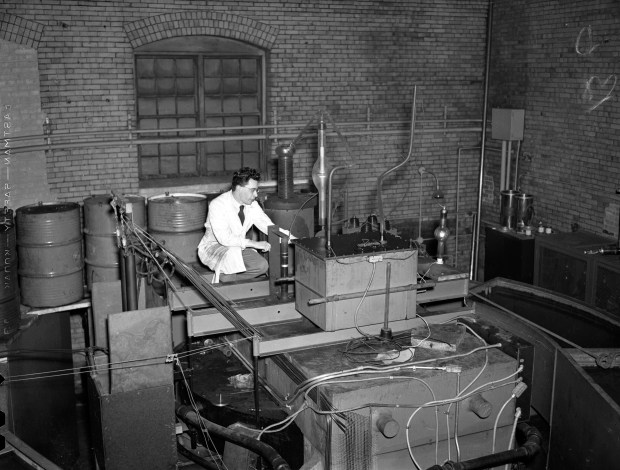
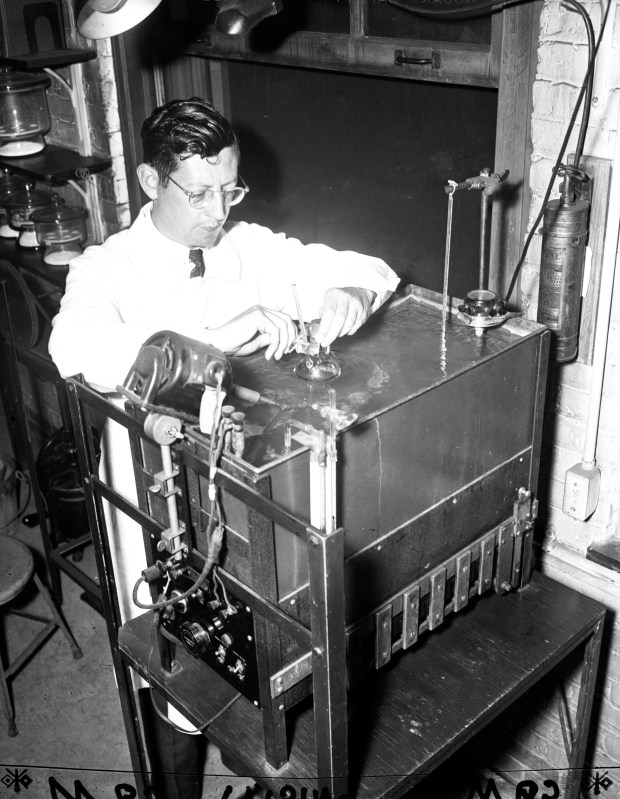
Earl A. Evans Jr. places an isotope solution in a water thermostat, the water at body temperature, on July 10, 1946, at the University of Chicago. (Ray Rising/Chicago Herald American)
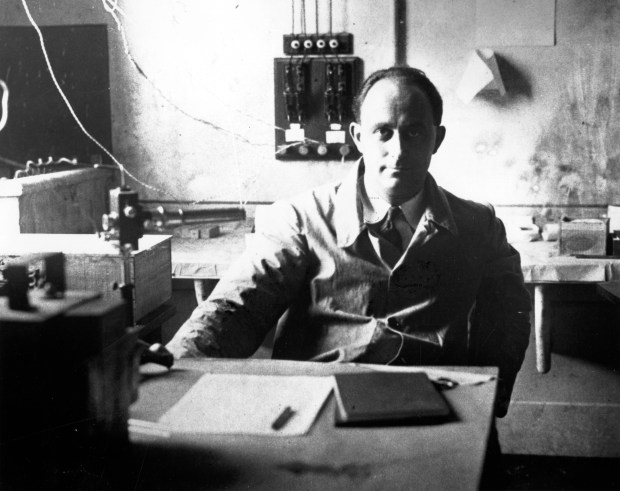
Enrico Fermi in his early days at the University of Chicago. (Argonne National Laboratory)
Louis Slotin, research assistant in the physics lab at the University of Chicago, adjusts an attachment on the 8,000,000-volt cyclotron on Jan. 13, 1941. The 80-ton machine will be used to create artificially radioactive substances that will be employed as "tracers" in treating cancer in blood forming organs. (P.K. Burgess/Chicago Tribune)
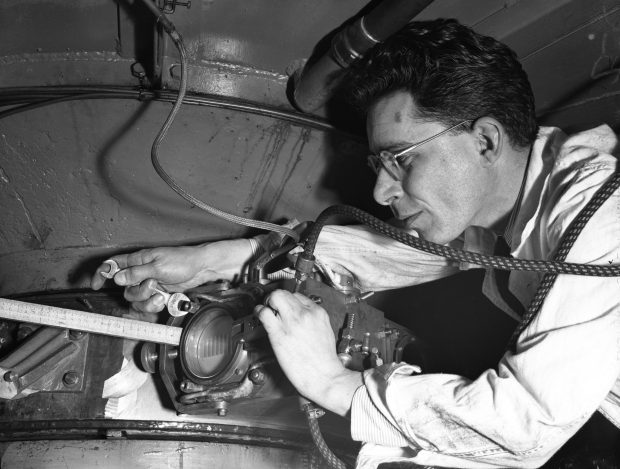
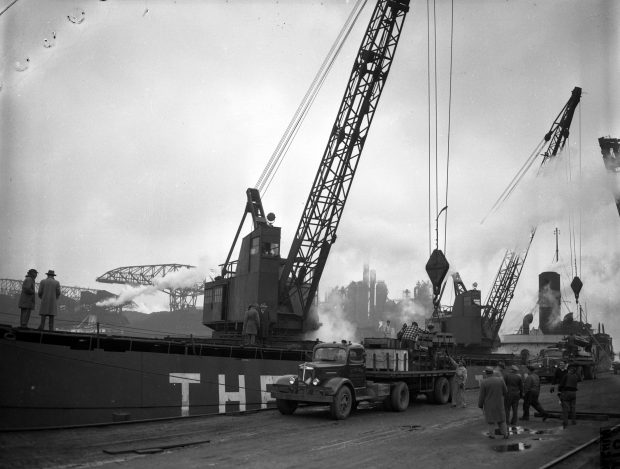
Atom smashing equipment is unloaded from the Columbia Trans Co. steamship Buckeye on Nov. 13, 1948, at 9355 Kreiter Ave. The equipment was going to the University of Chicago. (Arnold Tolchin/Chicago Tribune)
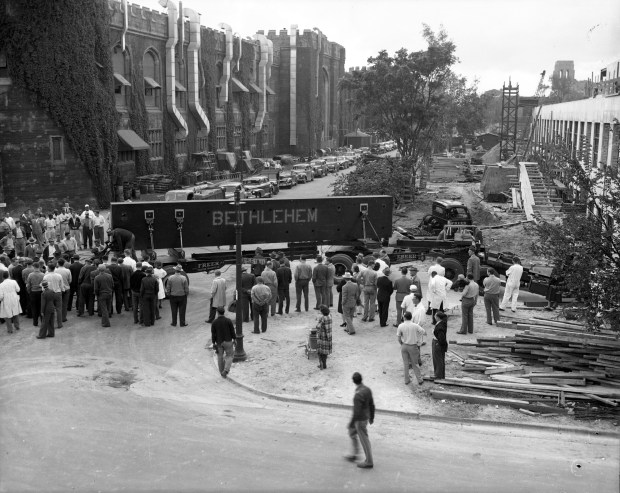
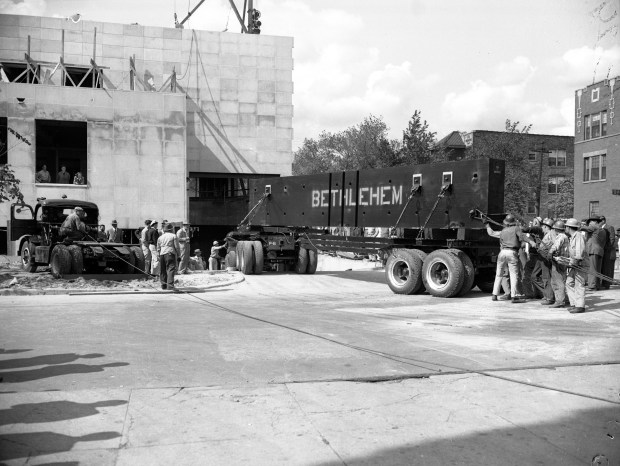
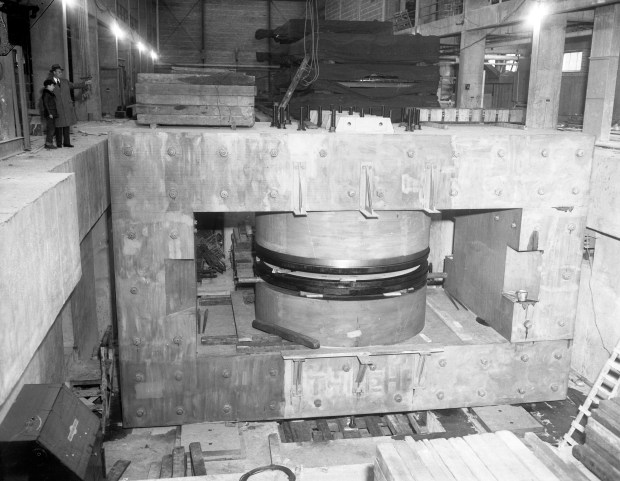
Part of the Cyclotron, a 2073 ton magnet, is brought on a trailer to the basement of the Accelerator Building at the University of Chicago on Sept. 24, 1948, at 56th and Ellis Avenue. (Frank Berger/Chicago Herald American)
Part of the Cyclotron, a 2073 ton magnet, is brought on a trailer to the basement of the Accelerator Building at the University of Chicago on Sept. 24, 1948, at 56th and Ellis Avenue. (Frank Berger/Chicago Herald American)
Richard H. Templeton and his son Richard III as they look at the immensity of the new University of Chicago atom smasher in the process of building on Nov. 14, 1948. (Irvin Heberg/Chicago Tribune)
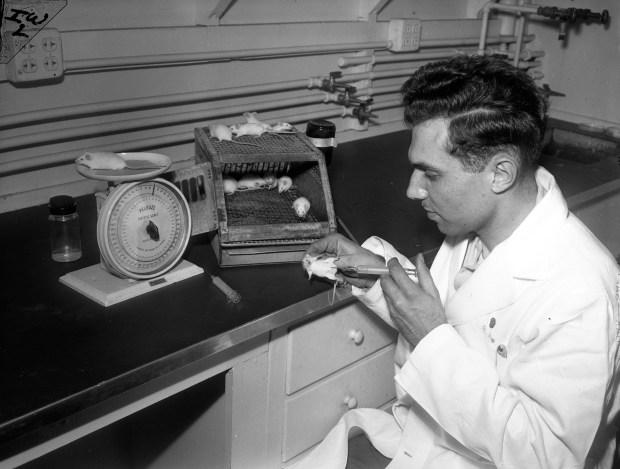
Harvey Patt, of the Argonne National Lab, conducts test for radiation sickness on May 18, 1949, at the University of Chicago. (Irvin Heberg/Chicago Herald American)
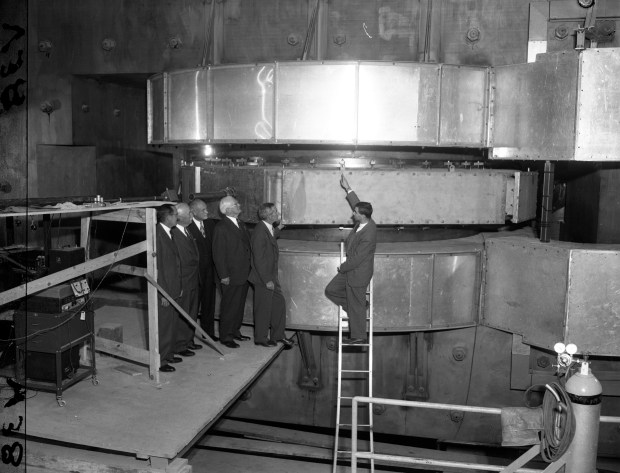
Looking over the $2,200,00 Synchrocyclotron at the Accelerator Building at the University of Chicago is Solomon Smith, from left, of Northern Trust Co., Joseph Capps, Harold Swift, the chairman of board at Swift and Co.; Merle J. Trees, of the Chicago Bridge Co.; Edward Ryerson, chairman of board at Inland Steel Co.; and Leroy Schwarcz, engineer on ladder, Oct. 28, 1949. (Howard Borvig/Chicago Tribune)
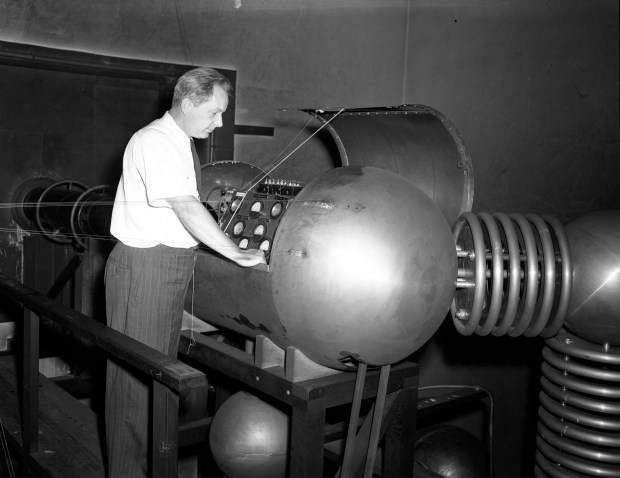
Samuel K. Allison, director of the Institute of Nuclear Studies at the University of Chicago, is shown in the laboratory with a Kevatron, a Cockcroft-Walton circuit machine for high-voltage studies on Oct. 21, 1949. (Joe Mignon/Chicago Tribune)
Donald W. Connor and Charles R. McKinney, both Betatron engineers, discuss the 100,000,000 volts the Betatron controls on Oct. 28, 1949, at the Accelerator Building at Chicago University. The Betatron cost $225,000. (Howard Borvig/Chicago Tribune)
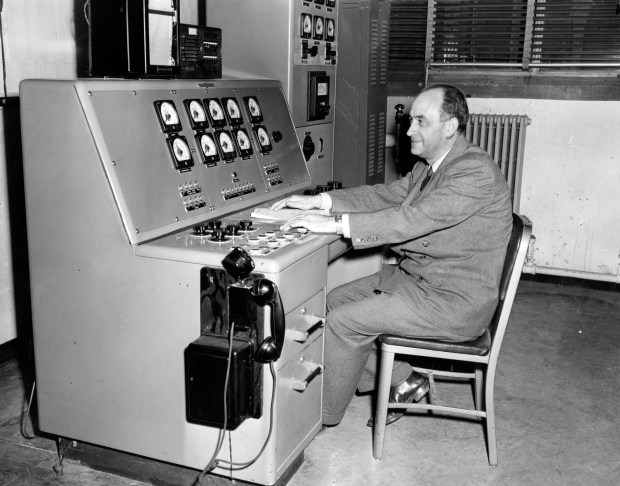
Enrico Fermi at the controls of a 100-million-volt betatron at the University of Chicago on May 2, 1950. (Chicago Tribune historical photo)
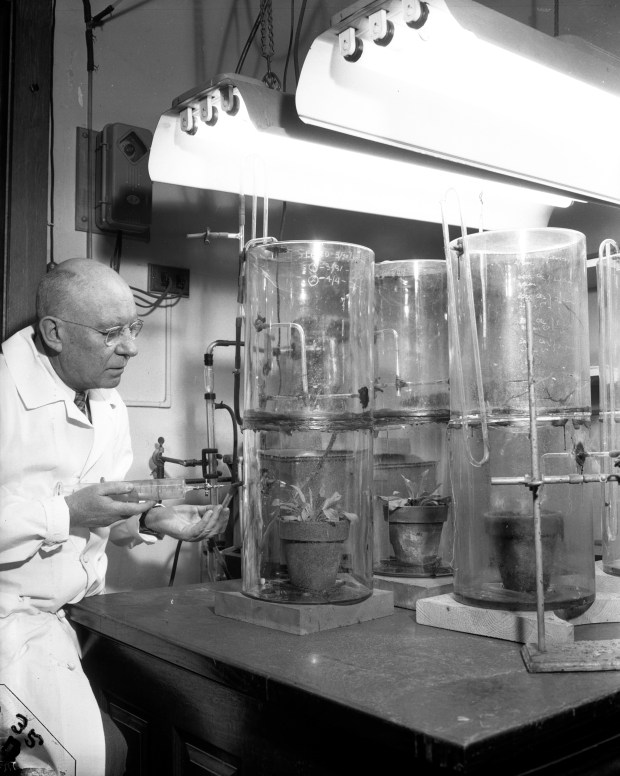
Eugene M.K. Geiling injects radioactive carbon dioxide into plants at the University of Chicago on April 7, 1949. (Arnold Tolchin/Chicago Herald American)
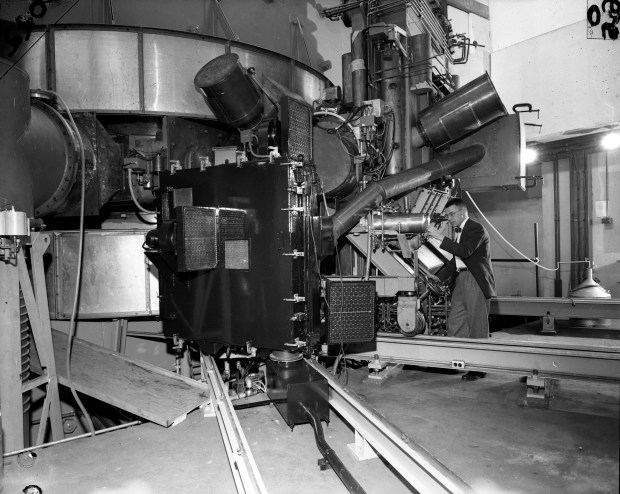
John Marshall, assistant professor of physics at the University of Chicago, is shown with the completed synchrocyclotron, the most powerful known, on May 15, 1951. The $2,500,000 device accelerates protons, up to energies of 450 million electron volts. (Bill Allison/Chicago Tribune)
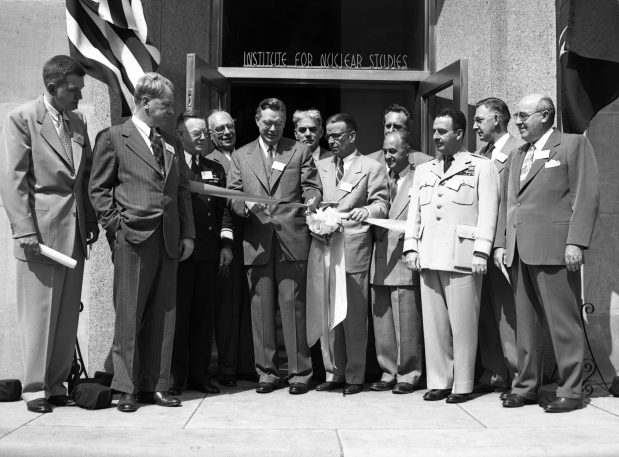
The $11 million dollar Institute for Nuclear Studies opened on May 16, 1951, at the University of Chicago. Front Row, from left, are T.H. Davies, Samuel K. Allison, Admiral Thorvald Solberg, Lawrence Kimpton, cutting ribbon; M.J. Kelly, Enrico Fermi, Gen. David M. Schlatter, Cryil S. Smith and Robert Wilson. The back row, from left to right, are Carid Bell, Thorfin Hogness and Monroe Spaght. (Howard Borvig/Chicago Tribune)
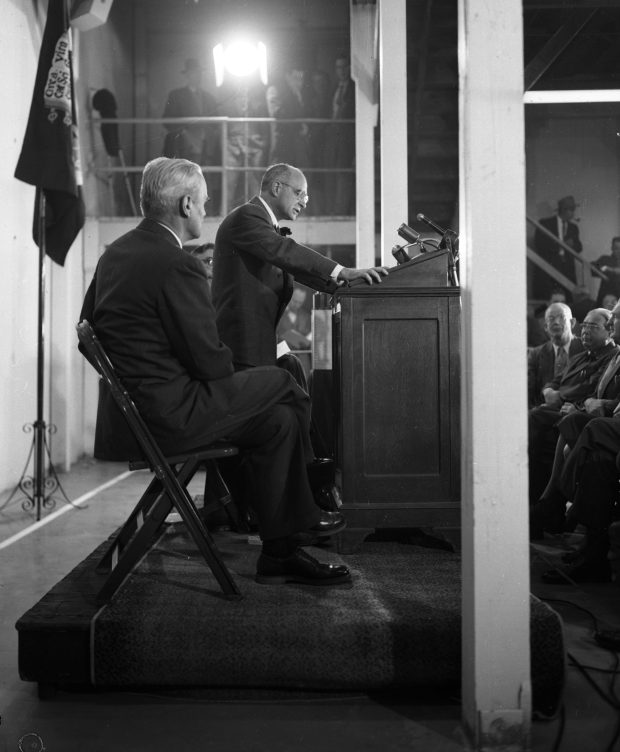
Arthur H. Compton, left, chancellor of Washington University, listens to Enrico Fermi, builder of the first atomic pile, as he speaks at the tenth anniversary of the Atomic Age at the University of Chicago on Dec. 2, 1952. (Arnold Tolchin/Chicago Tribune)
1 of 24
The west stands of Stagg Field at the University of Chicago in the mid-1940s. It was in a secret laboratory under the stands that physicist Enrico Fermi and a team of scientists achieved the first controlled and self-sustained nuclear reaction that led humanity into the Nuclear Age. (Argonne National Laboratory)
U.S. scientists and government officials (collectively known as the Manhattan Project) had to figure out how to create a nuclear chain reaction before they could build an atomic bomb. That’s just what a team gathered beneath the stands at Stagg Field on the University of Chicago campus on Dec. 2, 1942, did with the world’s first nuclear reactor — nicknamed Chicago Pile-1.
Why did this happen in Chicago? The city by the lake was an ideal location for several reasons. One, it had a huge pool of talent. Nobel Prize winner and physicist Enrico Fermi, who defected from Fascist-controlled Italy, was the team leader. Two, it was a central location away from the coasts, which were believed to be vulnerable to attack. Three, since the University of Chicago no longer had a football team, the project could be conducted in secrecy with added security on a former squash court underneath the football stadium’s stands.
Chicago’s role in the breakthrough experiment wasn’t revealed publicly until after the first atomic bomb was dropped on Japan — nearly three years later.
First Black-oriented magazine in the U.S. (1945)
John H. Johnson, publisher of Ebony magazine, circa 1967. (Chicago Tribune archive)
First published on Nov. 1, 1945, Ebony became an influential monthly lifestyle magazine based in Chicago that documented the African American experience for more than seven decades. The 25,000-copy press run of the inaugural 52-page issue sold out. By its 10th year, the magazine was being read by 500,000 people.
Founded by John H. Johnson, the monthly publication — focused like Life magazine on showing American lives — chronicled the achievements of those in the Black community. During its heyday, Ebony’s reporters and photographers followed Martin Luther King Jr. from the 1955 Montgomery bus boycott to the 1965 Selma march, culminating in the assassinated civil rights leader’s 1968 funeral.
Johnson Publishing went out of business in 2019, but the magazine lives on in a digital format and its incredible archives were acquired by a consortium that includes Getty and the Smithsonian National Museum of African American History and Culture.
First American canonized by the Roman Catholic Church (1946)
Saint Frances Xavier Cabrini. (The National Shrine of Saint Frances Xavier Cabrini)
When she first arrived in America, Cabrini didn’t speak English and was told by the archbishop of New York that her trip was a mistake. Yet Cabrini persisted and even became a naturalized citizen in 1909. Before her death in Chicago at age 67, Cabrini founded 67 schools, orphanages, hospitals, convents and places of worship in North and South America. Pope Pius XII canonized Cabrini, which recognized her as a saint, on July 7, 1946.
First commercial nuclear power plant in the nation (1960)
Pat Nixon, left, wife of President Richard Nixon, watches as Richard Meagher, manager of production, explains a model of the Dresden nuclear plant on Feb. 6, 1970, near Morris, Illinois. (Arthur Walker/Chicago Tribune)
The Dresden Generating Station near Morris was the second nuclear power plant built in the U.S. (the first was Shippingport Atomic Power Station in Pennsylvania), but it was the first that was privately financed (by Commonwealth Edison). The plant was retired on Oct. 31, 1978, but the site houses two nuclear reactors operated by Constellation that produce enough electricity to power roughly 1.4 million homes.
Birthplace of the birth control pill (1960)
The revolution in birth control can be dated to 1960, when the federal government approved the first birth control pill, "Enovid," sold by G.D. Searle. (Chicago Tribune archive)
Gov. Otto Kerner signs the last of the bills involving the legislative session on Aug. 25, 1961, at the state of Illinois building in Chicago. James Moran, standing from left, and Harry Golter, both special research assistants on legislation, along with Dawn Clark, assistant to the governor, watch the signing. (George Quinn/Chicago Tribune)
The Chicago Special Olympics, co-sponsored by the Chicago Park District and the Joseph Kennedy Jr. Foundation, was held for the first time on July 20, 1968, at Soldier Field in Chicago. The event provided an athletic competition for people with disabilities. (William Yates/Chicago Tribune)
About 1,000 children with intellectual disabilities from 26 states and Canada who ranged in age from 8 to 18 gathered at Soldier Field in Chicago to compete in 200 events. Responding to a written proposal from Chicago Park District employee Anne Burke, a $25,000 check from the Joseph P. Kennedy Jr. Foundation was forwarded here to help start the games, courtesy of the foundation’s executive vice president, Eunice Kennedy Shriver. Now, more than 6 million athletes from around the world take part in the program.
First state to adopt an Environmental Protection Act and create a dedicated Environmental Protection Agency (1970)
Children from Grant Elementary School in Springfield present Sen. Egbert B. Groen with a petition with 38,000 signatures in support of the Environmental Protection Act on May 26, 1970. (James Quinn/Chicago Tribune)
Gov. Richard B. Ogilvie signed the landmark legislation on June 29, 1970, while attending a press conference at Pheasant Run Lodge near St. Charles. The new regulations went into effect July 1, 1970 — five months before the U.S. EPA was established.
First gay pride parade in the U.S. (1970)
Gay Liberation Front members march through Bughouse Square on their way to a rally at the Civic Center (now Daley Plaza) on June 27, 1970, as part of the city’s first Gay Pride Week. (Chicago Tribune historical photo)
More a march than a parade, the city’s Gay Liberation Movement staged its first rally and procession on June 27, 1970, as part of Gay Pride Week. A short Tribune story the next day said 150 people listened to speakers in Bughouse Square (now Washington Square Park) before walking to the Civic Center (now Daley Plaza) where they formed a chain around the Picasso statue and shouted, “Gay power to gay people.” Chicago beat New York City, Los Angeles and other cities by one day.
Birthplace of the cellphone (1973) and first commercial cellphone call (1983)
Martin Cooper, who led the team that built the first mobile cellphone, holds a prototype of that phone at his home on April 4, 2025, in San Diego. (Gregory Bull/AP)
Motorola executive Martin Cooper was standing on Sixth Avenue just blocks from Radio City Music Hall in Manhattan on April 3, 1973, when he dialed his Chicago-built cellphone prototype. The 2.5-pound, 10-inch-long model’s inspiration came from a bespoke, two-way radio system that the company created in the 1960s for the Chicago Police Department. Cooper officially claimed the first-ever cellphone call in history when Joel Engel — his rival at AT&T — answered. Cooper and seven others share U.S. Patent No. 3,906,166, published Oct. 17, 1973, for a “Radio Telephone System,” which included both the phone and the tower network to connect it.
In his Oakbrook Terrace office on Oct. 12, 2023, David Meilahn holds a 1983 photo of himself making the first commercial cellphone call alongside his wife, Gail Meilahn, and technician Jeff Benuzzi. (Stacey Wescott/Chicago Tribune)
David Meilahn, a suburban Chicago insurance agent, made the first commercial cellular call in the United States on Oct. 13, 1983, in a parking lot at Soldier Field. That’s when Ameritech Mobile Communications, then a subsidiary of AT&T, launched the first commercial cell service in Chicago. There was even a “Jeopardy!” answer about his accomplishment — you can look it up on your smartphone.
First state to designate the Rev. Martin Luther King Jr.’s birthday (Jan. 15) as a holiday (1973)
A portrait of the Rev. Martin Luther King Jr. hangs above a memorial service for the slain civil rights leader at Holy Angels Catholic Church at 607 Oakwood Blvd. on Jan. 15, 1974, in Chicago. (William Kelly/Chicago Tribune)
Illinois Gov. Dan Walker signed the measure into law on Sept. 17, 1973. The bill’s sponsor was then-Rep. Harold Washington, who was elected Chicago mayor 10 years later. The first Martin Luther King Jr. Day was observed in Illinois on Jan. 15, 1974. A cheering crowd of 1,000 people joined a celebration at Operation PUSH headquarters while others attended a candlelit memorial service at St. Martin Catholic Church. Chicago public schools and city colleges were closed. All city, state and county offices in Chicago were closed as were criminal and civil courts and three state motor vehicle facilities.
First handgun ban (1982)
Morton Grove police Officer Robert J. Jones holds all 12 handguns turned in by the town's residents after the village banned possession on Feb. 1, 1982. "They are the most photographed guns in the world," Jones said, speaking of the interest in the Morton Grove law. (Chuck Berman/Chicago Tribune)
Morton Grove began enforcement of the controversial ordinance on Feb. 1, 1982. Residents turned in five guns to police that first day. The ordinance also banned possession of automatic weapons, overriding a newly effective state law that allowed it.
The measure triggered a storm of publicity and a nationwide debate over the merits of using local ordinances to control gun ownership, but was upheld in 1984 by the Illinois Supreme Court. The ordinance was repealed in July 2008.
First Farm Aid (1985)
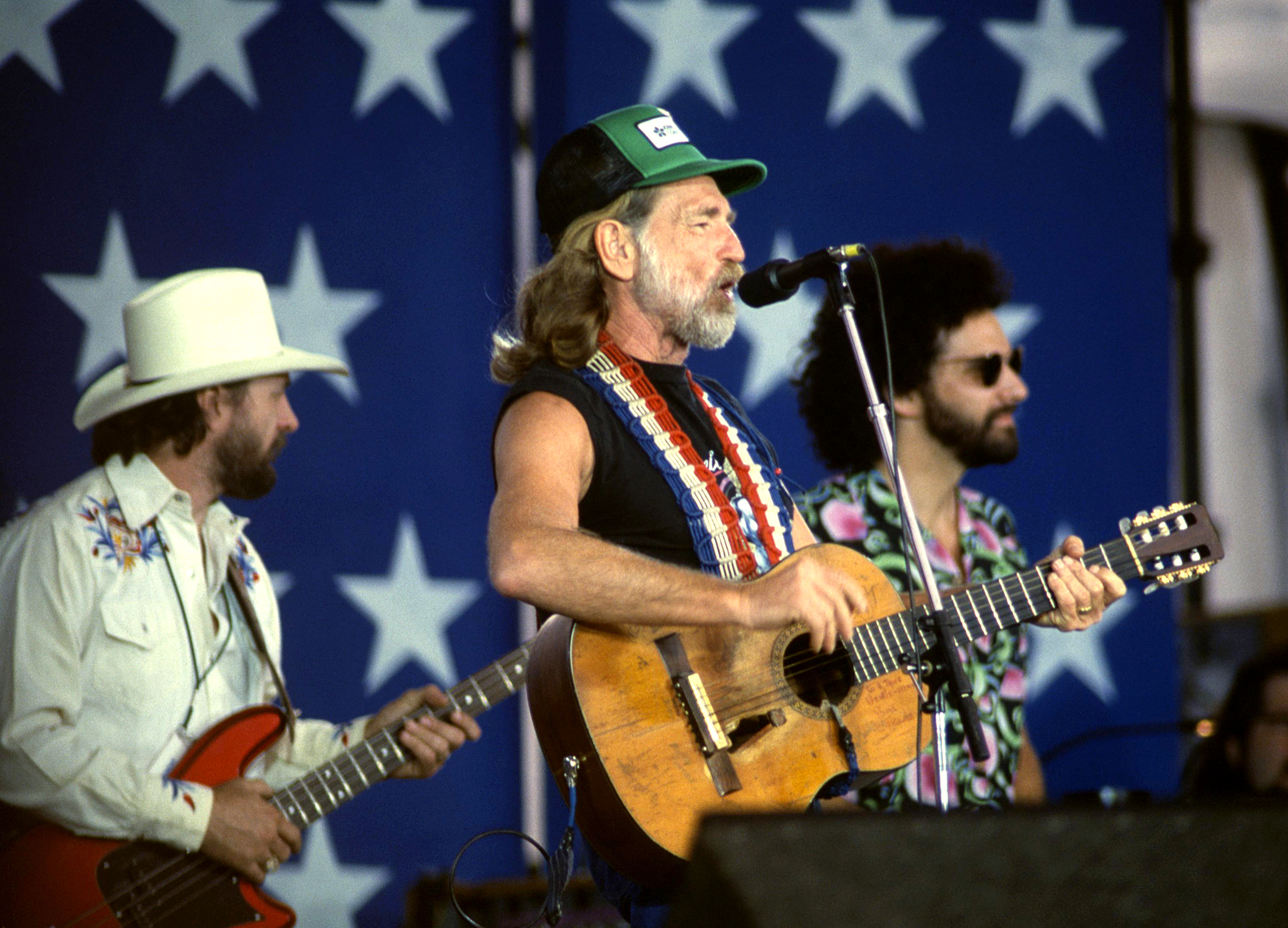
Willie Nelson performs at the first Farm Aid in Champaign on Sept. 22, 1985. (Ernie Cox Jr./Chicago Tribune)
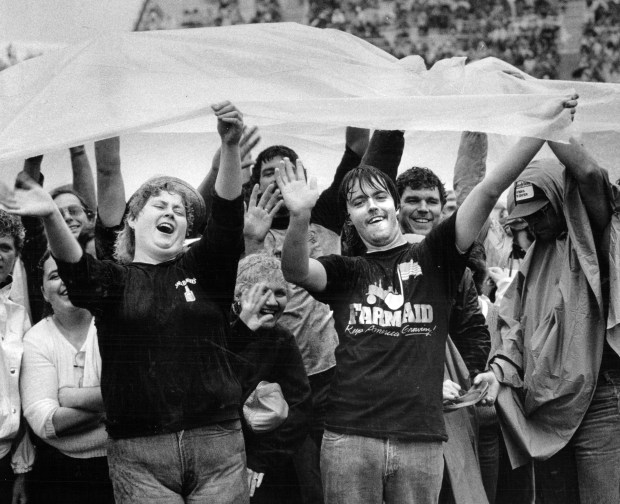
Wet but spirited, the crowd cheers musicians at the first Farm Aid concert at Champaign’s Memorial Stadium on Sept. 22, 1985. Ticket sales for the concert generated more than $1.4 million. (Ovie Carter/Chicago Tribune)
The crowd waits for the start of the first Farm Aid at Memorial Stadium in Champaign on Sept. 22, 1985. (Ovie Carter/Chicago Tribune)
Loretta Lynn performs at the first Farm Aid concert at the University of Illinois’ Memorial Stadium in Champaign on Sept. 22, 1985. (Ovie Carter/Chicago Tribune)
Concert goers dance in the rain at the University of Illinois’ Memorial Stadium in Champaign during a wet Farm Aid on Sept. 22, 1985. (Ovie Carter/Chicago Tribune)
Willie Nelson, right, shakes hands with co-organizer Neil Young, left, during the first Farm Aid in Champaign, Illinois on Sept. 22, 1985. (Ernie Cox Jr./Chicago Tribune)
A crowd attends the first Farm Aid all-day concert held at University of Illinois’ Memorial Stadium in Champaign on Sept. 22, 1985. (Ovie Carter/Chicago Tribune)
An attendee sits on a tarp in the rain at the University of Illinois’ Memorial Stadium in Champaign during a rainy Farm Aid on Sept. 22, 1985. (Ovie Carter/Chicago Tribune)
People try to stay dry during the first Farm Aid concert at Memorial Stadium on Sept. 22, 1985, in Champaign, Illinois. (Ernie Cox Jr./Chicago Tribune)
During a lull in the rain, two people ring out a blanket at the first Farm Aid at the University of Illinois’ Memorial Stadium in Champaign on Sept. 22, 1985. (Ovie Carter/Chicago Tribune)
The Charlie Daniels Band performs at the first Farm Aid concert held at the University of Illinois’ Memorial Stadium in Champaign on Sept. 22, 1985. (Ovie Carter/Chicago Tribune)
Concert goers dance in the rain at the University of Illinois’ Memorial Stadium in Champaign during a wet Farm Aid on Sept. 22, 1985. (Ovie Carter/Chicago Tribune)
Concert goers stand in the rain during the first Farm Aid all-day concert held at University of Illinois’ Memorial Stadium in Champaign on Sept. 22, 1985. (Ovie Carter/Chicago Tribune)
Willie Nelson performs at the first Farm Aid in Champaign, Illinois on Sept. 22, 1985. (Ernie Cox Jr./Chicago Tribune)
People take cover from the rain during the first Farm Aid in Champaign, Illinois on Sept. 22, 1985. (Ernie Cox Jr./Chicago Tribune)
Willie Nelson raises his guitar during his performance at the first Farm Aid in Champaign, Illinois on Sept. 22, 1985. (Ernie Cox Jr./Chicago Tribune)
Despite the rain, concert goers dance in Memorial Stadium during a wet Farm Aid on Sept. 22, 1985, in Champaign, Illinois. (Ovie Carter/Chicago Tribune)
A large crowd attends the first Farm Aid concert at Memorial Stadium in Champaign, Illinois on Sept. 22, 1985. (Ernie Cox Jr./Chicago Tribune)
1 of 18
Willie Nelson performs at the first Farm Aid in Champaign on Sept. 22, 1985. (Ernie Cox Jr./Chicago Tribune)
“It was the biggest country music concert in history,” the Tribune wrote the day after the first Farm Aid on Sept. 22, 1985. “For more than 14 hours Memorial Stadium on the University of Illinois campus was transformed into Rockabilly Heaven before a rain-soaked but spirited crowd of about 78,000 and a national television audience estimated at more than 24 million.”
Illinois Secretary of State Alexi Giannoulias holds his 11-month-old daughter, Alexia, and the bill signed by Gov. JB Pritzker to prevent book bans on June 12, 2023, at the Harold Washington Library in Chicago, while Pritzker applauds. (Brian Cassella/Chicago Tribune)
The measure was signed into law by Gov. JB Pritzker on June 12, 2023. Public libraries in Illinois could be cut off from state funding if they remove books and other materials from their shelves for “partisan or doctrinal” reasons.
First American elected pope (2025)
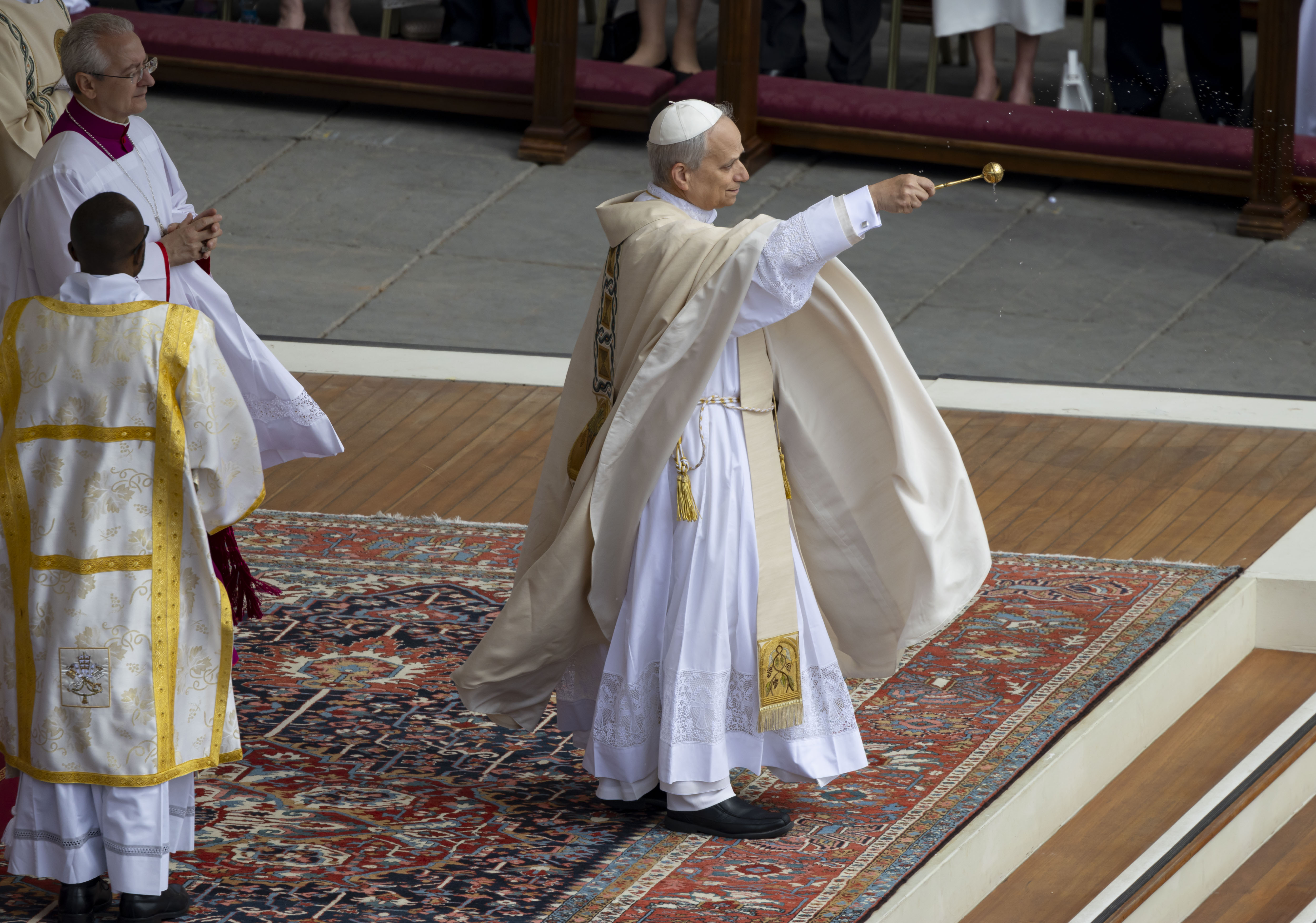
Pope Leo XIV sprinkles holy water during his installation Mass in St. Peter’s Square on May 18, 2025, at the Vatican. (Brian Cassella/Chicago Tribune)
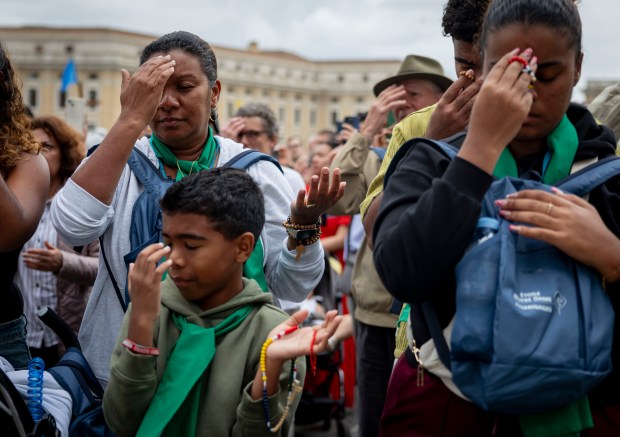
People pray while Pope Leo XIV holds his first general audience in St. Peter’s Square at the Vatican on May 21, 2025. (Brian Cassella/Chicago Tribune)
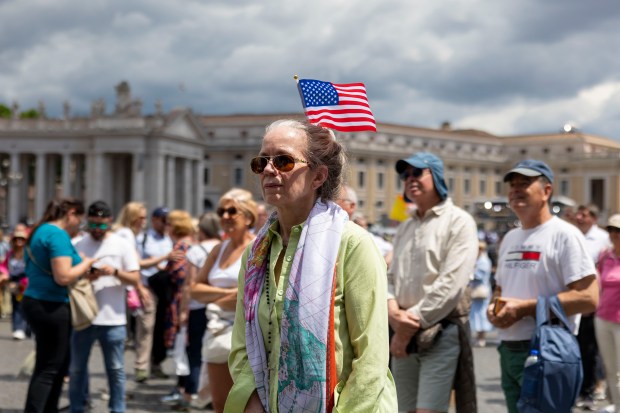
Two people hold an American flag while Pope Leo XIV holds his first general audience on May 21, 2025, in St. Peter’s Square at the Vatican. (Brian Cassella/Chicago Tribune)
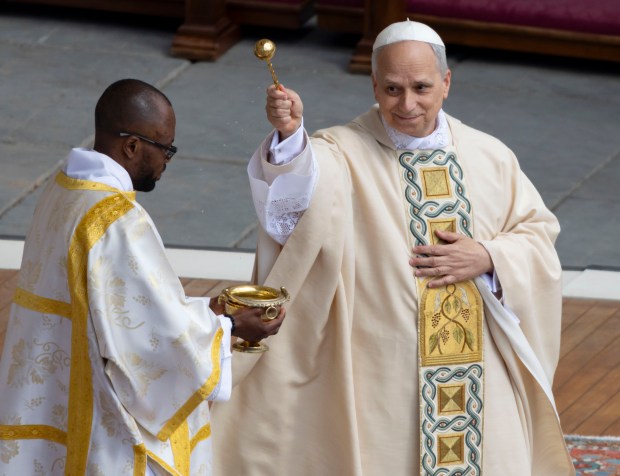
Pope Leo XIV blesses the crowd with holy water during his installation Mass in St. Peter’s Square on May 18, 2025, at the Vatican. (Brian Cassella/Chicago Tribune)
Attendees watch while Pope Leo XIV holds his first general audience on May 21, 2025, in St. Peter’s Square at the Vatican. (Brian Cassella/Chicago Tribune)
Pope Leo XIV begins his installation Mass in St. Peter’s Square on May 18, 2025, at the Vatican. (Brian Cassella/Chicago Tribune)
Pope Leo XIV receives the pallium as he’s installed during Mass in St. Peter’s Square on May 18, 2025, at the Vatican. (Brian Cassella/Chicago Tribune)
People hold objects to be blessed while Pope Leo XIV holds his first general audience May 21, 2025, in St. Peter’s Square at the Vatican. (Brian Cassella/Chicago Tribune)
A woman with an American flag watches the screens after Pope Leo XIV is installed during Mass in St. Peter’s Square on May 18, 2025, at the Vatican. (Brian Cassella/Chicago Tribune)
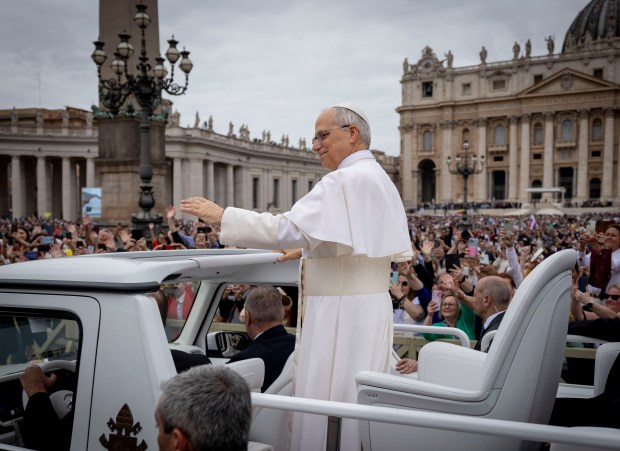
Pope Leo XIV waves to the crowd while holding his first general audience on May 21, 2025, in St. Peter’s Square at the Vatican. Leo is the first pontiff from the U.S. in the 2,000-year history of the Roman Catholic Church. (Brian Cassella/Chicago Tribune)
Children cheer after Pope Leo XIV held his first general audience on May 21, 2025, in St. Peter’s Square at the Vatican. (Brian Cassella/Chicago Tribune)
Pope Leo XIV reacts after receiving the fisherman's ring during his installation Mass in St. Peter’s Square on May 18, 2025, at the Vatican. (Brian Cassella/Chicago Tribune)
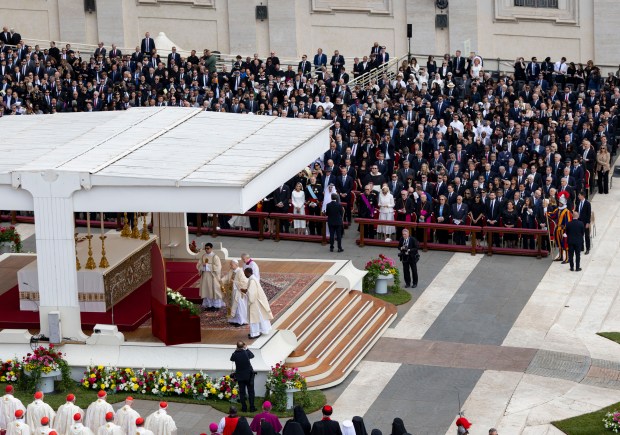
Crowds pack St. Peter’s Square as Pope Leo XIV is installed during a Mass on May 18, 2025, at the Vatican. (Brian Cassella/Chicago Tribune)
Pope Leo XIV waves to the crowds as he arrives for his installation Mass in St. Peter’s Square on May 18, 2025, at the Vatican. (Brian Cassella/Chicago Tribune)
Pope Leo XIV is installed during Mass in St. Peter’s Square on May 18, 2025, at the Vatican. (Brian Cassella/Chicago Tribune)
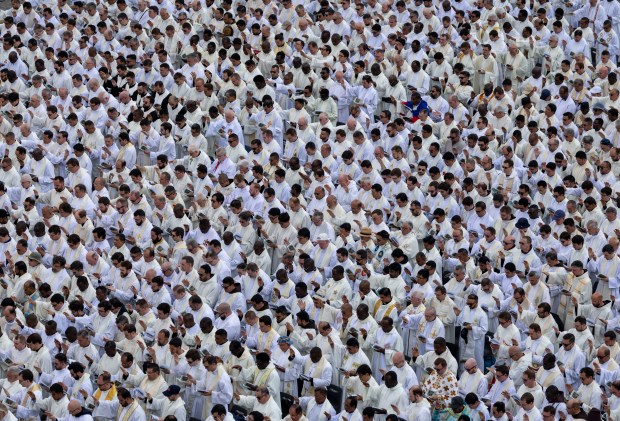
Members of the clergy pray as Pope Leo XIV is installed during Mass in St. Peter’s Square on May 18, 2025, at the Vatican. (Brian Cassella/Chicago Tribune)
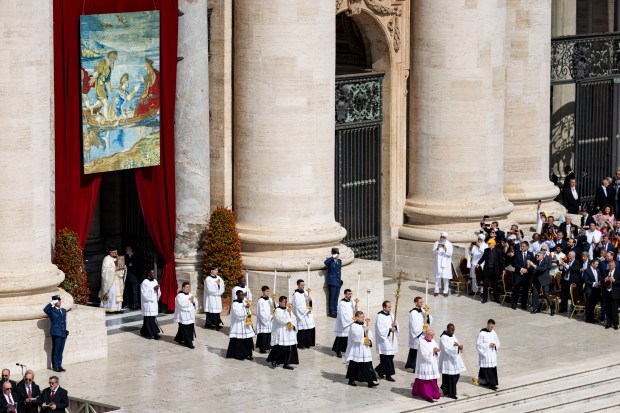
Members of the clergy carry incense as Pope Leo XIV is installed during Mass in St. Peter’s Square on May 18, 2025, at the Vatican. (Brian Cassella/Chicago Tribune)
Members of the clergy pray as Pope Leo XIV is installed during Mass in St. Peter’s Square on May 18, 2025, at the Vatican. (Brian Cassella/Chicago Tribune)
The brother of Pope XIV, Louis Prevost, far left, kneels in prayer along with front of Secretary of State Marco Rubio, second row left, and next to second lady Usha Vance, and her husband Vice President JD Vance, as Pope Leo XIV is installed during Mass in St. Peter’s Square on May 18, 2025, at the Vatican. (Brian Cassella/Chicago Tribune)
Oprah Winfrey, Gayle King, Maria Shriver, the Rev. Manuel Dorantes of Chicago and a group carrying a Chicago flag watch Pope Leo XIV arrive for his installation Mass in St. Peter’s Square on May 18, 2025, at the Vatican.
Cardinal Blase Cupich, third from left, arrives with the other cardinals as Pope Leo XIV is installed during Mass in St. Peter’s Square on May 18, 2025, at the Vatican. (Brian Cassella/Chicago Tribune)
Pope Leo XIV waves to the crowds as he arrives for his installation Mass in St. Peter’s Square on May 18, 2025, at the Vatican. (Brian Cassella/Chicago Tribune)
Members of the clergy pray as Pope Leo XIV is installed during Mass in St. Peter’s Square on May 18, 2025, at the Vatican. (Brian Cassella/Chicago Tribune)
U.S. Secretary of State Marco Rubio, second lady Usha Vance and Vice President JD Vance arrive as Pope Leo XIV is installed during Mass in St. Peter’s Square on May 18, 2025, at the Vatican. (Brian Cassella/Chicago Tribune)
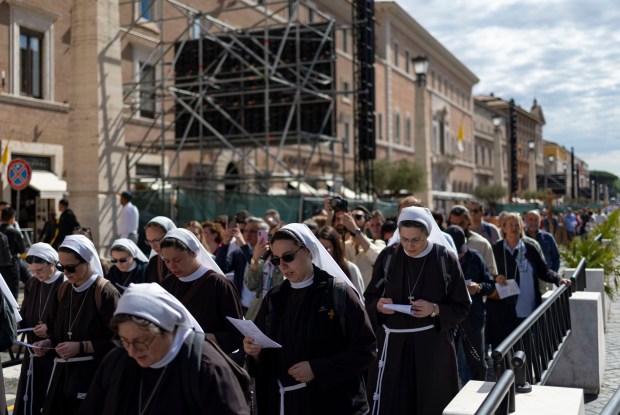
Nuns pick up newspapers featuring Pope Leo XIV after his installation Mass in St. Peter’s Square on May 18, 2025, at the Vatican. (Brian Cassella/Chicago Tribune)
Security officers arrive before dawn in St. Peter’s Square as Pope Leo XIV is installed during Mass on May 18, 2025, at the Vatican. (Brian Cassella/Chicago Tribune)
People sleep on the street before dawn while waiting to enter St. Peter’s Square to see Pope Leo XIV installed during Mass on May 18, 2025, at the Vatican. (Brian Cassella/Chicago Tribune)
Nuns take pictures in St. Peter’s Square on May 16, 2025. (Brian Cassella/Chicago Tribune)
A photo of Pope Leo XIV is displayed in a shop window on May 16, 2025, near St. Peter’s Square at the Vatican. (Brian Cassella/Chicago Tribune)
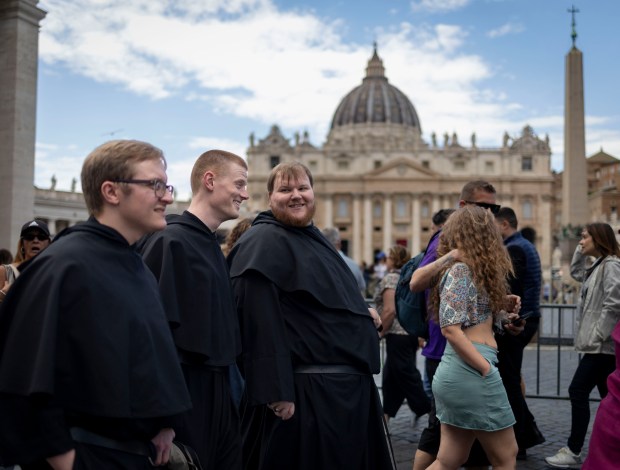
Augustinian friars, from left, Brother David Relstab, the Rev. Jack Tierney and the Rev. Joe Roccasalva visit St. Peter’s Square after their arrival in Rome on May 17, 2025, before the installation of Pope Leo XIV at the Vatican. Relstab is a teacher at Providence Catholic in New Lenox, Tierney is a former teacher at St. Rita in Chicago and Roccasalva grew up in Beverly and attended Marian Catholic. (Brian Cassella/Chicago Tribune)
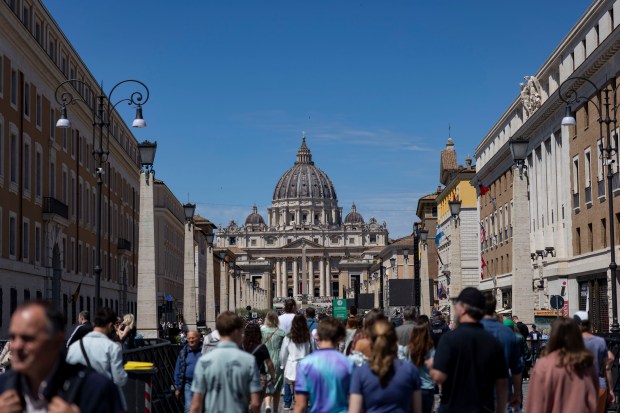
People walk down Via della Conciliazione near St. Peter’s Square on May 17, 2025, before the installation of Pope Leo XIV at the Vatican. (Brian Cassella/Chicago Tribune)
A photo of Pope Leo XIV is displayed on a souvenir stand next to St. Peter’s Square on May 17, 2025, a day before his installation at the Vatican. (Brian Cassella/Chicago Tribune)
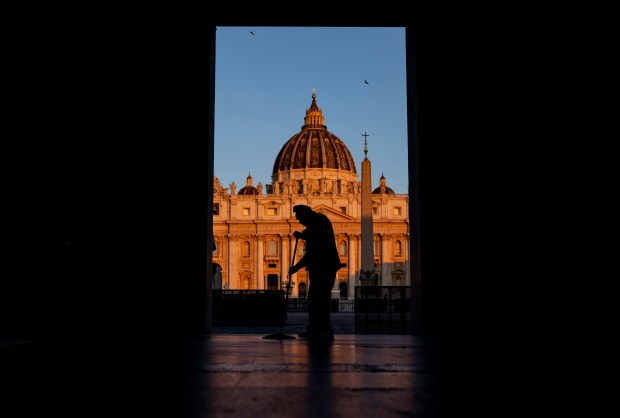
A man mops the sidewalk as the sun rises on St. Peter’s Basilica on May 16, 2025, before the installation of Pope Leo XIV at the Vatican. (Brian Cassella/Chicago Tribune)
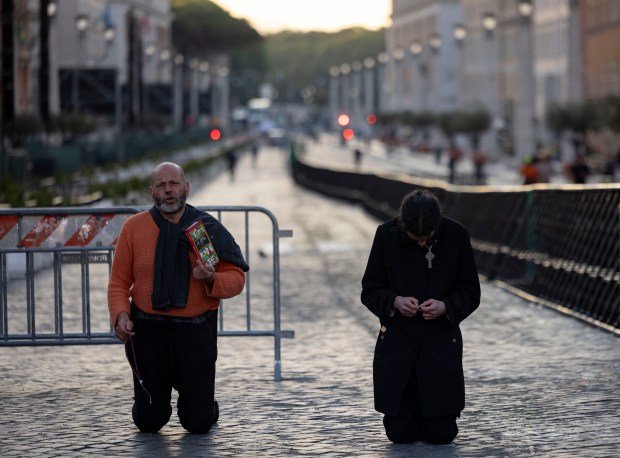
Two men recite prayers at sunrise in St. Peter’s Square on May 16, 2025, before the installation of Pope Leo XIV at the Vatican. (Brian Cassella/Chicago Tribune)
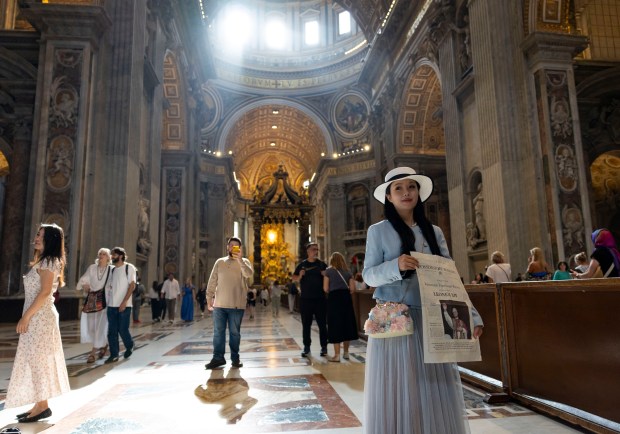
A woman holds a picture of Pope Leo XIV while visiting St. Peter’s Basilica on May 15, 2025, before the installation at the Vatican. (Brian Cassella/Chicago Tribune)
Nuns join a procession into St. Peter’s Square as part of the Jubilee celebration, May 16, 2025, before the installation of Pope Leo XIV at the Vatican. (Brian Cassella/Chicago Tribune)
A visitor takes in St. Peter’s Square as dusk falls, May 15, 2025, before the installation of Pope Leo XIV at the Vatican. (Brian Cassella/Chicago Tribune)
Augustinian friars Brother David Relstab, from left, the Rev. Jack Tierney and the Rev. Joe Roccasalva visit St. Peter’s Square in Rome on May 17, 2025, before the installation of Pope Leo XIV at the Vatican. Relstab is a teacher at Providence Catholic in New Lenox, Tierney is a former teacher at St. Rita in Chicago and Roccasalva grew up in Beverly and attended Marian Catholic. (Brian Cassella/Chicago Tribune)
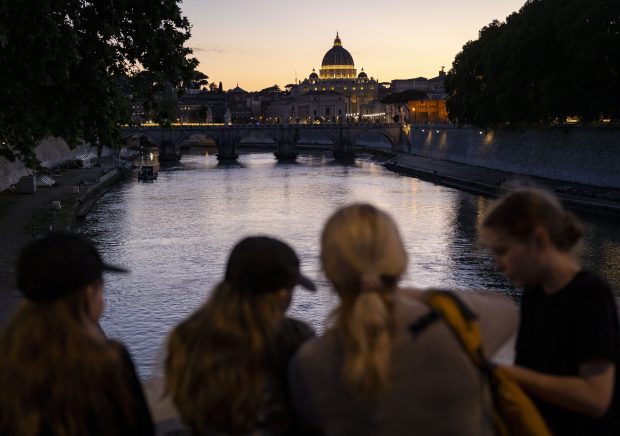
St. Peter’s Basilica glows as the sun sets on the Tiber River on May 16, 2025, before the installation of Pope Leo XIV at the Vatican. (Brian Cassella/Chicago Tribune)
Strollers sit outside St. Peter’s Basilica on Thursday, May 15, 2025, before the installation of Pope Leo XIV at the Vatican. (Brian Cassella/Chicago Tribune)
Chairs are set up in St. Peter’s Square on May 15, 2025, before the installation of Pope Leo XIV at the Vatican. (Brian Cassella/Chicago Tribune)
A newsstand shows covers featuring Pope Leo XIV and Pope Francis on May 16, 2025, near St. Peter’s Square at the Vatican. (Brian Cassella/Chicago Tribune)
People visit St. Peter’s Square on Friday, May 16, 2025, before the installation of Pope Leo XIV at the Vatican. (Brian Cassella/Chicago Tribune)
1 of 43
Pope Leo XIV sprinkles holy water during his installation Mass in St. Peter’s Square on May 18, 2025, at the Vatican. (Brian Cassella/Chicago Tribune)
Chicago-born Robert Prevost, a longtime missionary and member of the Augustinian religious order, was introduced on May 8, 2025, as Pope Leo XIV — the first pontiff from the U.S. in the 2,000-year history of the Roman Catholic Church.
Since then, the Holy Father has consistently uplifted his birthplace on the international scene, from cheering on the White Sox and Bears to lauding the city’s South Side during an October general audience in St. Peter’s Square. Pope Leo has also emerged as a powerful counter to President Donald Trump, condemning his administration’s hardline immigration stance, framing of Russia’s war against Ukraine and military action in Venezuela.
The pope’s patchwork background speaks to the melting pot that is the U.S. Though Prevost worked in Peru for 20 years and has a deep bond to the country, his father was French and Italian and his mother was of Spanish descent. Genealogists later unearthed that his maternal grandparents were Creole people from Louisiana — an often mixed-race cultural identity linked to French, Spanish, African and Indigenous heritages.