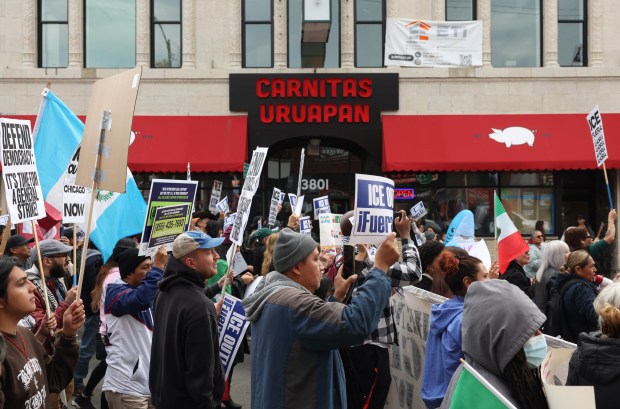

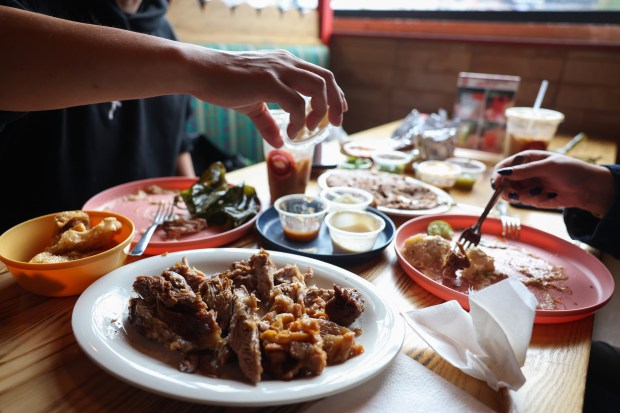

Most days as of late, a heaviness envelops 26th Street in Chicago’s Little Village. Some restaurants are closing earlier than usual, street vendors are fewer and farther away, and more and more customers are using food delivery services instead of dining in.
On a recent Wednesday, only a handful of people were nervously standing at the bus stop on Hamlin Avenue across from Carnitas Uruapan. Inside the popular Mexican restaurant, tables sat empty during what would typically be a busy weekday lunch hour. Staff were screening customers at the door before letting them in.
It had been a chaotic morning marked by U.S. Immigration and Customs Enforcement agents on the city’s Southwest Side. Federal immigration agents, accompanied by Border Patrol Cmdr. Gregory Bovino, had swarmed one of Chicago’s oldest and largest immigrant communities — known as “Mexico of the Midwest” — and neighboring Cicero, arresting at least seven people, including U.S. citizens, and clashing with residents who filmed them. The security camera at Carnitas Uruapan had caught what appeared to be an ICE agent trying to enter — but the door was locked.
“We’re being selective about who we let in today, I guarantee most places out here right now have their doors locked,” Marcos Carbajal, owner of Carnitas Uruapan, told the Tribune on Oct. 22. “Lately, we have to keep an eye on the door just to make sure we’re only letting people in who look like they’re a regular diner.”
Intense immigration enforcement continues to ripple across the Chicago area as part of the Trump administration’s “Operation Midway Blitz.” And the restaurant industry has been feeling the impact: Significantly fewer customers are dining in, owners are locking their doors when they feel unsafe and businesses are operating at a loss.
Since September, Little Village had largely avoided large-scale ICE raids. But on Oct. 22, the shrill sound of whistles filled the neighborhood as volunteers sprang into action, warning people to duck into stores or hide inside private properties.
“We are dying a slow death,” Carbajal said. As soon as the threat of the immigration enforcement “blitz” happened, weekday traffic dropped 50% at the Little Village restaurant, he said. And looking at an entire week, they are down 35%-40% compared with any given week before the operation started, Carbajal said.
Carnitas Uruapan opened its third location in Little Village at the end of January, shortly after President Donald Trump’s inauguration, when fears about potential ICE raids were already circulating. Business started picking up in the summer, but it was short-lived.
“We’ve become unprofitable — we’re running at a loss,” he said. “I’m using my other two (locations) to keep people employed here and running at a loss so that I can try to get to the other side and just keep the doors open and keep people here. If I didn’t have three locations, this would have been over. I would just have to shut down.”
Carbajal employs 19 people across the locations and relies heavily on takeout from the Pilsen shop to stay afloat. The Gage Park location, tucked away on 55th Street and California Avenue, has seen a 15%-20% drop in revenue.
“If there are active raids in the area, you see a sharp impact in any of these places — if there’s anything going on that day, it almost lingers,” Carbajal said. “The rest of the day you’re going to have an empty dining room and the few days after will probably be slow too.”
On Sundays, Carnitas Uruapan has a security guard at the front entrance watch for suspicious activity that might require the restaurant to lock its doors, and to make sure customers are safe. On Saturdays, Carbajal and his father, Inocencio — also known to locals as “El Guero” — man the door.
The Tribune spoke to several restaurant owners about the impact of immigration enforcement on their businesses and on diners. The blow to foot traffic is widespread across the city, but was felt most in neighborhoods with higher Latino populations. The fear of run-ins with agents, or worse — detainment — has dampened an otherwise energetic shopping district in Little Village.
Little Village and Pilsen, much like Devon Avenue’s Little India in Rogers Park or Greektown on Chicago’s Near West Side, are microeconomies that rely heavily on a shared culture to keep things moving.
“A lot of people that work in these neighborhoods feel comfortable working in these neighborhoods because they speak the same language and share the same traditions,” Carbajal said, noting that his father came to Pilsen in 1969, settling in an area that reminded him of Mexico.
Chicago Ald. Mike Rodríguez, 22nd, who represents Little Village on the City Council, said the foundations that hold up the local economies will begin to crack when interconnected communities are attacked.
“The people who have worked in these neighborhoods their whole lives are just hurting,” Rodriguez told the Tribune.
Rodriguez said he didn’t see a single street vendor on 26th Street the Monday following the Oct. 22 raid in Little Village, an area typically humming with venderos selling produce or chicharrones. He said the raid was a turning point for the neighborhood. Locals are much more scared than they were before that day, Rodriguez said.
A certain part of the overall revenue funneled into Little Village has always been from individuals from neighboring states, Rodriguez noted. And it’s most often migrant tourists looking for specialty goods or dishes not found elsewhere.
“Those folks aren’t coming because they also don’t want to put their families at risk,” he said. “They may be going somewhere else, or just waiting for this to blow over.”
Rodriguez said some business owners he spoke to reported that weekly sales had already dropped around 70% even before the Trump administration took office in January. So it’s not all attributed to Trump or the increased immigration enforcement activity, Rodriguez noted, as some restaurants in Little Village have yet to fully bounce back to pre-pandemic levels of revenue.
At Rubi’s Tacos on 18th Street in neighboring Pilsen, business is steady, but the general fear of ICE is equally unsettling. Maria Landa, owner of Rubi’s, said she has to think about protecting both her customers and her staff.
“We tell our customers, you are safe here. You want to come, come here,” Landa said. “We’ll lock the doors if we ever need to.”
Landa, who moved to the U.S. in 1984 when she was 18 years old, focuses on the authentic flavors of Mexico’s Guerrero region at Rubi’s. The restaurant has been fortunate enough to serve a decent amount of diners, Landa said, but there are several longtime customers who haven’t been to the restaurant in over a month.
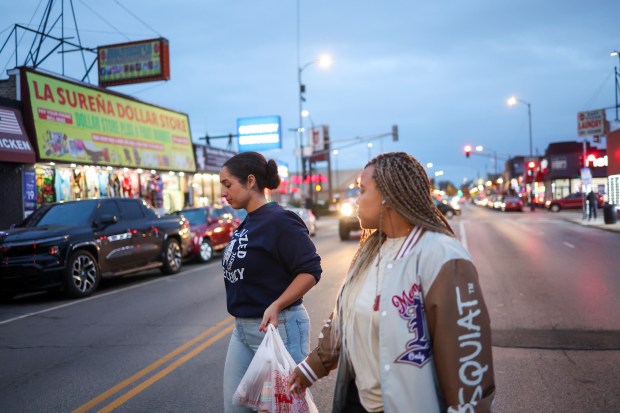
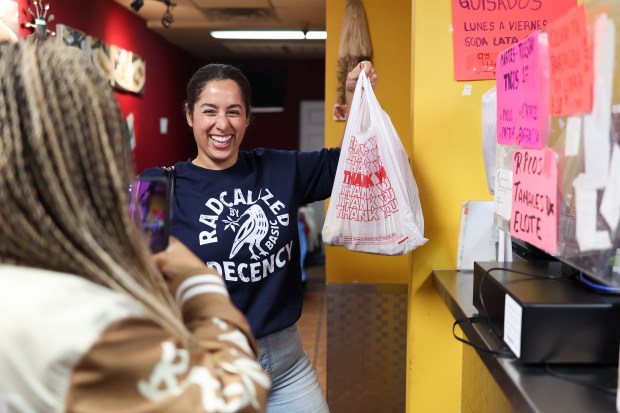
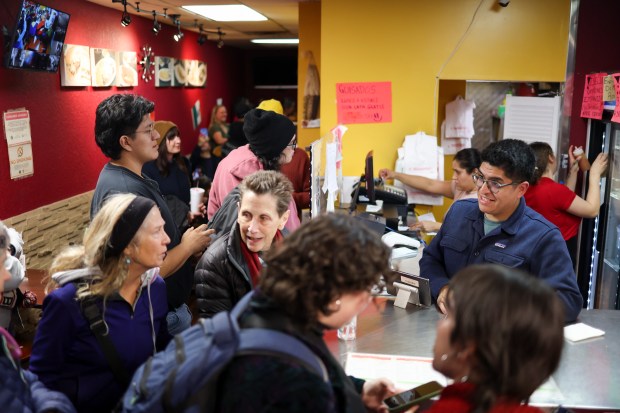
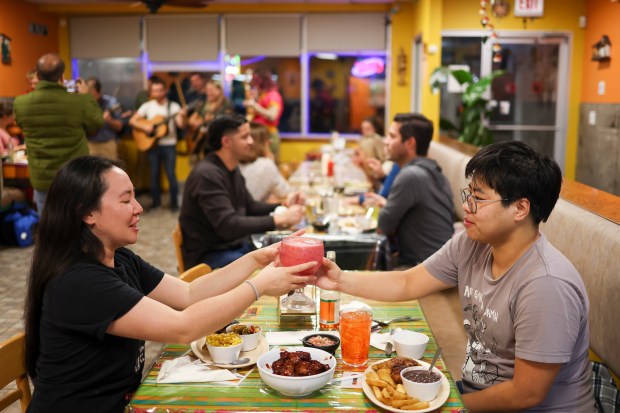
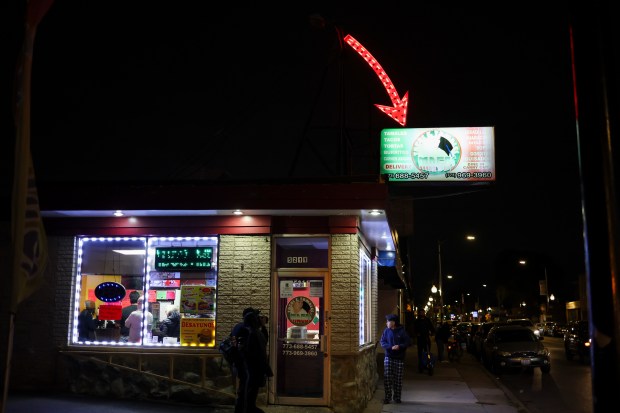
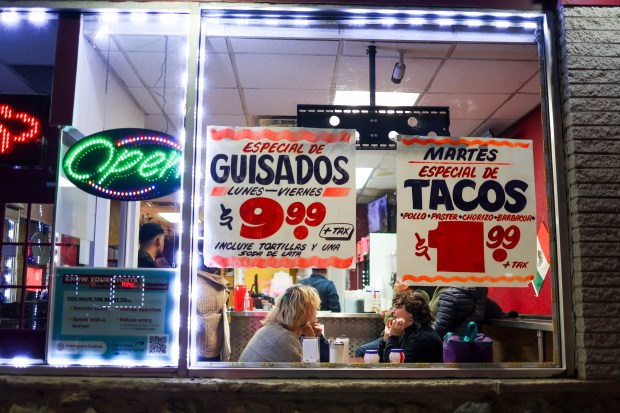
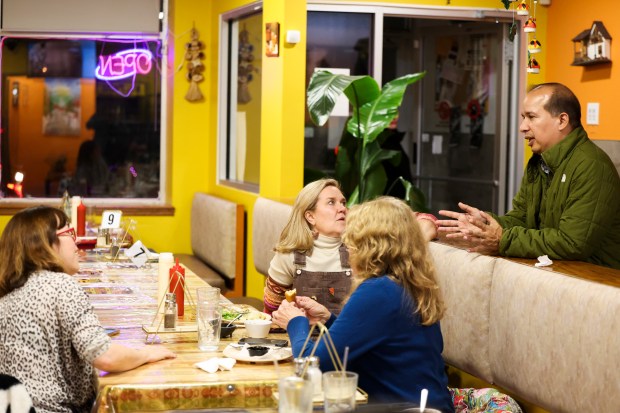
Community groups have recently begun organizing events that draw customers to local restaurants. Belmont Cragin United launched a mini “Taste of Belmont Cragin” event at the end of October. The restaurant crawl featured mom-and-pop shops like Latin Patio, Avenida Peru, El Taconazo Jr. and The Fancy Scoop, as well as street carts operated by the vendors’ children and grandchildren.
Ambrocio Gonzalez, chef and owner of La Catedral Cafe, which has locations in Little Village, North Lawndale, New Eastside and Brighton Park, said community events are the one silver lining: People are coming together and becoming even stronger.
Gonzalez, who employs a staff of 80, said he’s grateful for customers who purposefully come into his Mexican restaurants to support the culture.
“We’re trying to survive and at this point, we are living day by day,” he said. “Sales is a huge factor because if we don’t sell, we are not able to cover expenses or payroll. And on top of that, we don’t know what’s going to happen the next day.”
Gonzalez said his dining rooms barely fill up anymore, and it isn’t just the location in Little Village seeing less traffic.
“This is where we see that it’s not just about race, it’s about everyone being fearful because even if you’re out and you’re a citizen, (immigration agents) have been seen coming after people just for trying to help someone,” he said.
Gonzalez, like Carbajal at Carnitas Uruapan, also locks his doors as needed, but will soon go one step further.
“We’re trying to see if something can be done about the masks (that agents are wearing). So if you have those gator-type masks on, we’re not going to open the door,” Gonzalez said, noting that customers with medical masks and face coverings for religious reasons will be allowed in. “The amount of things that we have to be thinking and worrying about is just crazy.”
Gonzalez and several other restaurant owners compared the current climate to how small businesses fought to stay open during the COVID-19 pandemic. But Esam Hani, a restaurateur who owns several restaurants along Milwaukee Avenue in Logan Square under the group One of a Kind Hospitality, said it’s significantly worse.
Hani, who is Palestinian, has had to make some difficult but necessary operational decisions to ensure his employees get their paychecks.
“I have to dip into my personal savings to keep the doors open, but for how long can I do that?” he said. “The landlords are not making concessions for us like they did in COVID. We’re still making the monthly rents, paying our employees, paying gas and electric … all that kind of stuff. Those costs are still there.”
A representative for One of a Kind Hospitality said the company employs over 100 people, of whom 80% identify as Latino.
“Three of my restaurants are Mexican restaurants I’ve had for 24 years now, so we built an old base of a Hispanic clientele that’s been with us and loyal to us and they’re not coming out anymore because of this,” Hani said.
Among the seven restaurants the group oversees is Cafe Con Leche, serving mostly Latin fusion food and coffee, as well the gastropub Harding Tavern and Saba Italian. Hani said the ICE-related lull, while affecting immigrant communities the most, is also prevalent in other demographics.
“At Saba, it was pizza Wednesday, and we have $10 pizzas that night as a special … I literally had three tables last week — it was horrible,” Hani explained. “Normally, we have a packed house. And I had a similar situation at one of my other restaurants where we didn’t even break $1,000 in sales.”
Hani is reporting a 35%-40% loss in sales with expenses “through the roof.” A drop in customers day to day, week after week, is not just abnormal for a restaurant, it’s also unsustainable, Hani added.
“And unfortunately, if this does go past the next couple of months, you’ll see a lot of small businesses start closing because they can’t pay their staff or they can’t pay their rent,” he said. “That’s just how it is in our industry.”
Those running restaurants stressed one thing over and over: Customers who are not afraid and are not being targeted should go out to eat now more than ever.
“We’re a whole ecosystem — we hire local people, we buy all our produce from local vendors, the people that are driving the delivery trucks that bring our meat, the people that are bringing our ingredients, these are all neighborhood people and the majority of them are Latino,” Carbajal said. “We all depend on each other.”
Carbajal said Carnitas Uruapan will happily drive beyond their normal delivery areas to field orders from office workers downtown, which could offset some of the impact of their empty dining room.
“I know it’s hard for people to go far outside of where they are or where they usually eat, but we need people who consider themselves allies to really make it a point to visit local restaurants,” he said. “Grab a drink with friends, join us for lunch, tip our staff well — we really are struggling for our livelihoods out here.”