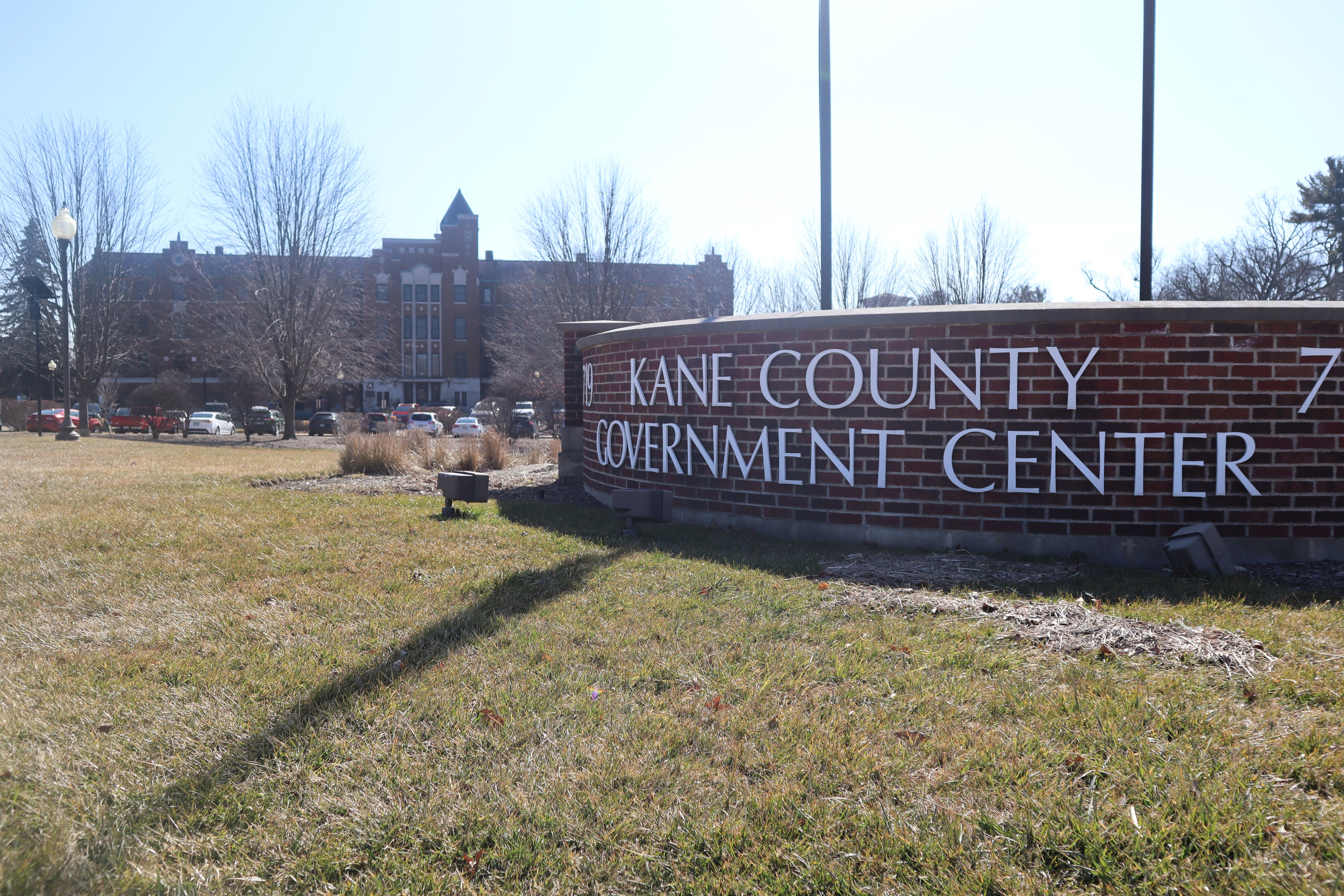

As President Donald Trump’s federal immigration crackdown in Chicago and its surrounding suburbs enters its third month, the Kane County Board on Monday gave final approval to a measure expressing support for immigrant rights in the county and calling on the state and federal government to prohibit immigration enforcement at sensitive locations and enact immigration reforms.
The board is also discussing a ban on civil immigration enforcement actions on county-owned property.
Since the Trump administration’s surge of immigration law enforcement in Chicago — dubbed “Operation Midway Blitz” — began in September, hundreds have been arrested, thousands have protested across Chicago and the suburbs and numerous cities and counties have considered or passed local legislation aiming to address the ongoing immigration crackdown.
Chicago Mayor Brandon Johnson established Chicago city property as “ICE-free” zones in early October, and municipalities like Evanston, Waukegan, Carpentersville and Elgin have followed suit with similar measures. Cook, Will and Lake counties, too, have prohibited federal immigration enforcement actions on their property.
In Kane County, a measure expressing support for immigrant rights in Kane County and calling on the state and federal government to reform immigration procedures — but not banning immigration enforcement on county property — was brought forward by board member Myrna Molina and considered by the board’s Legislative Committee in late October.
It has since generated discussion among board members about what the resolution does and the county’s part in it.
For example, at the Kane County Board Executive Committee meeting last week, board member Leslie Juby said the resolution is reaffirming the county’s commitments to its residents, and that that is its job. She said she doesn’t understand why the county committing to providing services “in a fair, equitable and culturally responsive manner to all residents,” as the resolution states, “would be a point of contention for anyone.”
“We’re asking the state of Illinois and the federal government to do something, because we recognize that, as Kane County Board members, we do not have the purview to do that,” Juby said. “While I understand it looks like it’s symbolic only, we’re doing everything that we are allowed to do in our capacity.”
Board member Clifford Surges said the resolution “looks awfully much like a proclamation,” rather than an actionable request, and said the county’s proclamations have gotten “more and more political.”
Board member Michelle Gumz, on the other hand, said the resolution requests action of state and federal elected officials. And board member Mavis Bates said it was the job of the Legislative Committee to send directives to the legislature about the county’s priorities.
After ultimately being recommended by the Executive Committee last week, the matter came to the full board for final approval on Monday, where it again generated a mix of opinions among the board.
Board member David Young, for example, criticized the way the federal immigration crackdown is being talked about, saying that claiming federal agents “are literally ripping people out of their homes” is “putting a target on these agents that are just doing their job.”
“That rhetoric, I think, just has to stop,” Young said. “And this resolution actually does that. It actually goes ahead and, I think, puts a target … on the back of those ICE agents that are just doing their job.”
He also said that the current immigration enforcement actions going on are “being done based upon our Constitution,” and suggested that, under the Supremacy Clause of the U.S. Constitution, which dictates that federal law takes priority over conflicting state laws, this resolution could open the county up to a lawsuit from the federal government.
Board member Jon Gripe took issue with what he said was the “condemnation of an entire group of law enforcement officers.” Gripe previously attempted to add an amendment to the measure expressing support for law enforcement officers, but it failed to get sufficient support from the Legislative Committee.
And board member Mohammad Iqbal said there were “so many defects” in the measure that was ultimately passed by the board.
Iqbal said the term “human dignity” in the measure is “ambiguous” and that, despite the title indicating “fair reform,” the resolution doesn’t propose reform in the county. He also criticized the resolution’s calling on the state of Illinois to enact reform because the federal government handles immigration enforcement, not states, and said that the resolution’s request to “ensure no person is detained or deported based on racial or ethnic profiling” is already in the law.
“The committee should re-look at it,” Iqbal said. “They’re putting too much into this resolution. If there’s only one thing they want to say, prohibit immigration enforcement in a sensitive location such as school, places of worship or community centers, that’s probably reasonable.”
A number of other board members spoke in favor of the measure.
Board member Sonia Garcia spoke about the fear she sees in her community about the recent immigration enforcement operations.
“I can’t go ahead and be quiet on this,” Garcia said.
And Gumz, too, indicated support for the resolution in light of the fear she says she sees in her district as the federal immigration crackdown continues.
“I watch it with my own eyes,” Gumz said. “To act is something that I have to do.”
And board member Vern Tepe suggested that expressing support for human rights is necessary in the country right now.
“It’s the way that they’re treated, and it’s the amount of hate that seems to be prevalent throughout our society on … both sides,” Tepe said. “And the only way to stop it is to stand up for human rights and to realize that we have to work and point out those inequities that happen.”
Board member Michael Linder said that the way the immigration crackdown is being carried out is “not even what was intended,” saying that the surge of enforcement had been meant to “remove the criminals.” He said the country still needs to address illegal immigration, but “it’s not addressed by being inhuman(e).”
And Juby again pointed out that, though the county can’t enact immigration reform, it can advocate for changes at the state and federal levels.
“The things that we’re asking for them to do are not things in our control, but things that we believe in,” she said. “We believe that we should be humane and that we should have comprehensive immigration … reforms. We believe in due process. We believe in keeping families together. We recognize that everybody who comes here has value and contributes in one way or another. We’re asking for you not to sweep them out of churches and hospitals and schools. That’s not hard.”
Several residents also spoke both in favor of and against the measure during the meeting’s public comment period.
Ultimately, the measure passed in a split vote, with board members Gary Daugherty, Gripe, Iqbal, Bill Lenert, Bill Roth, Rick Williams and Young voting against it, and Surges abstaining.
With that measure passed, the board is also beginning to consider an ordinance prohibiting federal immigration agents from using county-owned property for enforcement actions like staging or processing, much like the legislation local municipalities around Chicago and its suburbs have enacted in recent weeks.
At Monday’s meeting, Molina said the request “comes from a deep concern for our community,” and said the intention of the proposed ordinance is to “ensure that every family in Kane County feels safe, respected and welcome in the places we all share.”
Kane County State’s Attorney Jamie Mosser, at the meeting, said it is her job to provide legal advice to the county board, not to draft policies. She said she would provide her assessment of what’s constitutional and what’s not out of what other municipalities have done in their legislation as the county considers proceeding with the proposed ordinance.
“I’m not a policy decision-maker, nor am I the one who’s supposed to write policy for you,” Mosser said. “I am more than happy that, once an ordinance is given to us, to review it.”
The proposed ordinance’s text was not presented on Monday, but Molina said she has drafted an ordinance and is seeking review and feedback from the state’s attorney.
Linder pointed out that the ordinance may not forbid anything not already prohibited by the state’s Trust Act, which generally prohibits state and local law enforcement from getting involved in deportation efforts with U.S. Immigration and Customs Enforcement or other federal policing agencies dealing with immigration matters.
And Gripe said he wants the State’s Attorney’s Office to provide insight on the matter, and expressed concern about the possibility of a lawsuit from the federal government over such an ordinance.
Young said the matter should become a proclamation, rather than an ordinance, suggesting that would reduce the legal risk for the county. But Kane County Board Chair Corinne Pierog said the proposal “doesn’t share values, it requests action.”
mmorrow@chicagotribune.com