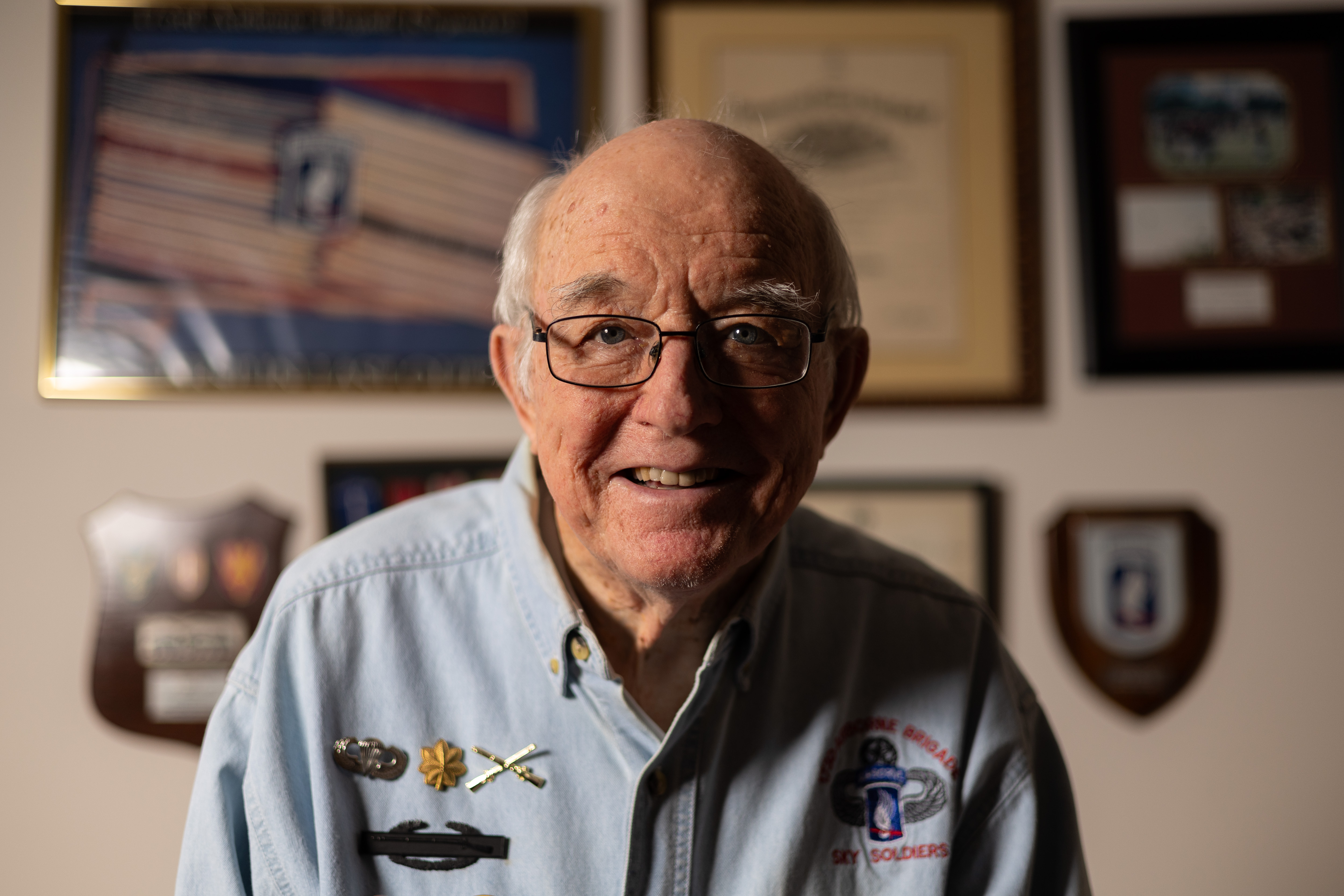

Nearly 55 years after serving two tours of duty in Vietnam, Army veteran Bob Getz lives with the aftereffects of his war experience on a daily basis.
His exposure to Agent Orange, a powerful herbicide used to defoliate jungle land, is the presumed cause of his prostate cancer, and he suffers from a stomach ailment that can’t be diagnosed and hearing loss, the result of exposure to explosions, he said.
It would be easy to be bitter, the 82-year-old Elgin resident said, but he enjoyed his military career and he’s thankful to receive full Veterans Administration compensation to pay for his cancer treatment.
“There’s nothing I could do. You’ve got to live life and never get mad at anything,” Getz said. “I concentrate on what I need to do to get through this. You’ve got to be positive.
“If I didn’t have the (medical) coverage I do have available to me, it would take an awful lot of money to get care to the degree I have had. I am not sure I would have been able to afford it.”
That positive attitude means he’s also dedicated to his fellow veterans and actively involved in various veteran organizations.
“Bob has been a stalwart of our local veterans community for as long as I can remember,” said Jake Zimmerman, superintendent of the Veterans Assistance Commission of Kane County.
“Whether it is with the American Legion, Veterans of Foreign Wars, Edgewater Veterans Group in his Elgin subdivision, Jesse White’s Veterans Advisory Council, a group of those who served with 173rd Airborne Brigade or here with the Veterans Assistance Commission, Bob has always been there to help and look after his fellow veterans.”

Getz credits Zimmerman with helping him get qualified for full VA compensation for his cancer treatment a dozen years ago.
The military considers prostate cancer a presumptive condition for some veterans exposed to Agent Orange or other toxic substances during their military service. The herbicide was used extensively in some areas to clear the ground and make it easier for U.S. forces to spot the Viet Cong.
Getz said his exposure to it most likely came during his first tour of duty from spring 1967 to spring 1968. He was a senior advisor to a Vietnamese infantry battalion, whose responsibilities included guarding railways along the country’s central coast.
“There would be airplanes going over, and sometimes there would be a funny smell. You never really knew what they were doing up there,” he said.
For Getz, who grew up in Chicago, military life began with a short stay at the U.S. Military Academy West Point in New York.
While he enjoyed the physical training, “Two weeks into classes, I realized I was not a mathematical person. And West Point is an engineering school,” Getz said.
As soon as he could, he left for Loyola University Chicago, which he attended on a ROTC scholarship.
“I truly enjoyed being in the military,” Getz said.
Under the terms of his ROTC scholarship, he initially served as an infantry training officer at Fort Ord in California before being shipped to Vietnam. And after his first tour, he spent a year at Fort Benning in Georgia before serving another year in Vietnam.

His second tour was with the 173rd Airborne Brigade as a task force commander in the 2-503 Parachute Infantry Regiment, Getz said.
During the first six months of his second tour, duties included disguising personnel carriers as tanks and being told to fight as if in a major battle in World War II, he said. Making that difficult was when vehicles broke down in rice paddies, he said.
For the last six months of the tour, he worked out of division headquarters as a junior logistics officer, helping with operational and supply needs.
“That was scary as hell too, and I am not sure it was any better or worse than seeing combat,” Getz said.
What made it so were the bullets that would whoosh past his head while he was carrying out his duties, he said.
“Someone there once told me, ‘If you don’t hear that sound, it means you’re dead,’” Getz said.
He still remembers or sometimes dreams about things from war, like almost being killed a mortar.
“I don’t talk much about it,” Getz said.
After his second tour ended, he was made the chief of logistics at Wildflecken Training Area in Germany, where he and his wife, Patricia, lived for several years. All told, he spent 10 years in active duty and 10 years in the reserve.

Stateside, Getz’s logistics experience led to his job as the superintendent of operations for the University of Illinois Chicago from 1976 to 1993 and then as the physical plant director for Harper College in Palatine from 1993 to 2008.
He and his wife have lived in the Bartlett and Elgin area since the late 1970s. The couple raised a son nad two daughters and have seven grandchildren. Getz also served two terms in the early 2000s as a member of the Elgin Community College Board of Trustees.
Of still being connected to so many veteran-related organizations, Getz said he likes being involved with others who have served.
“There are unique situations that we’re part of,” he said. “Not just battles, but what life was like in various situations, like in Germany.”
The veterans group at Del Webb’s Edgewater in Elgin, where he lives, are working on a book detailing their personal experiences in the military, he said.
As for what the public can do to support veterans, they need to tell elected officials to provide the support that those who served need, Getz said.
Mike Danahey is a freelance reporter for The Courier-News.